Ciudad Colonial in Santo Domingo, Distrito Nacional, Dominican Republic — Caribbean Region of the Americas (Hispaniola, Greater Antilles, West Indies)
The Bastidas House
Photographed by J. Makali Bruton, March 10, 2018
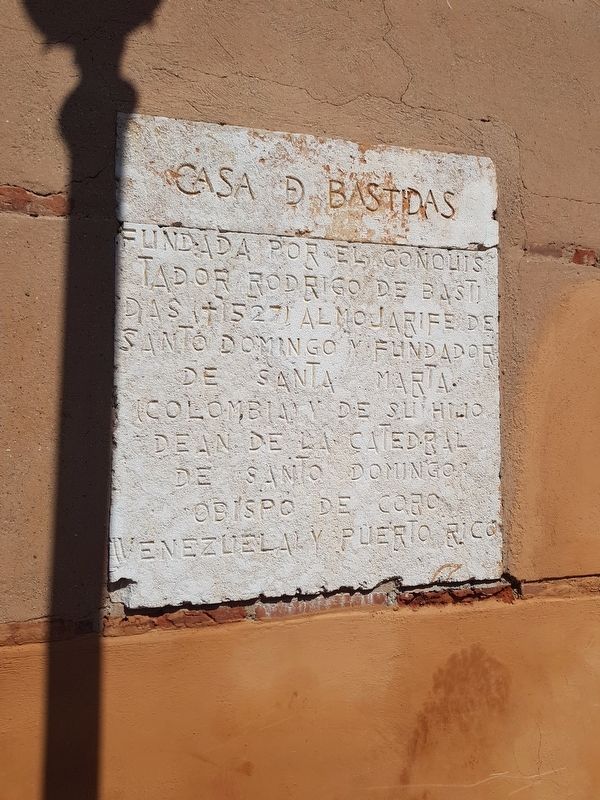
1. The Bastidas House Marker

Fundada por el Conquistador Rodrigo de Bastidas († 1527) Almojarife de Santo Domingo y fundador de Santa Marta.
(Colombia) y de su hijo Dean de la Catedral de Santo Domingo.
Obispo de Coro (Venezuela) y Puerto Rico
Founded by the Conquistador Rodrigo de Bastidas († 1527), Treasurer and founder of Santa Marta, Colombia and of his son, Dean of the Cathedral of Santo Domingo and Bishop of Coro, Venezuela and Puerto Rico
Topics. This historical marker is listed in these topic lists: Colonial Era • Government & Politics.
Location. 18° 28.413′ N, 69° 52.955′ W. Marker is in Ciudad Colonial, Distrito Nacional, in Santo Domingo. It is on Calle Las Damas just north of Calle Alfau, on the right when traveling north. Touch for map. Marker is in this post office area: Ciudad Colonial, Distrito Nacional 10210, Dominican Republic. Touch for directions.

Regionally, it is one of the Greater Antilles on the Caribbean Sea, on in the Atlantic Ocean, in North America, and in the Western Hemisphere. Historically, it finds
this page online
Other nearby markers. At least 8 other markers are within walking distance of this marker: History of the Dominican Society of the Bibliophiles’ House (a few steps from this marker); House of the Lions (within shouting distance of this marker); Calle de las Damas (within shouting distance of this marker); The Fortress of Santo Domingo (within shouting distance of this marker); The Academy of Sciences Building of the Dominican Republic (within shouting distance of this marker); Gonzálo Fernández de Oviedo (within shouting distance of this marker); Diego Caballero House (within shouting distance of this marker); Las Damas Street (within shouting distance of this marker). Touch for a list and map of all markers in Ciudad Colonial.
Regarding The Bastidas House. The son of Rodrigo Bastidas was named Rodrigo de Bastidas y Rodríguez de Romera, first Bishop of Coro, Venezuela and second Bishop of Puerto Rico. He died in 1570.
Photographed by J. Makali Bruton, March 10, 2018
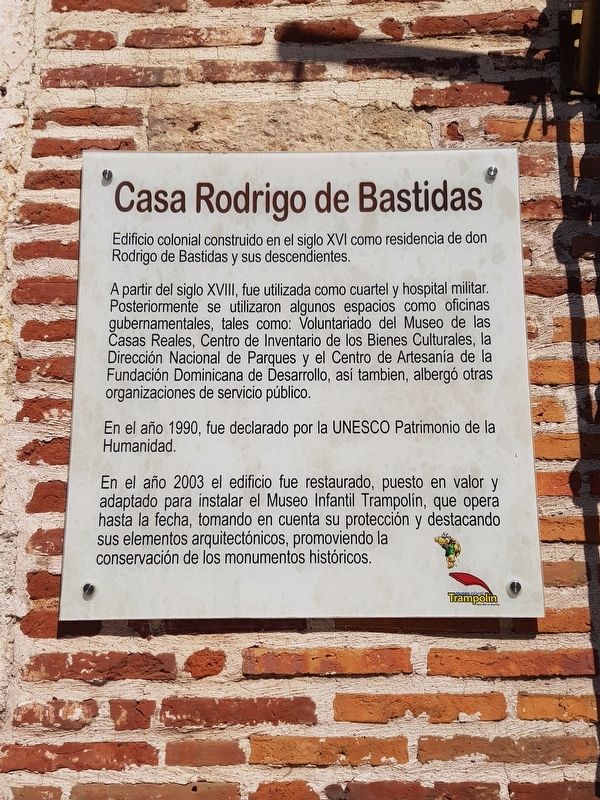
2. The Bastidas House additional Marker
This additional marker is directly to the right of the Museum's entrance. It reads:
Casa Rodrigo de Bastidas Edificio colonial construido en el siglo XVI como residencia de don Rodrigo de Bastidas y sus descendientes.
A partir del siglo XVIII, fue utilizada como cuartel y hospital militar. Posteriormente se utilizaron algunos espacios como oficinas gubermentales, tales como: Voluntario del Museo de las Casas Reales, Centro de Inventario de los Bienes Culturales, la Dirección Nacional de Parques y el Centro de Artesanía de la Fundación Dominicana de Desarrollo, así también, albergó otras organizaciones de servicio público.
En el año 1990, fue declarado por la UNESCO Patrimonio de la Humanidad.
En el año 2003 el edificio fue restaurado, puesto en valor y adaptado para instalar el Museo Infantil Trampolín, que opera hasta la fecha, tomando en cuenta su protección y destacando sus elementos arquitectónicos, promoviendo la conservación de los monumentos históricos.
English translation:
The Rodrigo Bastidas House
Colonial building built in the 16th century as the residence of Rodrigo de Bastidas and his descendants.
From the 18th century, it was used as a barracks and a military hospital. Subsequently, some spaces were used as government offices, such as: Volunteer of the Museum of the Royal Houses, Center of Inventory of Cultural Goods, the National Direction of Parks and the Craft Center of the Dominican Development Foundation, as well as having housed other public service organizations.
In 1990, it was declared a World Heritage Site by UNESCO.
In 2003 the building was restored and adapted in order to install the Trampoline Children’s Museum, which operates to date, taking into account its protection, highlighting its architectural elements and promoting the conservation of historical monuments.
A partir del siglo XVIII, fue utilizada como cuartel y hospital militar. Posteriormente se utilizaron algunos espacios como oficinas gubermentales, tales como: Voluntario del Museo de las Casas Reales, Centro de Inventario de los Bienes Culturales, la Dirección Nacional de Parques y el Centro de Artesanía de la Fundación Dominicana de Desarrollo, así también, albergó otras organizaciones de servicio público.
En el año 1990, fue declarado por la UNESCO Patrimonio de la Humanidad.
En el año 2003 el edificio fue restaurado, puesto en valor y adaptado para instalar el Museo Infantil Trampolín, que opera hasta la fecha, tomando en cuenta su protección y destacando sus elementos arquitectónicos, promoviendo la conservación de los monumentos históricos.
Colonial building built in the 16th century as the residence of Rodrigo de Bastidas and his descendants.
From the 18th century, it was used as a barracks and a military hospital. Subsequently, some spaces were used as government offices, such as: Volunteer of the Museum of the Royal Houses, Center of Inventory of Cultural Goods, the National Direction of Parks and the Craft Center of the Dominican Development Foundation, as well as having housed other public service organizations.
In 1990, it was declared a World Heritage Site by UNESCO.
In 2003 the building was restored and adapted in order to install the Trampoline Children’s Museum, which operates to date, taking into account its protection, highlighting its architectural elements and promoting the conservation of historical monuments.
Photographed by J. Makali Bruton, March 10, 2018
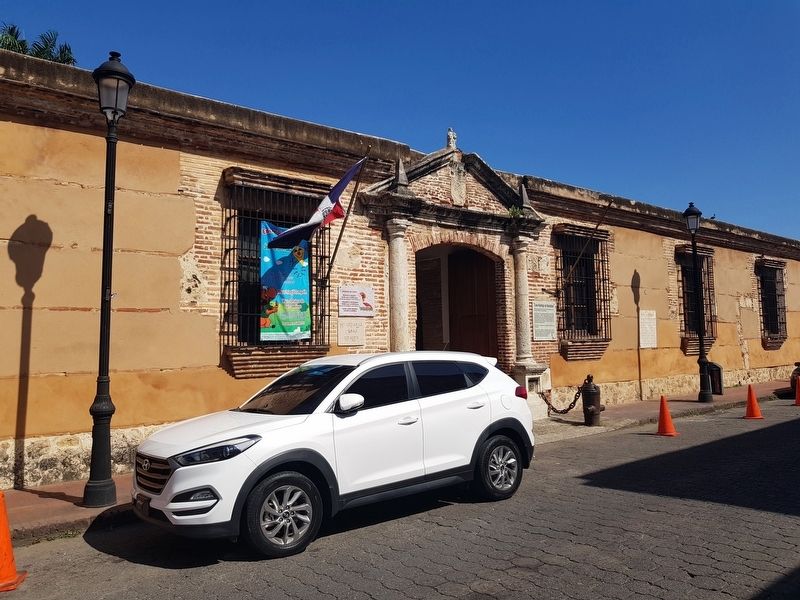
3. The Bastidas House and Markers
The featured marker is to the far right in this view of the house. The additional historical marker is to the right of the main entrance to the house.
Photographed by J. Makali Bruton, March 10, 2018
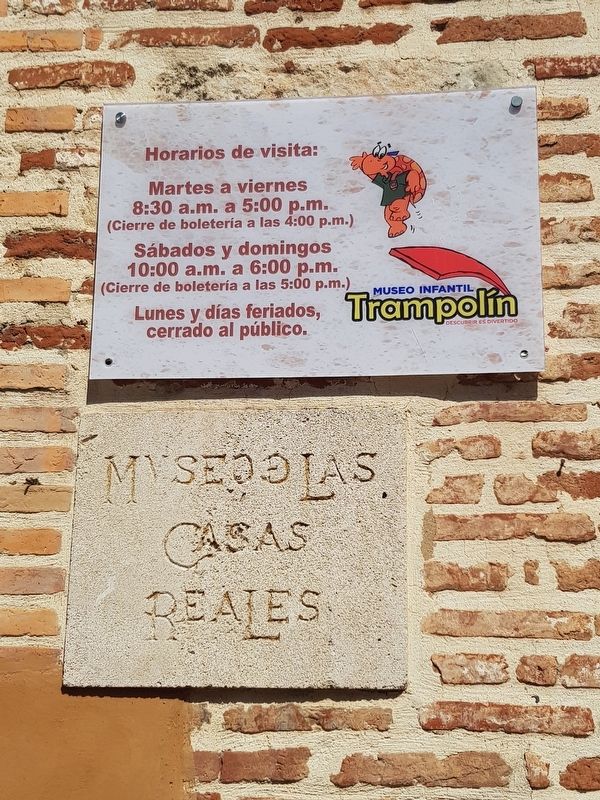
4. Additional signage at The Bastidas House
To the left of the house's entrance is this modern informational sign and a stone from the period when the house was the Museum of the Royal Houses (Museo de las Casas Reales).
Credits. This page was last revised on July 28, 2023. It was originally submitted on March 30, 2018, by J. Makali Bruton of Washington, District of Columbia. This page has been viewed 407 times since then and 47 times this year. Photos: 1, 2, 3, 4. submitted on March 30, 2018, by J. Makali Bruton of Washington, District of Columbia.
