Concord in Merrimack County, New Hampshire — The American Northeast (New England)
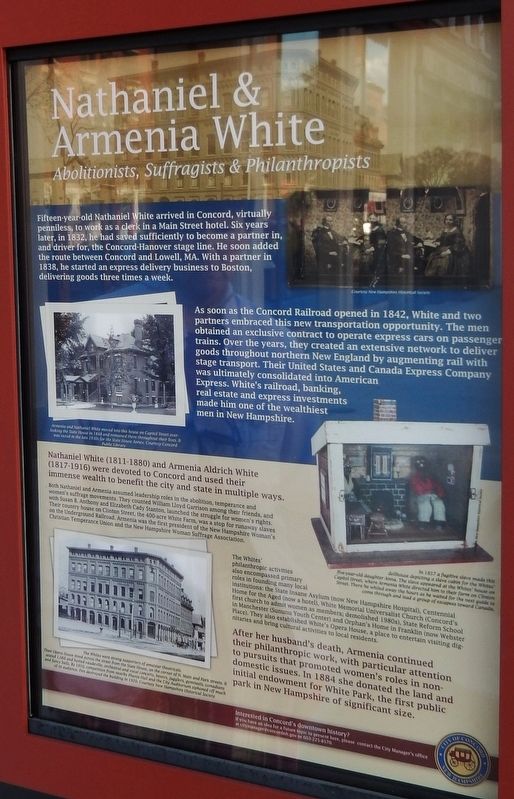
Nathaniel & Armenia White
Downtown Concord
| — | Est. 1725 | — |
Photographed by Cosmos Mariner, June 25, 2017
1. Nathaniel & Armenia White Marker
Abolitionists, Suffragists & Philanthropists
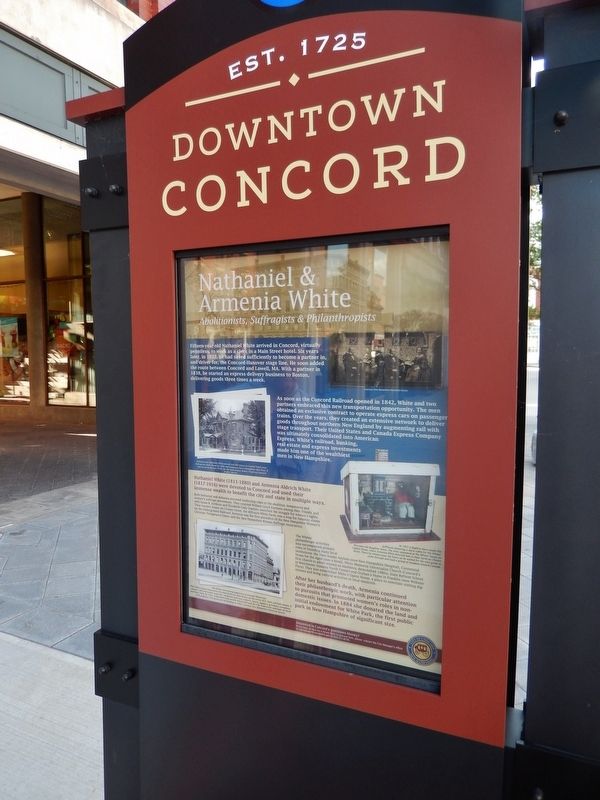
Fifteen-year-old Nathaniel White arrived in Concord, virtually penniless, to work as a clerk in a Main Street hotel. Six years later, in 1832, he had saved sufficiently to become a partner in, and driver for, the Concord-Hanover stage line. He soon added the route between Concord and Lowell, MA. With a partner in 1838, he started an express delivery business to Boston, delivering goods three times a week.
As soon as the Concord Railroad opened in 1842, White and two partners embraced this new transportation opportunity. The men obtained an exclusive contract to operate express cars on passenger trains. Over the years, they created an extensive network to deliver goods throughout northern New England by augmenting rail stage transport. Their United States and Canada Express Company was ultimately consolidated into American Express. White's railroad, banking, real estate and express investments made him one of the wealthiest men in New Hampshire.
Nathaniel White (1811-1880) and Armenia Aldrich White (1817-1916) were devoted to Concord and used their immense wealth to benefit the city and state in multiple ways.
Both Nathaniel and Armenia assumed leadership roles in the abolition, temperance and women's suffrage movements. They counted William Lloyd Garrison among their friends, and with Susan B. Anthony and Elizabeth Cady Stanton, launched the struggle for women's rights. Their country house on Clinton Street, the 400-acre White Farm, was a stop for runaway slaves on the Underground Railroad. Armenia was the first president of the New Hampshire Woman's Christian Temperance Union and the New Hampshire Woman Suffrage Association.
The Whites' philanthropic activities also encompassed primary roles in founding many local institutions:
this page online
After her husband's death, Armenia continued their philanthropic work, with particular attention to pursuits that promoted women's roles in non-domestic issues. In 1884 she donated the land and initial endowment for White Park, the first public park in New Hampshire of significant size.
Interested in Concord’s Downtown history?
If you have an idea for a future topic to present here, please contact the City Manager's office
at [email protected] or 603-225-8570
Erected by City of Concord, New Hampshire.
Topics and series. This historical marker is listed in these topic lists: Abolition & Underground RR • Charity & Public Work • Industry & Commerce •
Courtesy Concord Public Library
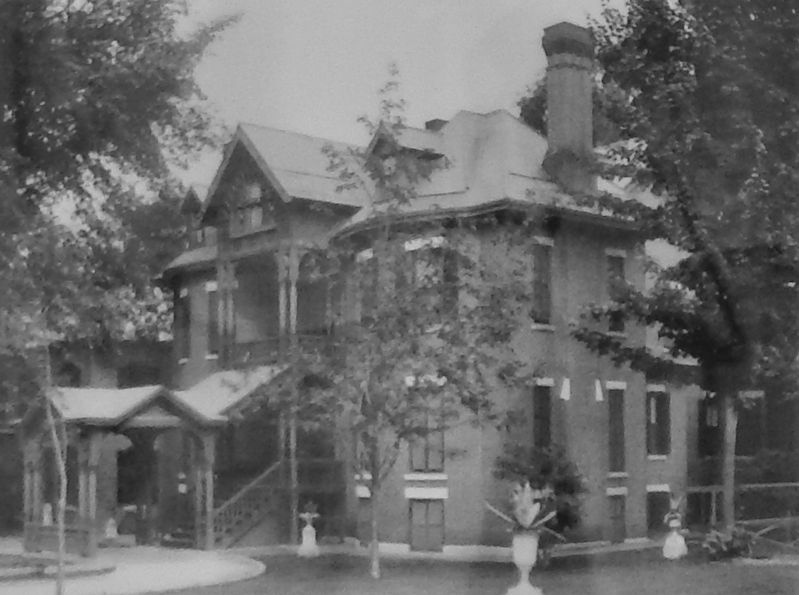
2. Marker detail: Nathaniel and Armenia White House
Armenia and Nathaniel White moved into this house on Capitol Street over-looking the State House in 1848 and remained there throughout their lives.
It was razed in the late 1930’s for the State House annex.
Location. 43° 12.355′ N, 71° 32.158′ W. Marker is in Concord, New Hampshire, in Merrimack County. It is on North Main Street (U.S. 3) south of School Street, on the right when traveling north. Marker is located on the sidewalk, on the east side of North Main Street. Touch for map. Marker is at or near this postal address: 58 North Main Street, Concord NH 03301, United States of America. Touch for directions.

Regionally, this marker is in the American Northeast and in New England. Globally, it is in North America, the Western Hemisphere, the Western World, and the Anglosphere. Historically, it finds itself in what was once one of the original Thirteen Colonies.
Other nearby markers. At least 8 other markers are within walking distance of this marker: An Architectural Treasure Trove (within shouting distance of this marker); Isaac A. Hill (about 300 feet away, measured in a direct line); Site of Home of Isaac Hill (about 300 feet away); Concord's Architectural Heritage
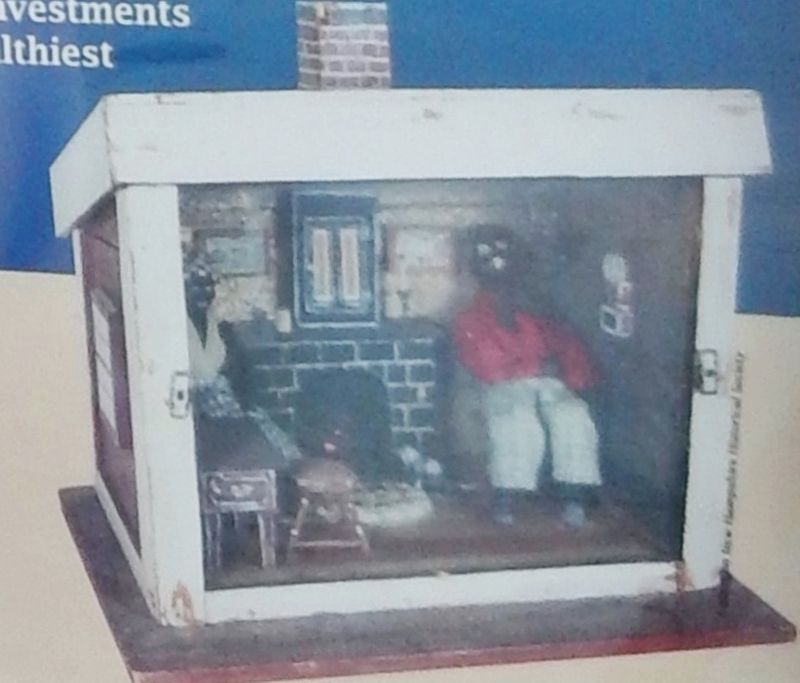
3. Marker detail: Doll House
In 1857 a fugitive slave made this dollhouse depicting a slave cabin for the Whites' five-year-old daughter Anna.
The slave appeared at the Whites' house on Capitol Street, where Armenia White directed him to their farm on Clinton Street. There he whiled away the hours as he waited for the next guide to come through and lead a group of escapees toward Canada.
More about this marker. Marker is mounted on a large, tall "kiosk-like" structure.
Related markers. Click here for a list of markers that are related to this marker. Downtown Concord Series
Also see . . .
1. White, Nathaniel (1811-1880).
Member, New Hampshire House of Representatives, 1852
Prohibition Candidate for Governor, New Hampshire, 1875
Delegate, Republican National Convention, 1876
Benefactor, White Memorial Universalist Church, Concord
Benefactor, Centennial Home for the Aged, Concord
Benefactor, Orphans Home, Franklin (Submitted on April 4, 2018, by Cosmos Mariner of Cape Canaveral, Florida.)
2. Armenia S. (Aldrich) White.
Few names are better known in connection with reform and philanthropic work than that of Armenia S. White, wife of the late Nathaniel White, of Concord. Like her husband, she was an ardent friend of the anti-slavery cause,
Courtesy New Hampshire Historical Society
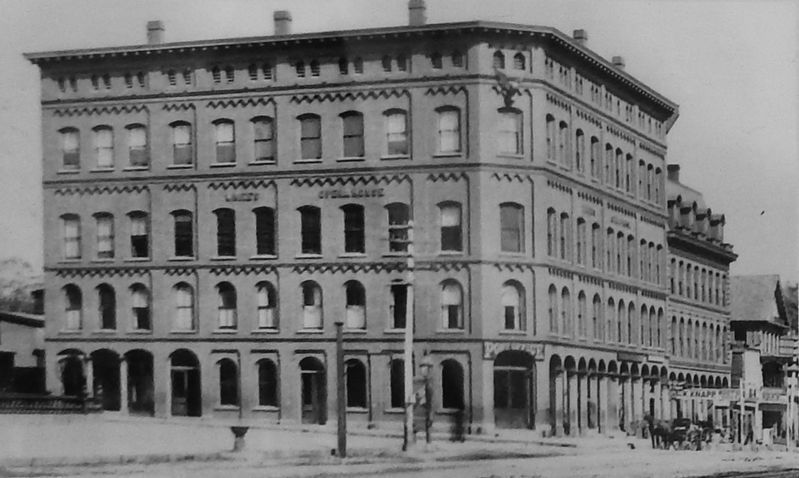
4. Marker detail: Opera House
The Whites were strong supporters of amateur theatricals. Their Opera House stood across the street from the State House, on the corner of N. Main and Park streets. It seated 1,066 and hosted vaudeville, orchestral and vocal concerts, boxers, jugglers, gymnasts, comedians end fancy balls. By 1910, competition from nearby Phenix Hall and the City Auditorium siphoned off much of its audience. Fire destroyed the building in 1920.
3. Nathaniel & Armenia White.
Armenia was a part of the
•Universalist Ladies Social Aid
•Anti Slave Society
•American Purity Alliance
•American Peace Society
•NH Prisoners Aid
•The New Hampshire Humane Society
Nathaniel associated with the
•NH Asylum for the insane
•State reform school
•New Hampshire Orphans' Home
•Home for the Aged. (Submitted on April 4, 2018, by Cosmos Mariner of Cape Canaveral, Florida.)
4. Nathaniel White (businessman).
He arrived in Concord, August 25, 1826, with one shilling in his pocket. For five years, or until he came of age, he continued at the Columbian Hotel, rendering a strict account of his wages to his father, and saving the dimes and quarters which came as perquisites, until by his twenty-first birthday, he had a fund of US$250. (Submitted on April 4, 2018, by Cosmos Mariner of Cape Canaveral, Florida.)
Photographed by Cosmos Mariner, June 25, 2017
5. Nathaniel & Armenia White Marker (wide view)
Photographed by Cosmos Mariner, June 25, 2017
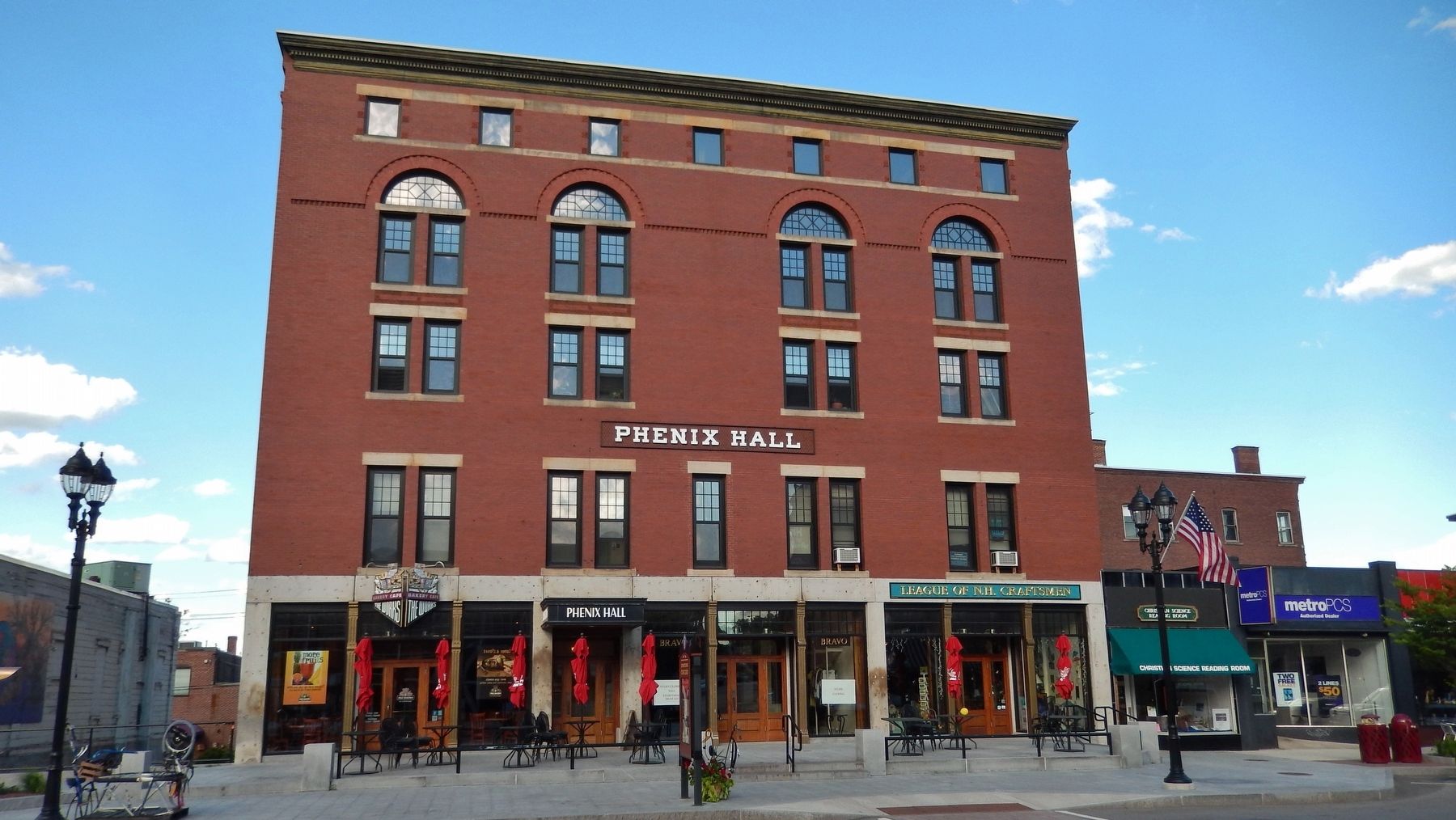
6. Phenix Hall (Competed with White's Opera House)
"Phenix Hall replaced "Old" Phenix Hall, which burned in 1893. Both the old and new buildings featured auditoriums on the top story used for political speeches, lectures, theater productions, boxing and wrestling matches, agricultural fairs, and firemen’s dances.
The existing 500-seat theater has a stage that rolls out into the audience. Abraham Lincoln spoke at the old building in 1860; Theodore Roosevelt spoke at the new building in 1912.
Credits. This page was last revised on April 15, 2018. It was originally submitted on April 3, 2018, by Cosmos Mariner of Cape Canaveral, Florida. This page has been viewed 971 times since then and 45 times this year. Photos: 1, 2, 3, 4, 5, 6. submitted on April 4, 2018, by Cosmos Mariner of Cape Canaveral, Florida. • Andrew Ruppenstein was the editor who published this page.
