London City Wall - Bastion 14
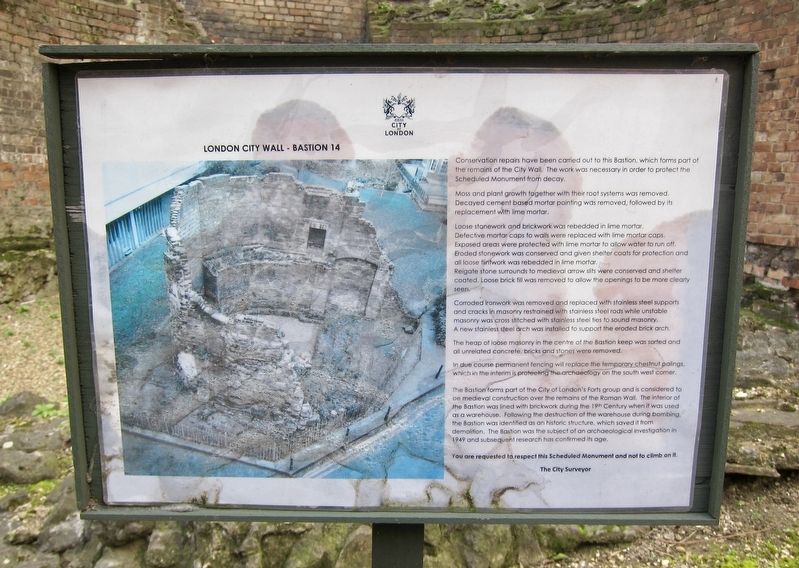
Moss and plant growth together with their root systems was removed. Decayed cement based mortar pointing was removed, followed by its replacement with lime mortar.
Loose stonework and brickwork was rebedded in lime mortar. Defective mortar caps to walls were replaced with lime mortar caps. Exposed areas were protected with lime mortar to allow water to run off. Eroded stonework was conserved and given shelter coats for protection and all loose flintwork was rebedded in lime mortar.
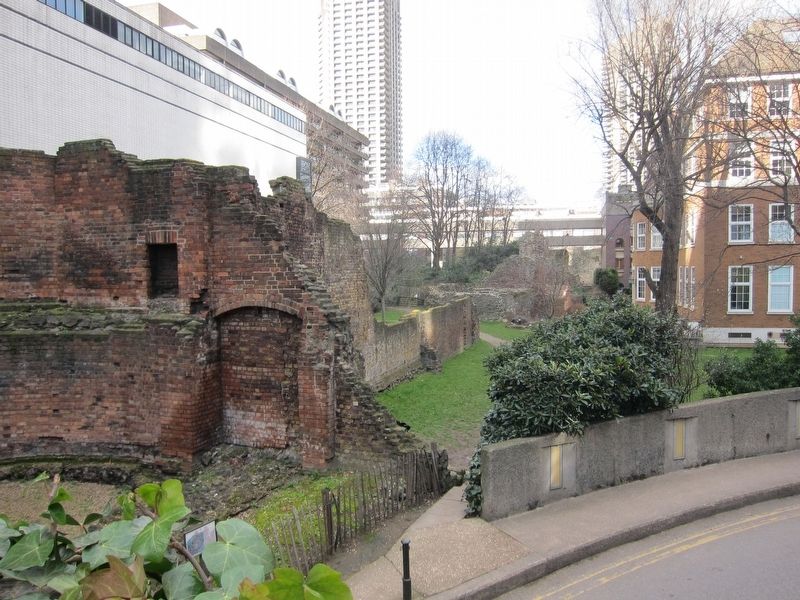
Reigate stone surrounds to medieval arrow slits were conserved and shelter coated. Loose brick fill was removed to allow the openings to be more clearly seen.
Corroded ironwork was removed and replaced with stainless steel supports and cracks in masonry restrained with stainless steel rods while unstable masonry was cross stitched with stainless steel ties to sound masonry. A new stainless steel arch was installed to support the eroded brick arch.
The
this page online
In due course permanent fencing will replace the temporary chestnut palings, which in the interim is protecting the archaeology on the south west corner.
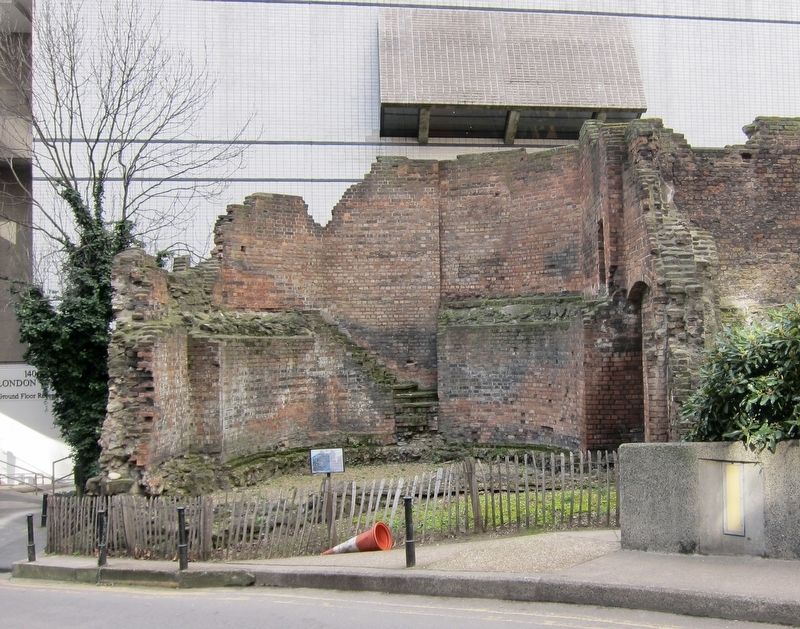
The Bastion forms part of the City of London's Forts group and is considered to be medieval construction over the remains of the Roman Wall. The interior of The Bastion was lined with brickwork during the 19th Century when it was used as a warehouse. Following the destruction of the warehouse during bombing, the Bastion was identified as an historic structure, which saved it from demolition. The Bastion was the subject of an archaeological investigation in 1949 and subsequent research has confirmed its age.
You are requested to respect this Scheduled Monument and not to climb on it.
Erected by City of London Corporation.
Topics. This historical marker is listed in these topic lists: Anthropology & Archaeology • Forts and Castles. A significant historical year for this entry is 1949.
Location. 51° 31.066′ N, 0° 5.705′ W.

Regionally, this marker is in London and in the Greater South East. Globally, it is on the Atlantic Ocean, in the North Atlantic Region, in Europe, in Atlantic Europe, on one of the British Isles, in the Western World, and in the Anglosphere. Historically, it finds itself in what was once the Roman Empire.
Other nearby markers. At least 8 other markers are within walking distance of this marker: The London Wall Walk – 18 (a few steps from this marker); London City Wall - Bastion 13 (within shouting distance of this marker); William Shakespeare (within shouting distance of this marker); St. Olave Silver Street (within shouting distance of this marker); The London Wall Walk – 15 (within shouting distance of this marker); Out of the ashes (about 90 meters away, measured in a direct line); Streets ahead (about 90 meters away); Set in stone
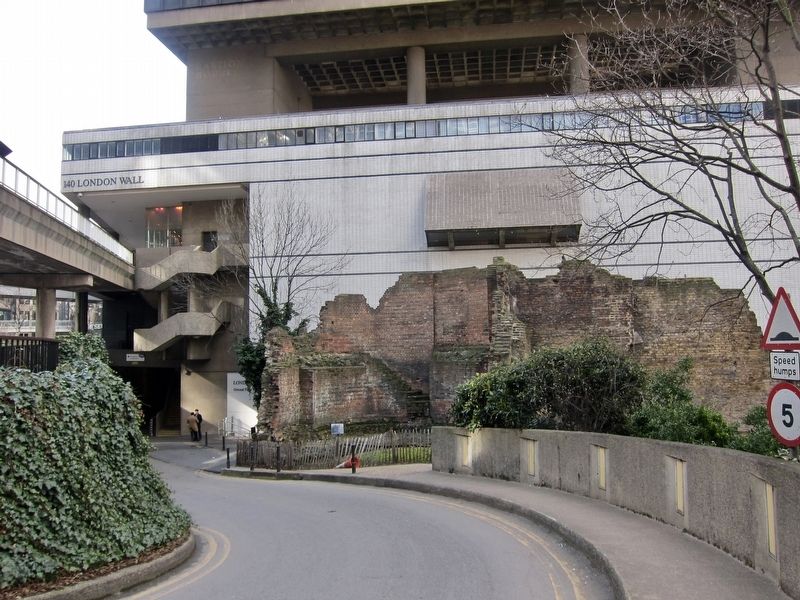
More about this marker. The London Wall Bastion and marker are visible to pedestrians from, yes, the street named "London Wall", address 140. There is a vehicle offramp leading down from the street level to an underground car park, and one may take the sidewalk alongside the ramp to view the bastion and wall.
Also see . . .
1. London Wall (Wikipedia). "The London Wall was the defensive wall first built by the Romans around Londinium, their strategically important port town on the River Thames in what is now London, England, and subsequently maintained until the 18th century....It is now the name of a road in the City of London running along part of the course of the old wall between Wormwood Street and the Rotunda junction where St. Martin's Le Grand meets Aldersgate Street. Until the later Middle Ages the wall defined the boundaries of the City of London." (Submitted on April 6, 2018.)
2. A standing building survey of Bastion 14, City of London (Museum of London Archaeology). "The medieval masonry structure lies on top
Credits. This page was last revised on January 27, 2022. It was originally submitted on April 6, 2018, by Andrew Ruppenstein of Lamorinda, California. This page has been viewed 720 times since then and 41 times this year. Photos: 1, 2, 3, 4. submitted on April 6, 2018, by Andrew Ruppenstein of Lamorinda, California.
