Memphis in Shelby County, Tennessee — The American South (East South Central)
Skipwith Crevasse/Sara Cutoff/Island No. 89
Mississippi River Walk
Photographed by Jason Voigt, August 2, 2024
1. Skipwith Crevasse/Sara Cutoff/Island No. 89 Marker
Marker was replaced by one put up by Mud Island Park.
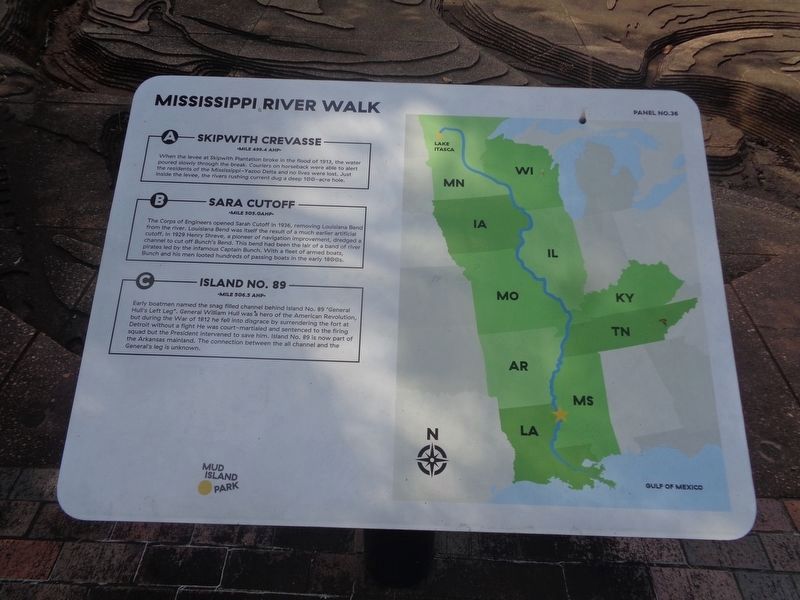
A. Skipwith Crevasse
Mile 499.4 AHP
When the levee at Skipwith Plantation broke in the flood of 1913, the water poured slowly through the break. Couriers on horseback were able to alert the residents of the Mississippi-Yazoo Delta, and no lives were lost. Just inside the levee, the river’s rushing current dug a deep 100-acre hole.
B. Sara Cutoff
Mile 505.0 AHPM
The Corps of Engineers opened Sarah Cutoff in 1936, removing Louisiana Bend from the river. Louisiana Bend was itself the result of a much earlier artificial cutoff. In 1929 Henry Shreve, a pioneer of navigation improvement, dredged a channel to cut off Bunch’s Bend. This bend had been the lair of a band of river pirates led by the infamous Captain Bunch. With a fleet of armed boats, Bunch and his men looted hundreds of passing boats in the early 1800’s
C. Island No. 89
Mile 506.5 AHP
Early Boatmen named the snag-filled channel behind Island No. 89 “General Hull’s Left Leg.” General William Hull was a hero of the American Revolution, but during the War of 1812, he fell into disgrace by surrendering to the fort at Detroit without a fight. He was court-martialed
this page online
Erected by Mississippi Riverwalk. (Marker Number 36.)
Topics. This historical marker is listed in these topic lists: Disasters • War, US Revolutionary • Waterways & Vessels. A significant historical year for this entry is 1913.
Location. 35° 8.875′ N, 90° 3.563′ W. Marker is in Memphis, Tennessee, in Shelby County. It can be reached from Island Drive. Marker is located at Mud Island Park. Touch for map. Marker is at or near this postal address: 125 N Front St, Memphis TN 38103, United States of America. Touch for directions.

Regionally, this marker is in West Tennessee. It is also in the American South, specifically in the Deep South, in the Upper South, in the Mississippi Delta, and in the Great River Road Region. Globally, it is in North America, the Western Hemisphere, the Western World, and the Anglosphere. Historically, it finds itself in what was once the territory of the Mississippian Culture, one of the

Photographed by Sandra Hughes, May 18, 2010
2. Skipwith Crevasse/Sara Cutoff/Island No. 89 Marker
Other nearby markers. At least 8 other markers are within walking distance of this marker: Grand Lake Cutoff/Worthington Cutoff/Kentucky Bend (a few steps from this marker); Lake Providence, Louisiana/Stack Island (a few steps from this marker); American Cutoff Mile/Greenville, Mississippi/Tarpley Cutoff (a few steps from this marker); Willow Cutoff/Salem Crevasse/Goodrich Landing,Louisiana (a few steps from this marker); Gauges and Navigation Lights (within shouting distance of this marker); Young’s Point / Milliken’s Bend / Omega Landing (within shouting distance of this marker); Ashbrook Cutoff/Eunice Landing, Arkansas/Arkansas City, Arkansas (within shouting distance of this marker); Yazoo River/Centennial Cutoff (within shouting distance of this marker). Touch for a list and map of all markers in Memphis.
Also see . . . William Hull. William Hull (June 24, 1753 – November 29, 1825) was an American soldier and politician. He fought in the American Revolution and was appointed as Governor of Michigan Territory (1805–13), gaining large land cessions
Photographed by Jason Voigt, August 2, 2024
3. Skipwith Crevasse/Sara Cutoff/Island No. 89 Marker
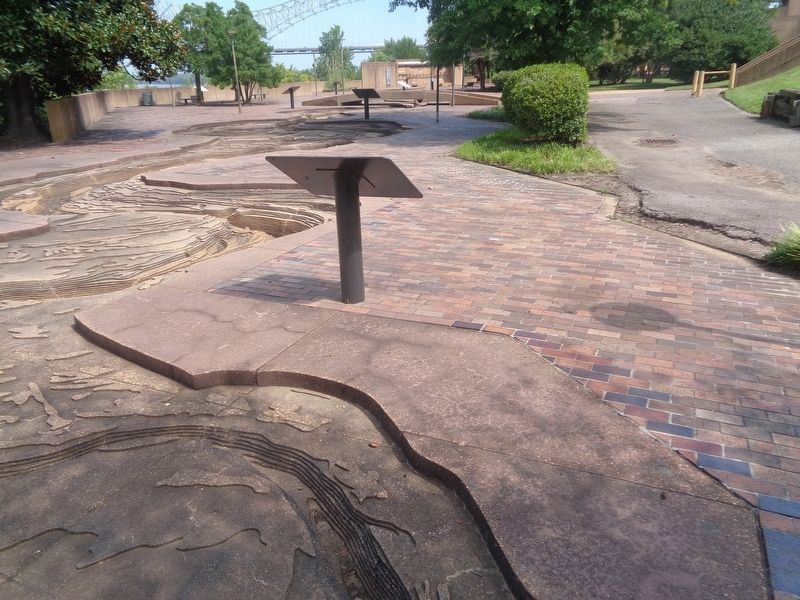
Marker is in the back, on the right side of the river model
Credits. This page was last revised on September 13, 2024. It was originally submitted on March 27, 2018, by Sandra Hughes Tidwell of Killen, Alabama, USA. This page has been viewed 388 times since then and 41 times this year. Last updated on April 11, 2018, by Byron Hooks of Sandy Springs, Georgia. Photos: 1. submitted on September 13, 2024, by Jason Voigt of Glen Carbon, Illinois. 2. submitted on March 27, 2018, by Sandra Hughes Tidwell of Killen, Alabama, USA. 3. submitted on September 13, 2024, by Jason Voigt of Glen Carbon, Illinois. • Andrew Ruppenstein was the editor who published this page.
