St. Simons Island in Glynn County, Georgia — The American South (South Atlantic)
Battle of Gully Hole Creek
Photographed by Mike Stroud, September 2008
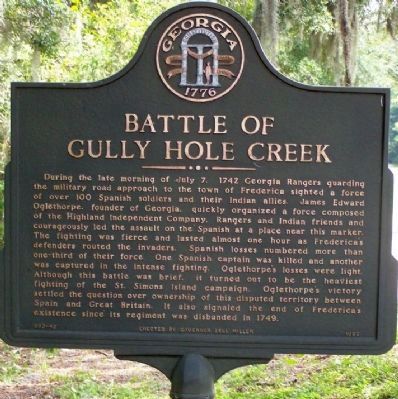
1. Battle of Gully Hole Creek Marker
During the late morning of July 7, 1742 Georgia Rangers guarding the military road approach to the town of Frederica sighted a force of over 100 Spanish soldiers and their Indian allies. James Edward Oglethorpe, founder of Georgia, quickly organized a force composed of the Highland Independent Company, Rangers and Indian friends and courageously led the assault on the Spanish at a place near this marker. The fighting was fierce and lasted almost an hour as Frederica's defenders routed the invaders. Spanish losses numbered more than one-third of their force. One Spanish captain was killed and another was captured in the intense fighting. Oglethorpe's losses were light. Although the battle was brief, it turned out to be the heaviest fighting on the St. Simons Island campaign. Oglethorpe's victory settled the question over ownership of this disputed territory between Spain and Great Britain. It also signaled the end of Frederica's existence since its regiment was disbanded in 1749.
Erected 1992 by Governor Zell Miller. (Marker Number 063-42.)
Topics and series. This historical marker is listed in this topic list:
this page online
Location. 31° 13.121′ N, 81° 23.054′ W. Marker is on St. Simons Island, Georgia, in Glynn County. It is on Frederica Road 0.1 miles east of Stevens Road, on the right when traveling west. Touch for map. Marker is in this post office area: Saint Simons Island GA 31522, United States of America. Touch for directions.

Regionally, this marker is on the Coastal Plain, on the Georgia Coast and the Golden Isles, and on the Sea Islands. It is also in the American South, specifically in the Deep South, and on the Eastern Seaboard. Globally, it is in the North Atlantic Region, North America, the Western Hemisphere, the Western World, and the Anglosphere. Historically, it finds itself in what was once New Spain, the territory of the Mississippian Culture, one of the original Thirteen Colonies, one of the Confederate States of America, and the Antebellum South.
Other nearby markers. At least 8 other markers are within walking distance of this marker: The Dodge Home for Orphan Boys (about 600 feet
Photographed by Mike Stroud, 2008
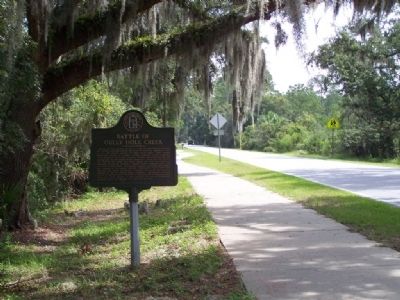
2. Battle of Gully Hole Creek Marker looking east on Frederica Road
Regarding Battle of Gully Hole Creek. The Battle of Gully Hole Creek was a battle in 1742 on St. Simons Island, Georgia, between Spanish troops from the Spanish colony of Florida and British colonial troops on St. Simons Island. It was won by the British. The British colonists also won the
Battle of Bloody Marsh later the same day, driving the Spanish out of the Georgia colony.
Also see . . . The Battle of Gully Hole Creek - St. Simons Island, Georgia. War of Jenkins' Ear in Georgia (Submitted on May 9, 2011, by Mike Stroud of Bluffton, South Carolina.)
Credits. This page was last revised on November 23, 2020. It was originally submitted on September 21, 2008, by Mike Stroud of Bluffton, South Carolina. This page has been viewed 2,333 times since then and 65 times this year. Photos: 1, 2. submitted on September 21, 2008, by Mike Stroud of Bluffton, South Carolina. • Craig Swain was the editor who published this page.
