Near Sumatra in Franklin County, Florida — The American South (South Atlantic)
Fort Gadsden
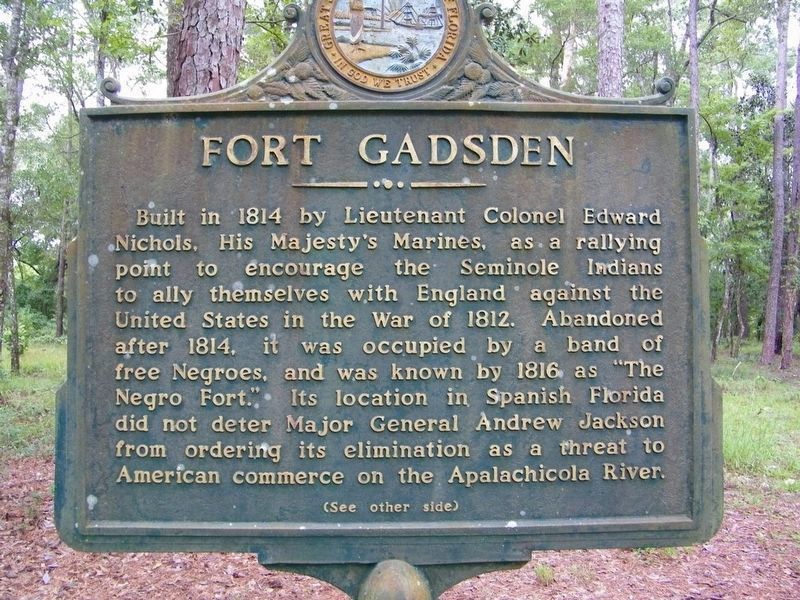
1. Fort Gadsden Marker (Side A)
(Side A)
Built in 1814 by Lieutenant Colonel Edward Nichols, His Majesty's Marines, as a rallying point to encourage the Seminole Indians to ally themselves with England against the United States in the War of 1812. Abandoned after 1814, it was occupied by a band of free Negroes, and was known by 1816 as "The Negro Fort." Its location in Spanish Florida did not deter Major General Andrew Jackson from ordering its elimination as a threat to American commerce on the Apalachicola River.
Erected 1968 by Florida Board of Parks and Historical Memorials. (Marker Number F-159.)
Topics and series. This historical marker
this page online
Location. 29° 56.297′ N, 85° 0.588′ W. Marker is near Sumatra, Florida, in Franklin County. It can be reached from Addie Road (Forest Road 129-D) 0.8 miles south of Brick Yard Road (Forest Road 129), on the right when traveling south. Located west of FL-65, where a sign marks the turn for the Fort Gadsden/Prospect Bluff Historic Sites (closed). The roads are unpaved and may contain potholes. Touch for map. Marker is in this post office area: Wewahitchka FL 32465, United States of America. Touch for directions.

Regionally, this marker is on the Florida Panhandle. It is also in the American South, specifically in the Deep South, and on the Gulf Coast. Globally, it is in the North Atlantic Region, North America, a Gulf of Mexico state, the Western Hemisphere, the Western World, and the Anglosphere. Historically, it finds itself in what was once New Spain, the territory of the Mississippian
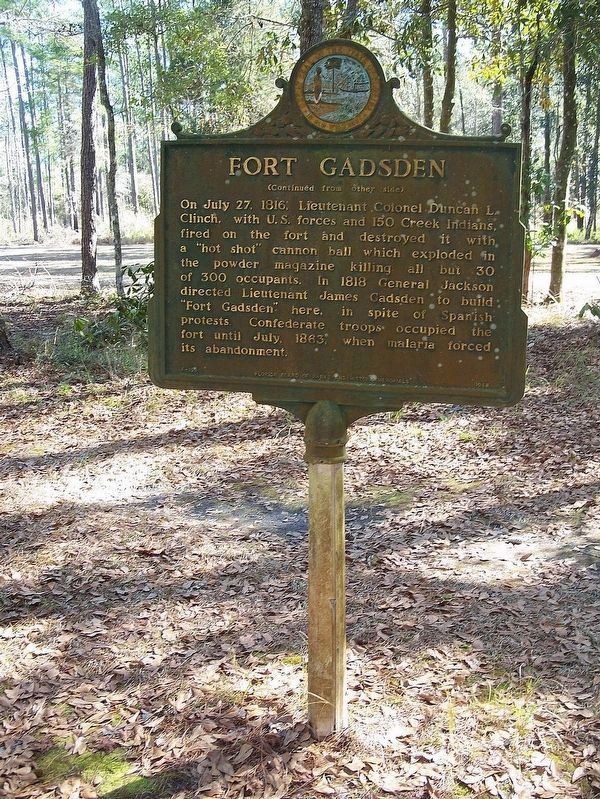
2. Fort Gadsden Marker (Side B)
Other nearby markers. At least 6 other markers are within 17 miles of this marker, measured as the crow flies: Steamship Tragedy (here, next to this marker); British Fort Magazine (here, next to this marker); "Milly Francis" (here, next to this marker); Fort Place ~ St. Joseph & Iola Railroad (approx. 13½ miles away); Wewahitchka Centennial (approx. 16.7 miles away); Gulf County Old Courthouse (approx. 16.7 miles away).
Another marker is no longer nearby. St. Joseph and Iola Railroad (was approx. 15.8 miles away but has been confirmed missing).
Regarding Fort Gadsden. The fort was abandoned by the British after 1815, not 1814. The fort was abandoned when Florida became a U.S. territory in 1821. Despite the marker, there is no known activity at the site between 1821 and 1862-63, when it was occupied by Confederate troops.
Also see . . .
1. Prospect Bluff Historic Sites. Forest Service, USDA (Submitted on September 17, 2025.)
2. Prospect Bluff Historic Sites. Wikipedia (Submitted on February 25, 2018, by Daniel Eisenberg of Boca Raton, Florida.)
3. Negro Fort. Wikipedia (Submitted on September 17, 2025.)
Additional commentary.
1. Now part of the National Underground Railroad Network to Freedom.
In March, 2019, Negro Fort, part of the Prospect Bluff Historic Sites on the Apalachicola National Forest, has been accepted by the National Park Service (NPS) for inclusion into the National Underground Railroad Network to Freedom. According to the NPS Certificate of Acceptance, this honor is bestowed upon sites that make a “significant contribution to the understanding of the Underground Railroad in American history.”
— Submitted April 22, 2019, by Mark Hilton of Montgomery, Alabama.
2. Hurricane Michael hits Prospect Bluff Historic Site.
Hurricane Michael, a Category 5 hurricane, severely damaged the Prospect Bluff Historic Sites and the surrounding buildings in October 2018, uprooted large trees, and created multiple safety hazards. As a result, the U.S. Forest Service closed the area to the public.
— Submitted April 22, 2019, by Mark Hilton of Montgomery, Alabama.
Credits. This page was last revised on September 17, 2025. It was originally submitted on February 24, 2018, by Daniel Eisenberg of Boca Raton, Florida. This page has been viewed 1,532 times since then and 177 times this year. Last updated on April 15, 2018, by Daniel Eisenberg of Boca Raton, Florida. Photos: 1. submitted on February 24, 2018, by Daniel Eisenberg of Boca Raton, Florida. 2. submitted on February 25, 2018, by Daniel Eisenberg of Boca Raton, Florida. • Bill Pfingsten was the editor who published this page.
Editor’s want-list for this marker. A wide shot of the marker and its surroundings. • Can you help?
