San Fernando in Los Angeles County, California — The American West (Pacific Coastal)
Rogerio Rocha
Rudy Ortega Park
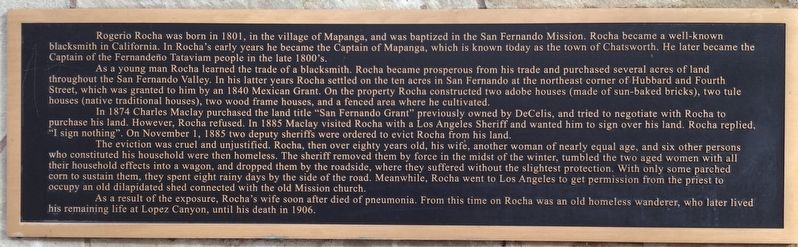
Rogerio Rocha was born in 1801, in the village of Mapanga, and was baptized in the San Fernando Mission. Rocha became a well-known blacksmith in California. In Rocha's early years he became the Captain of Mapanga, which is known today as the town of Chatsworth. He later became the Captain of the Fernandeño Tatavium people in the late 1800's.
As a young man, Rocha learned the trade of a blacksmith. Rocha became prosperous from his trade and purchased several acres of land throughout the San Fernando Valley. In his latter years Rocha settled on the ten acres in San Fernando at the northeast corner of Hubbard and Fourth Street, which was granted to him by an 1840 Mexican grant. On the property, Rocha constructed two adobe houses (made of sun-baked bricks), two tule houses (native traditional houses), two wood frame houses, and a fenced area where he cultivated.
In 1874 Charles Maclay purchased the land title "San Fernando Grant" previously owned by DeCelis, and tried to negotiate with Rocha to purchase his land. However, Rocha refused. In 1885 Maclay visited Rocha with a Los Angeles Sheriff and wanted him to sign
this page online
The eviction was cruel and unjustified. Rocha, then over eighty years old, his wife, another woman of nearly equal age, and six other persons who constituted his household were then homeless. The sheriff removed them by force in the midst of the winter, tumbled the two aged women with all their household effects into a wagon, and dropped them by the roadside, where they suffered without the slightest protection. With only some parched corn to sustain them, they spent eight rainy days by the side of the road. Meanwhile, Rocha went to Los Angeles to get permission from the priest to occupy an old dilapidated shed connected with the old Mission church.
As a result of the exposure, Rocha's wife soon died of pneumonia. From this time on, Rocha was an old homeless wanderer, who later lived his remaining life at Lopez Canyon, until his death in 1906.
Topics. This historical marker is listed in this topic list: Indigenous Peoples and Communities. A significant historical year for this entry is 1801.
Location. 34° 17.681′ N,
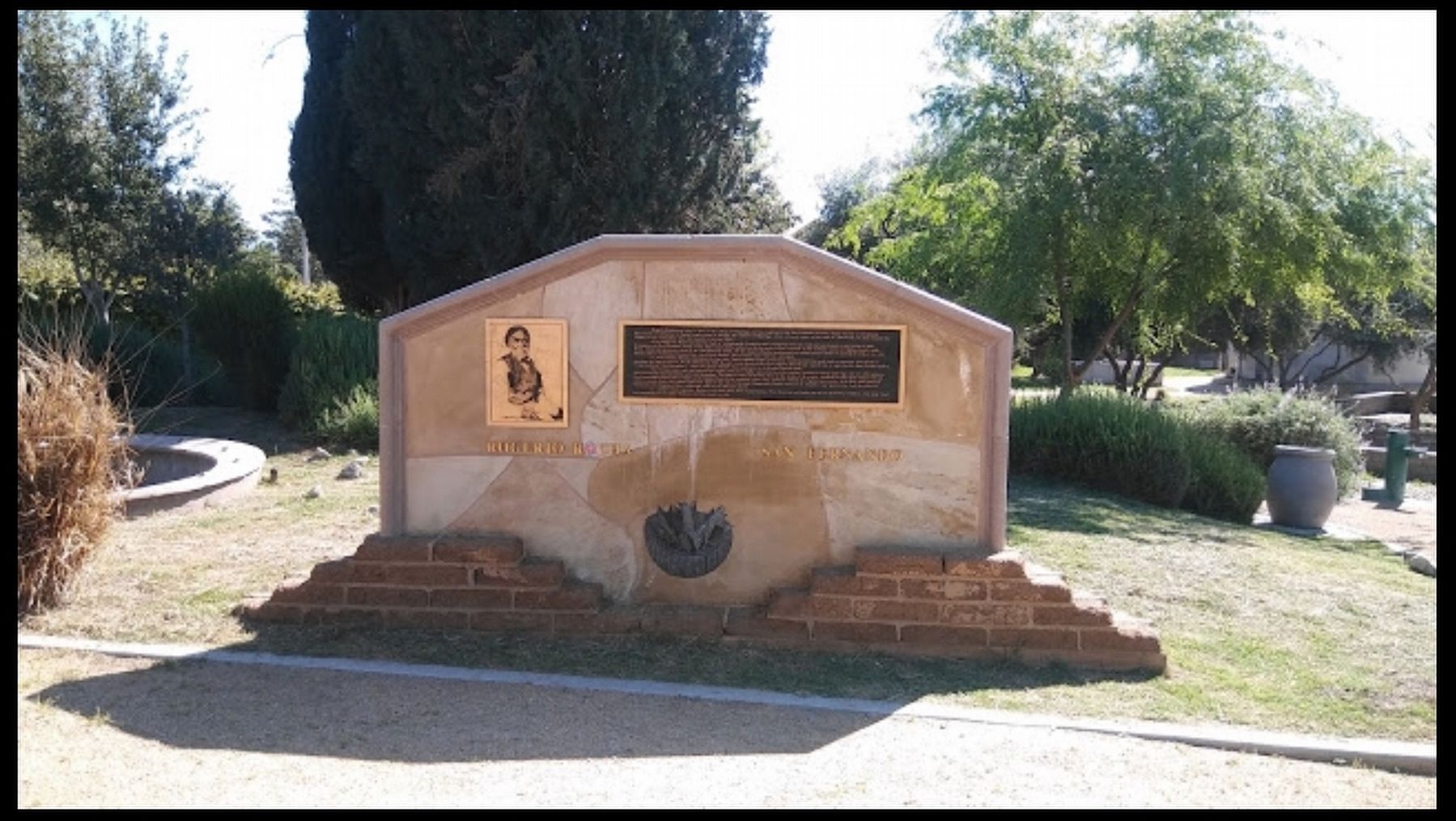
2. Rogerio Rocha Marker

Regionally, this marker is in The Valley (the San Fernando Valley), in Greater Los Angeles, and in the Transverse Ranges. It is also on the American Pacific Coast. Globally, it is in North America, on the Ring of Fire, on the Pacific Rim, in the Western Hemisphere, in the Western World, and in the Anglosphere. Historically, it finds itself in what was once New Spain and also Mexico’s Alta California.
Other nearby markers. At least 8 other markers are within 2 miles of this marker, measured as the crow flies: Mission Wells (approx. 0.6 miles away); Casa de Lopez (approx. 0.9 miles away); Father Junipero Serra (approx. 0.9 miles away); Cesar Chávez (approx. 1.1 miles away); Trinity Church (approx. 1.1 miles away); Mission Dam
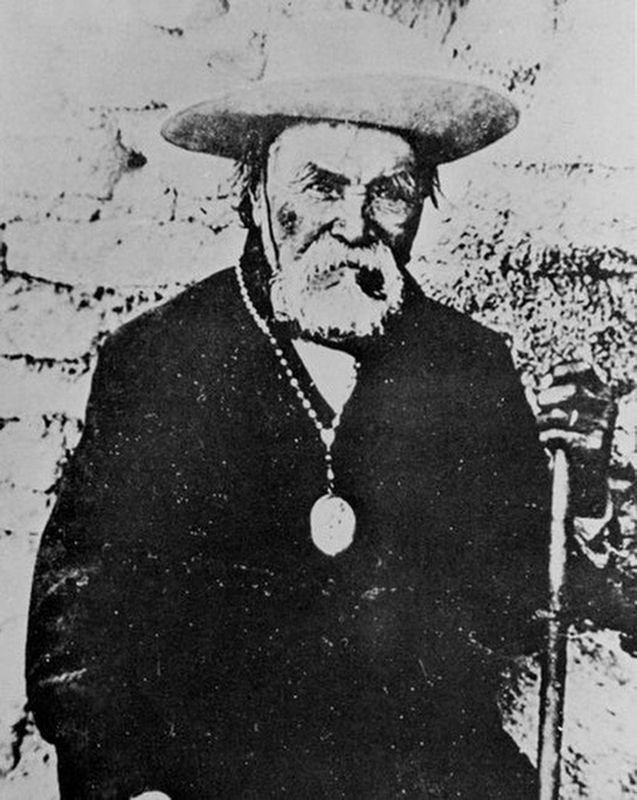
courtesy San Fernando Valley Historical Society, circa 1890
3. Rogerio Rocha
More about this marker. Half of the park is in the city of Los Angeles, but the entire park is owned by the city of San Fernando.
Additional keywords. Native American Indian, Rudy Ortega Park, Heritage Park

photo by Charles Lummis, courtesy Autry Museum
4. Rogerio Rocha
Credits. This page was last revised on May 18, 2026. It was originally submitted on September 26, 2017, by Craig Baker of Sylmar, California. This page has been viewed 2,891 times since then and 239 times this year. Last updated on April 20, 2018, by Craig Baker of Sylmar, California. Photos: 1, 2. submitted on September 26, 2017, by Craig Baker of Sylmar, California. 3. submitted on September 30, 2017. 4. submitted on May 18, 2026, by Craig Baker of Sylmar, California. • Andrew Ruppenstein was the editor who published this page.
