Cumberland Township near Gettysburg in Adams County, Pennsylvania — The American Northeast (Mid-Atlantic)
Poague's Howitzers
Pender's Division - Hill's Corps
| — | Army of Northern Virginia | — |
Photographed by Craig Swain, August 16, 2008
1. Poague's Howitzers Tablet
Hill's Corps Pender's Division
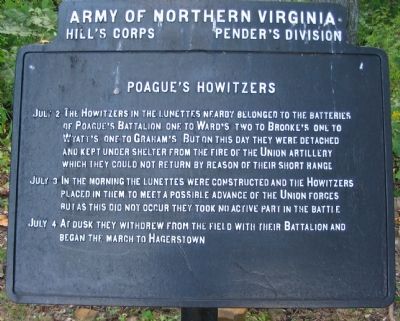
Poague's Howitzers
July 2 The Howitzers in the lunettes nearby belonged to the batteries of Poague's Battalion one to Ward's, two to Brooke's, one to Wyatt's, one to Graham's. But on this day they were detached and kept under shelter from the fire of Union artillery which they could not return by reason of their short range.
July 3 In the morning the lunettes were constructed and the Howitzers placed in them to meet a possible advance of the Union forces but as this did not occur they took no active part in the battle.
July 4 At dusk they withdrew from the field with their Battalion and began the march to Hagerstown.
Erected 1910 by Gettysburg National Military Park Commission.
Topics. This historical marker is listed in this topic list: War, US Civil. A significant day of the year for for this entry is July 2.
Location. 39° 48.877′ N, 77° 15.035′ W. Marker is near Gettysburg, Pennsylvania, in Adams County. It is in Cumberland Township. It is on West Confederate Avenue, on the right when traveling south. Located opposite the Virginia State Memorial (Driving Tour Stop 5) on
this page online

Regionally, this marker is in South-Central Pennsylvania. It is also in the American Northeast, in the Mid-Atlantic, in Appalachia, and specifically in Northern Appalachia. Globally, it is in North America, the Western Hemisphere, the Western World, and the Anglosphere. Historically, it finds itself in what was once the Haudenosaunee (Iroquois) Confederacy and also one of the original Thirteen Colonies.
Other nearby markers. At least 8 other markers are within walking distance of this marker: Posey's Brigade (a few steps from this marker); Ward's Battery - Poague's Battalion (within shouting distance of this marker); Brooke's Battery - Poague's Battalion (within shouting distance of this marker); Army of Northern Virginia (within shouting distance of this marker); Virginia Memorial (within shouting distance of this marker); Wright's Brigade (within shouting distance of this marker); The Storm of Battle (about 300 feet away); Gettysburg (about 300 feet
Photographed by Craig Swain, August 16, 2008
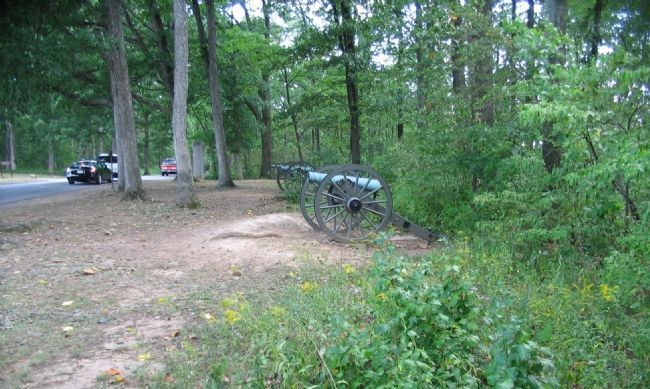
2. Howitzer Positions
Five 12-pounder Howitzers represent the positions occupied by the howitzer sections from Poague's Battalion. Confederate artillery batteries often were equipped with a mix of artillery types, unlike Federal batteries. In addition to causing problems with ammunition supply, the mixture of types caused tactical employment issues, as seen here. Over the open fields of Gettysburg, the howitzers were out ranged by Federal guns, and relegated to supporting roles.
Another marker is no longer nearby. Pickett's Charge (was about 300 feet away, measured in a direct line but has been replaced with another marker now near it).
Also see . . . Poague's Report on the Howitzers. In his official report of the battle, Major William T. Poague was not happy with the capabilities. He stated the howitzers were kept a short distance in rear, as no place could be found from which they could be used with advantage....Upon the repulse of our troops, anticipating an advance of the enemy, I ordered up the howitzers. The enemy, however, failed to follow up his advantage, and I got no service out of those useless guns. (Submitted on September 28, 2008, by Craig Swain of Leesburg, Virginia.)
Photographed by Craig Swain, August 16, 2008
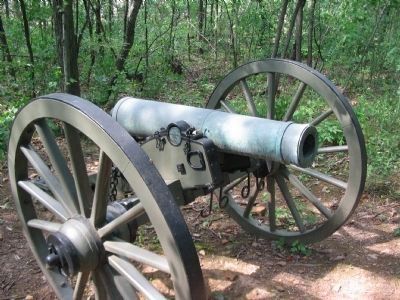
3. Noble and Brothers 12-pounder Howitzers
Of the five howitzers on display, two were manufactured by Noble and Brothers, of Rome, Georgia, in 1862. The design, while similar to the Federal Model of 1841, is slightly shorter than the regulation 12-pounder. The Noble brothers operated a major iron works in Rome before the war and shifted their work to providing cannon and other implements to the Confederate service in 1861. The brothers disliked interference from the Confederate ordnance inspectors, causing much friction and production delays. Eventually the government seized the cannon manufacturing equipment and the Noble Brothers shifted to producing railroad equipment.
Photographed by Craig Swain, August 16, 2008
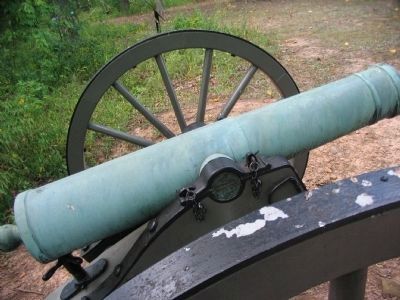
4. Quinby and Robinson 12-pounder Howitzer
Another early war Confederate manufacturer of cannon was Quinby and Robinson of Memphis, Tennessee. Basically these were straight copies of the pre-war 12-pounder Model of 1841. Forty-two were produced before a fire destroyed the machine shop in Memphis. When the city was lost to Federals in 1862, all activity ceased.
Photographed by Craig Swain, August 17, 2008
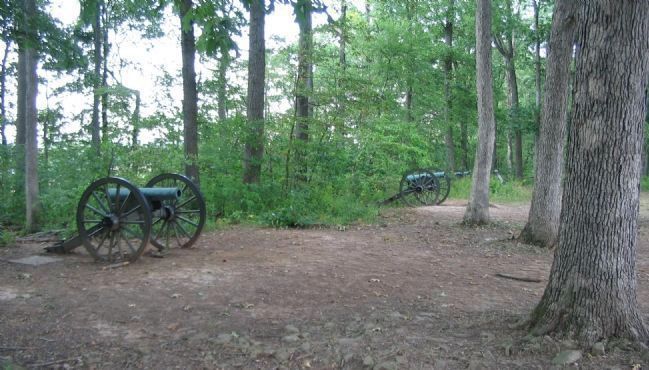
5. Poague's Howitzers
The lunettes are barely visible today as raised ground around the howitzers.
Credits. This page was last revised on February 7, 2023. It was originally submitted on September 28, 2008, by Craig Swain of Leesburg, Virginia. This page has been viewed 2,077 times since then and 47 times this year. Photos: 1, 2, 3, 4. submitted on September 28, 2008, by Craig Swain of Leesburg, Virginia. 5. submitted on September 29, 2008, by Craig Swain of Leesburg, Virginia.
