Downtown in San Antonio in Bexar County, Texas — The American South (West South Central)
Missions in the San Antonio River Valley
Photographed by Cosmos Mariner, May 21, 2018
1. Missions in the San Antonio River Valley Marker
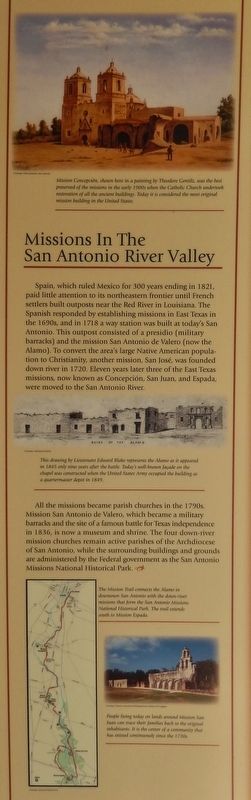
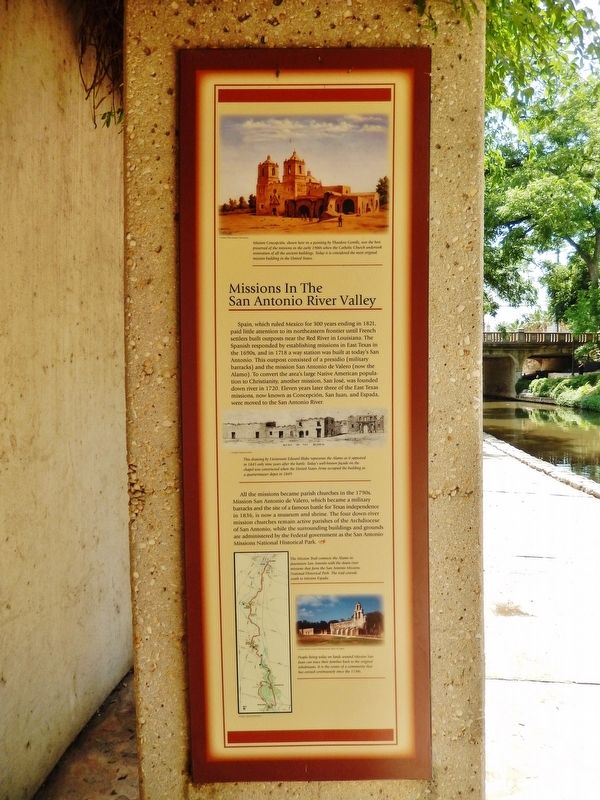
Spain, which ruled Mexico for 300 years ending in 1821, paid little attention to its northeastern frontier until French settlers built outposts near the Red River in Louisiana. The Spanish responded by establishing missions in East Texas in the 1690s, and in 1718 a way station was built at today's San Antonio. This outpost consisted of a presidio (military barracks) and the mission San Antonio de Valero (now the Alamo). To convert the area's large Native American population to Christianity, another mission, San José, was founded down river in 1720. Eleven years later three of the East Texas missions, now known as Concepción, San Juan, and Espada, were moved to the San Antonio River.
All the missions became parish churches in the 1790s. Mission San Antonio de Valero, which became a military barracks and the site of a famous battle for Texas independence in 1836, is now a museum and shrine. The four down-river mission churches remain active parishes of the Archdiocese of San Antonio, while the surrounding buildings and grounds are administered by the Federal government as the San Antonio Missions National Historical
this page online
Topics. This historical marker is listed in these topic lists: Colonial Era • Religion & Religious Structures. A significant historical year for this entry is 1718.
Location. 29° 25.905′ N, 98° 29.268′ W. Marker is in San Antonio, Texas, in Bexar County. It is in Downtown. It can be reached from Lexington Avenue north of Avenue A, on the right when traveling north. Marker is located on the San Antonio River Walk, on the south side of the river, 1/10 mile east of the Lexington Avenue bridge. Marker is a short walk from the 107 Avenue A parking lot. Touch for map. Marker is at or near this postal address: 107 Avenue A, San Antonio TX 78205, United States of America. Touch for directions.

Regionally, this marker is in South Texas. It is also in the American South. Globally, it is in North America, a Gulf of Mexico state, the Western Hemisphere, the Western World, and the Anglosphere. Historically, it finds itself in what was once New Spain, the Republic of Texas, and one of the Confederate States of America.
Other nearby markers. At least 8 other markers are within walking distance of this marker: The San Antonio River
Courtesy Witte Museum, San Antonio
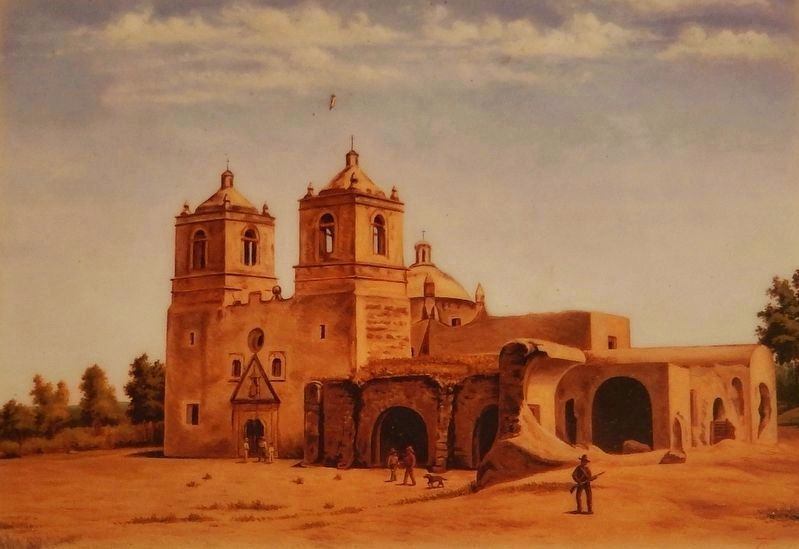
2. Marker detail: Mission Concepción
Mission Concepción, shown here in a painting by Theodore Gentilz, was the best preserved of the missions in the early 1900s when the Catholic Church undertook restoration of all the ancient buildings. Today it is considered the most original mission building in the United States.
More about this marker. This marker is one of five adjacent San Antonio River historical markers at this location.
Related markers. Click here for a list of markers that are related to this marker. San Antonio River History
Also see . . .
1. San Antonio Missions National Historical Park. San Antonio Missions National Historical Park is a National Historical Park and part of a UNESCO World Heritage Site preserving four of the five Spanish frontier missions in San Antonio, Texas, USA. These outposts were established by Catholic religious orders to spread Christianity among the local natives. These missions formed part of a colonization system that stretched across
Courtesy: National Archives
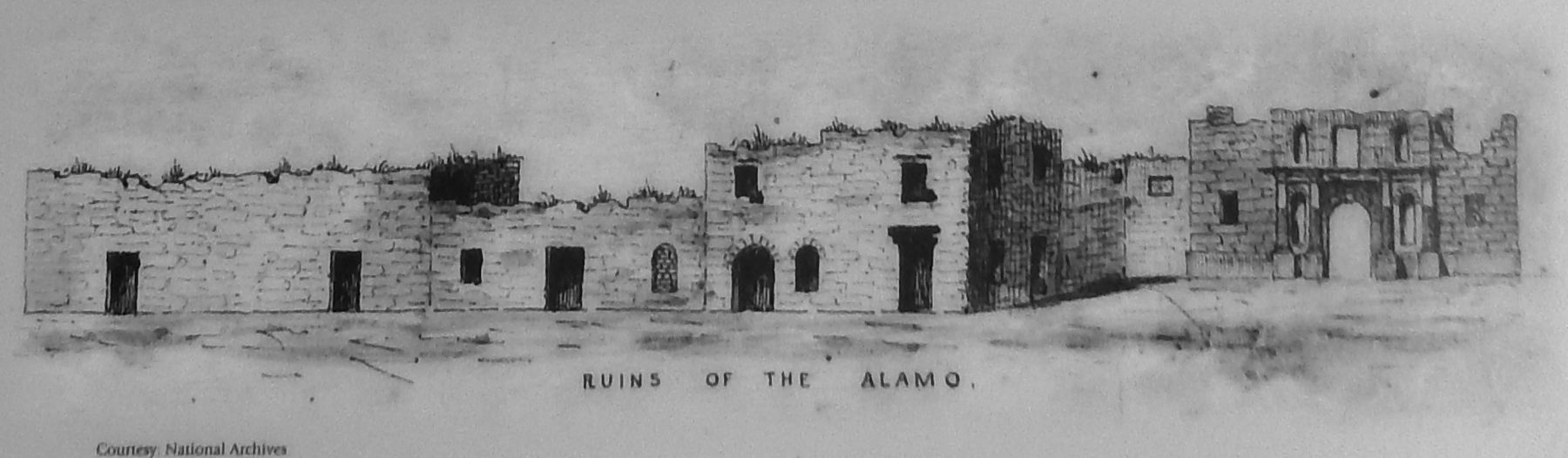
3. Marker detail: Alamo as it appeared in 1845
This drawing by Lieutenant Edward Blake represents the Alamo as it appeared in 1845 only nine years after the battle. Today's well-known facade on the chapel was constructed when the United States Army occupied the building as a quartermaster depot in 1849.
2. The San Antonio Missions.
Mission San José
San José y San Miguel de Aguayo, the “Queen of the Missions,” is the largest mission in San Antonio, established in 1720 and completed in 1782.
Mission Concepción
The beautiful church at Mission Nuestra Señora de la Purisima Concepción de Acuña looks much like it did in 1755 when it was first dedicated.
Mission San Juan Capistrano
Mission San Juan was established in San Antonio in 1731. The church, priest’s quarters and granary were completed in 1756. The mission’s fertile farmlands allowed for a self-sustainable community, and its surplus helped supply the region with produce.
Mission Espada
Mission San Francisco de la Espada, the
Photographed by Courtesy: National Park Service
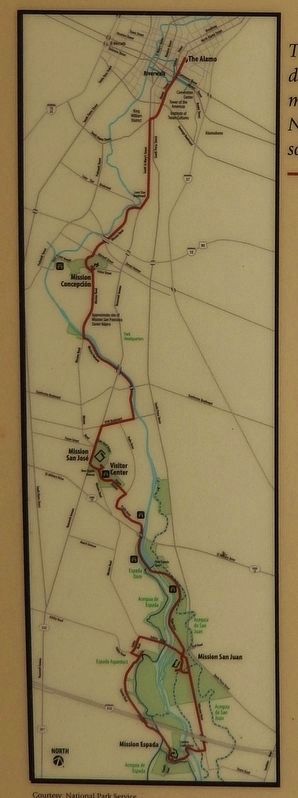
4. Marker detail: The Mission Trail
The Mission Trail connects the Alamo in downtown San Antonio with the down-river missions that form the San Antonio Missions National Historical Park. The trail extends south to Mission Espada.
Courtesy: Historic American Building Archives, Library of Congress
5. Marker detail: Mission Jan Juan
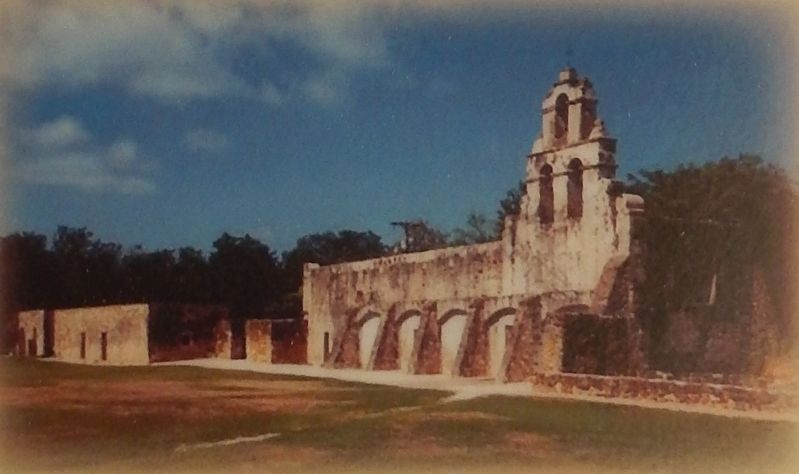
People living today on lands around Mission San Juan can trace their families back to the original inhabitants. It is the center of a community that has existed continuously since the 1730s.
Photographed by Cosmos Mariner, May 21, 2018
6. Missions San Antonio River Valley Marker (wide view; Lexington St. Bridge in background)
Credits. This page was last revised on May 25, 2024. It was originally submitted on June 21, 2018, by Cosmos Mariner of Cape Canaveral, Florida. This page has been viewed 833 times since then and 32 times this year. Last updated on July 3, 2018, by Cosmos Mariner of Cape Canaveral, Florida. Photos: 1, 2, 3, 4, 5, 6. submitted on June 21, 2018, by Cosmos Mariner of Cape Canaveral, Florida. • Andrew Ruppenstein was the editor who published this page.
