Yeni in Izmir in Konak, Turkiye — West Asia or Southeast Europe
The Ancient City of Smyrna
Photographed by Pam Benington, June 16, 2018
1. The Ancient City of Smyrna Marker
English Text:
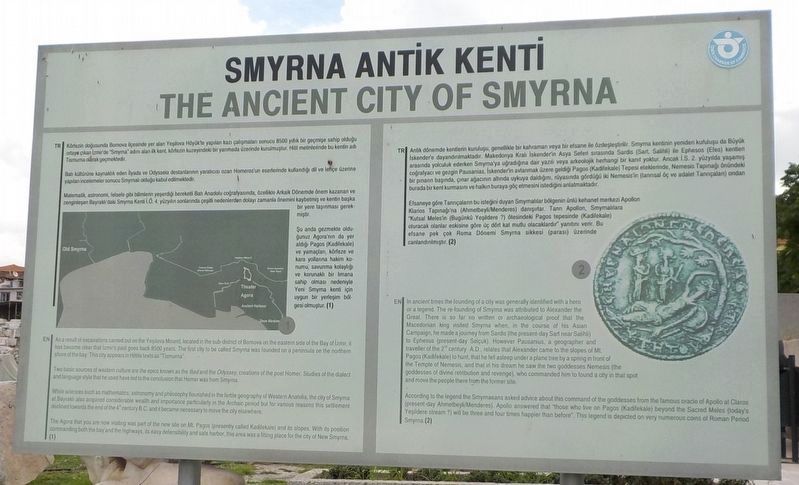
A result of excavations carried out on the Yeslova Mound, located in the sub-district of Bornova on the eastern side of the Bay of Izmir, it has become clear that Izmir's past goes back 8500 years. The first city to be called Smyrna was founded on a peninsula on the northern shore of the bay. This city appears in Hittite texts as Tismurna.
Two basic sources of western culture are the epics known as the Iliad and the Odyssey, creations of the poet Homer. Studies of the dialect and language style that he used have led to the conclusion that Homer was from Smyrna.
While sciences such as mathematics, astronomy and philosophy flourished in the fertile geography of Western Anatolia, the city of Smyrna at Bayraki also acquired considerable wealth and importance particularly in the Archaic period but for various reasons this settlement declined towards the end of the 4th century B.C and it became necessary to move the city elsewhere.
The Agora that you are now visiting was part of the new site on Mt Pagos (presently called Kadifekale) and its slopes. With its position commanding both the bay and the highways,
this page online
In ancient times the founding of a city was generally identified with a hero or a legend. The re-founding of Smyrna was attributed to Alexander the Great. There is so far no written or archaeological proof that the Macedonian king visited Smyrna when, in the course of his Asian Campaign, he made a journey from Sardis (the present-day Sart near Salihli) to Ephesus (present-day Selçuk). However Pausanius, a geographer and traveler of the 2nd century A.D., relates that Alexander came to the slopes of Mt Pagos (Kadifekale) to hunt, that he fell asleep under a plane tree by a spring in front of the Temple of Nemesis, and that in his dream he saw the two goddesses Nemesis (the goddesses of divine retribution and revenge), who commanded him to found a city in that spot and move the people there from the former site.
According to the legend the Smyrnaeans asked advice about this command of the goddesses from the famous oracle of Apollo at Claros (present day Ahmetbeyli/Menderes). Apollo answered that "those who live on Pagos (Kadifekale)
Photographed by Dale K. Benington, June 16, 2018
2. The Ancient City of Smyrna Marker
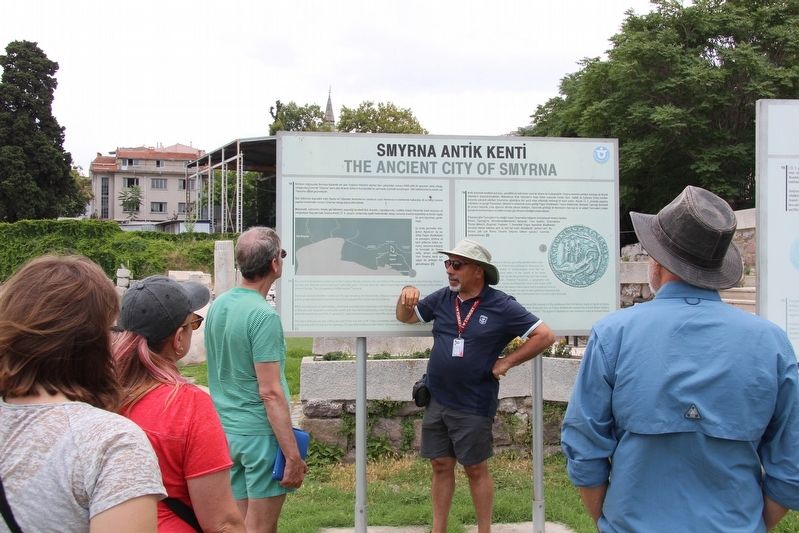
View of our group tour guide, standing in front of the featured marker, providing additional site related enhancements.
Erected by Izmir Chamber of Commerce.
Topics. This historical marker is listed in these topic lists: Parks & Recreational Areas • Settlements & Settlers.
Location. 38° 25.112′ N, 27° 8.315′ E. Marker is in Izmir, in Konak. It is in Yeni. It can be reached from Tarik Sari Sokagi close to Esrefpasa Cd., on the left when traveling east. This marker is situated in the Smyrna archaeological park, which is in a business/residential neighborhood. This particular marker is just inside the park, from the main entrance, and at the base of the entrance stairway, on the left, and is part of a cluster of markers. Touch for map. Marker is in this post office area: Izmir 35240, Turkiye. Touch for directions.

Regionally, this marker is in Turkish Asia Minor — Anatolia. Globally, it is in West Asia, Mesopotamia, and in a coastal Mediterranean country. Historically, it finds itself in what was once the Byzantine
Photographed by Dale K. Benington, June 16, 2018
3. The Ancient City of Smyrna Marker
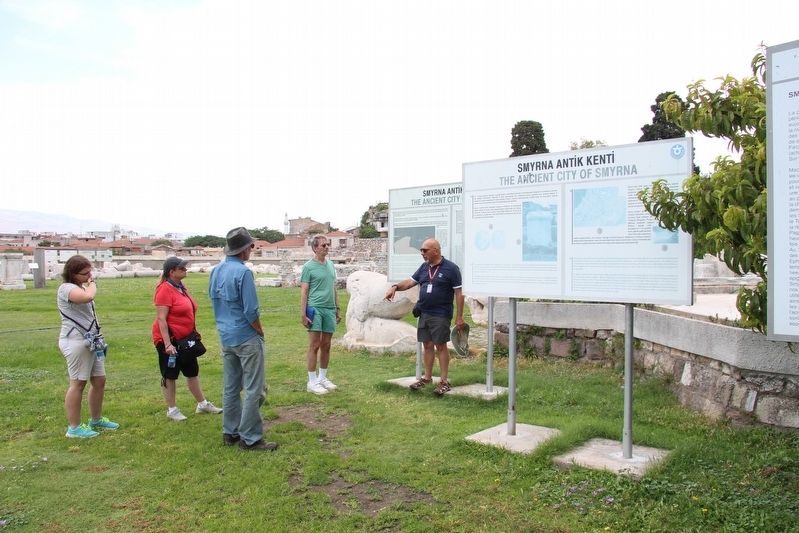
A distant view of our group tour guide, standing in front of the featured marker, explaining some of the historical background behind the ruins of ancient Smyrna.
Other nearby markers. At least 8 other markers are within walking distance of this marker: A different marker also named The Ancient City of Smyrna (here, next to this marker); The Agora of Smyrna (here, next to this marker); a different marker also named The Agora of Smyrna (a few steps from this marker); The West Portico (a few steps from this marker); Neocorus of the Cult of the Emperor at Smyrna (within shouting distance of this marker); Honorary Inscription (within shouting distance of this marker); Water Channels (within shouting distance of this marker); The Basement of the West Portico (within shouting distance of this marker). Touch for a list and map of all markers in Izmir.
Photographed by Dale K. Benington, June 16, 2018
4. The Ancient City of Smyrna Marker
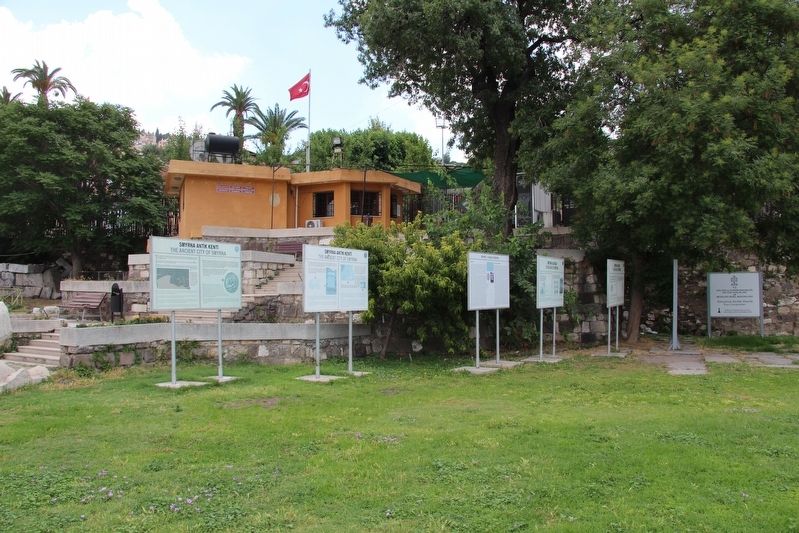
View of the featured marker (extreme left) situated in a cluster of markers, with a view of the entrance to the archaeological park on the high ground above the markers.
Photographed by Dale K. Benington, June 16, 2018
5. The Ancient City of Smyrna Marker
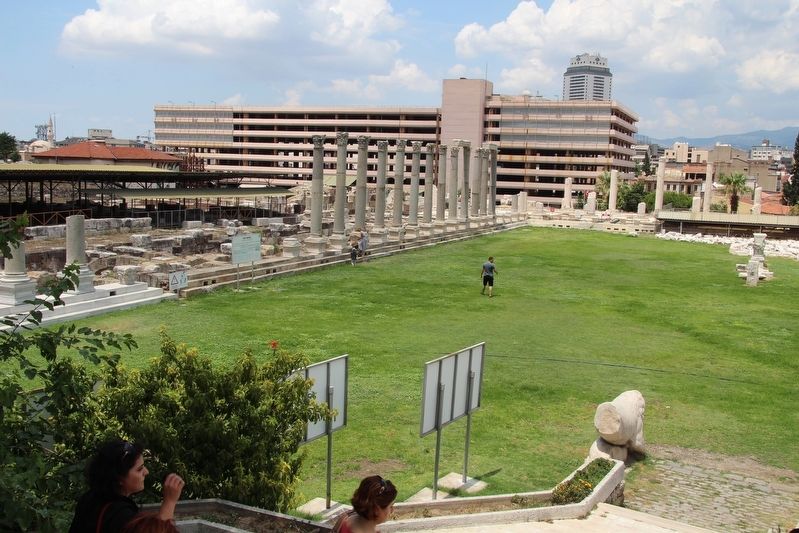
View of the backside of the marker (marker on right of two markers), as seen looking down from the main entrance, into the archaeological park.
Photographed by Dale K. Benington, June 16, 2018
6. The Ancient City of Smyrna Marker
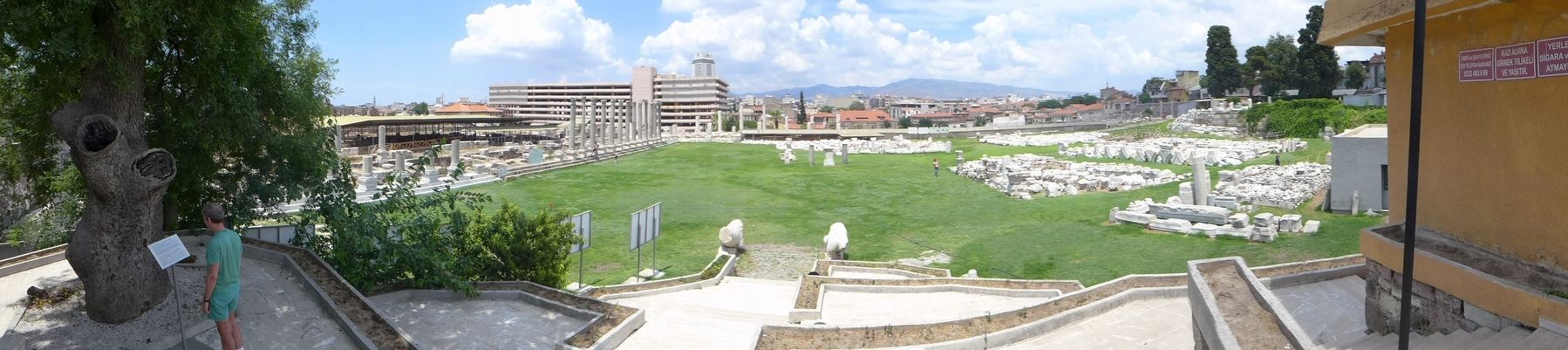
Panoramic view, as seen from the main entrance, of the archaeological park, along with the backside of the featured marker.
Photographed by Dale K. Benington, June 16, 2018
7. The Ancient City of Smyrna Marker
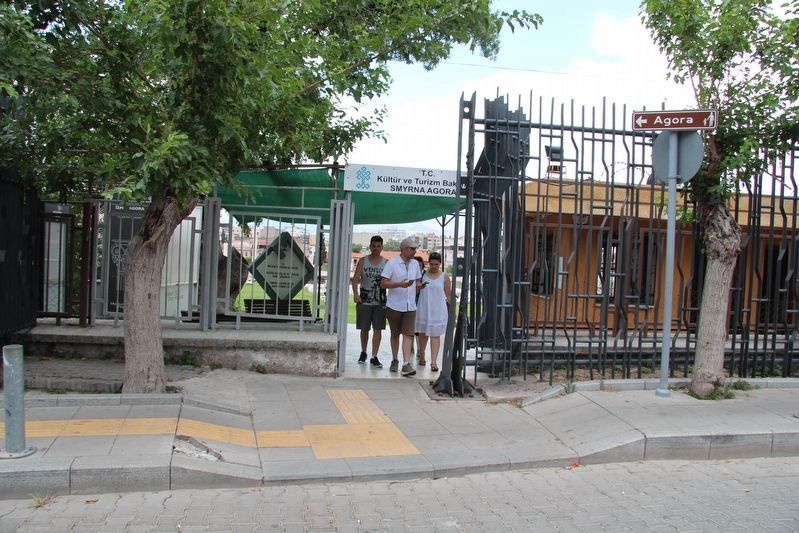
View of the street-side entrance to the archaeological park, with the featured marker being just inside of the entrance, at the base of the steps used by visitors upon first entering the park.
Credits. This page was last revised on February 13, 2023. It was originally submitted on July 3, 2018, by Dale K. Benington of Toledo, Ohio. This page has been viewed 481 times since then and 39 times this year. Photos: 1, 2, 3, 4, 5, 6, 7. submitted on July 3, 2018, by Dale K. Benington of Toledo, Ohio.
