Clinton in Laurens County, South Carolina — The American South (South Atlantic)
Providence Associate Reformed Presbyterian Church
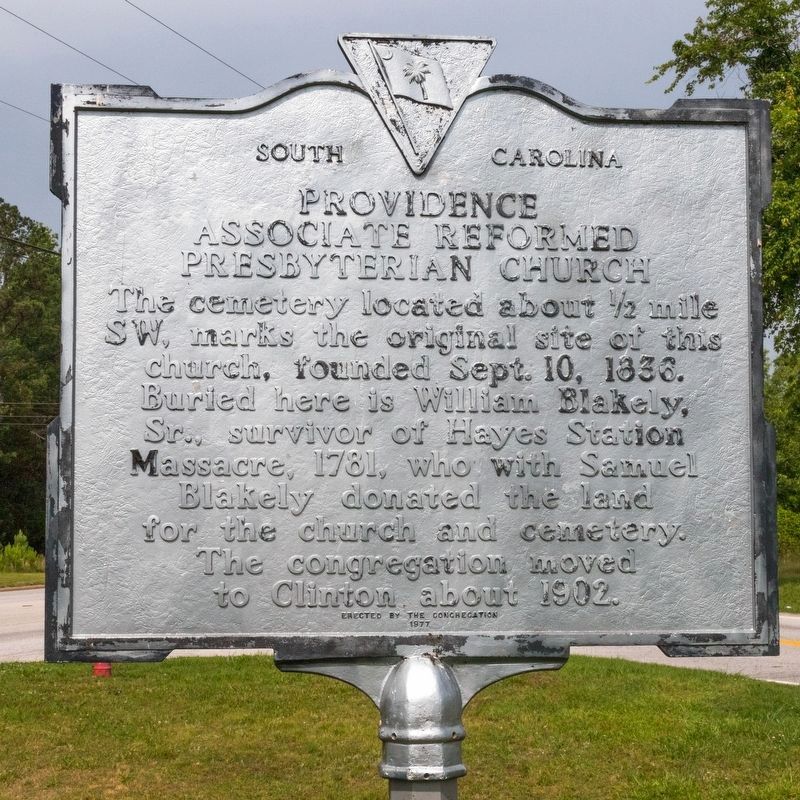
Photographed by J. J. Prats, May 19, 2025
1. Providence Associate Reformed Presbyterian Church Marker
Erected 1977 by Congregation of Providence Associate Reformed Presbyterian Church. (Marker Number 30-3.)
Topics. This historical marker is listed in these topic lists: Cemeteries & Burial Sites • Religion & Religious Structures • War, US Revolutionary. A significant historical date for this entry is September 10, 1941.
Location. 34° 28.171′ N, 81° 54.437′ W. Marker is in Clinton, South Carolina, in Laurens County. It is at the intersection of W C Dobbins Highway (U.S. 76) and A B Jacks Road (U.S. 76), on the right when traveling east on W C Dobbins Highway. Marker is located at the intersection of Ab Jacks Road and W.C. Dobbins Highway, about 1 mile west of Clinton, near the Copeland Shopping Plaza. Touch for map. Marker is at or near this postal address: 24824 US-76, Clinton SC 29325, United States of America. Touch for directions.

Regionally,
this page online
Other nearby markers. At least 10 other markers are within 2 miles of this marker, measured as the crow flies: William C. Dobbins Highway (about 300 feet away, measured in a direct line); a different marker also named Providence Associate Reformed Presbyterian Church (approx. 0.7 miles away); Bell Street School / Martha Dendy School (approx. 0.9 miles away); Friendship A.M.E. Church & Cemetery / Bell Street Schools (approx. 0.9 miles away); Malcolm A. MacDonald (approx. 1½ miles away); William Plumer Jacobs, D.D., LL.D. (approx. 1½ miles away); Henry Clinton Young (approx. 1½ miles away); Clinton Veterans Monument (approx. 1½ miles away); Clinton Confederate Monument (approx. 1.6 miles away); Broad Street Methodist Church (approx. 1.6
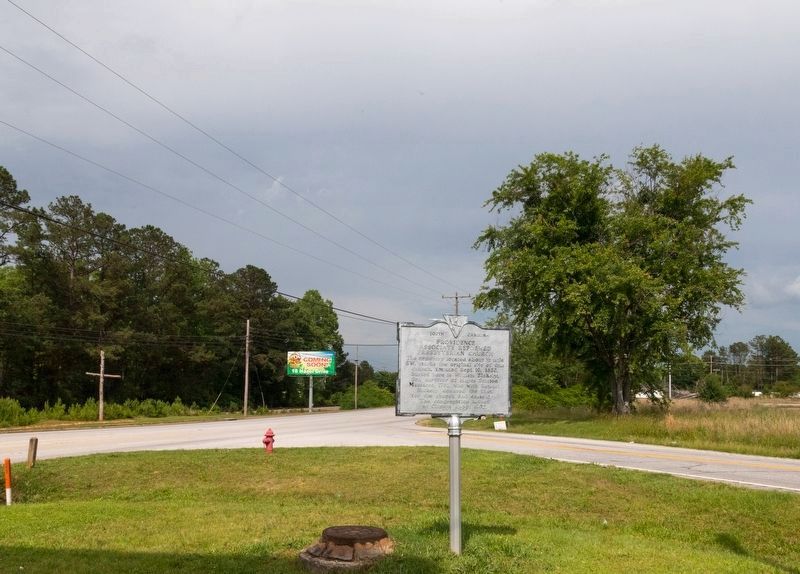
Photographed by J. J. Prats, May 19, 2025
2. Providence Associate Reformed Presbyterian Church Marker
Additional commentary.
1. About the Hayes Station Massacre
Located on land owned by the Laurens County Historical Association, the [site was the location] of a small American post known as Hayes Station. Named for its commander, Colonel Joseph Hayes, the post was garrisoned by forty Patriot soldiers.
In November 1781, following the Cloud's Creek Massacre, a communique was dispatched to Colonel Hayes informing him that Bloody Bill Cunningham was on a rampage in the area and ordering him to abandon his base.
Hayes had just returned from a scouting expedition on which he had found no evidence of Cunningham or his men. As a consequence, he decided to disregard the order and remain at his post. Word of his decision was sent to a nearby American installation in the event that aid might be needed.
Shortly thereafter, a group of Cunningham's marauders appeared at Hayes Station with a warning that if any shots were fired from the fort, all the Patriots there would die. No sooner had the words been spoken than a blast from a Patriot gun felled one of the Tories.
Presently,
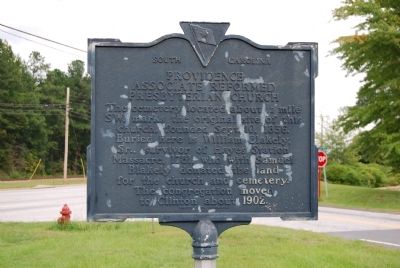
Photographed by Brian Scott, September 27, 2008
3. Providence Associate Reformed Presbyterian Church Marker
In its original colors back in 2008.
Wary because of Bloody Bill's lack of integrity and confident that Patriot reinforcements would arrive in time to chase the Tories away, Colonel Hayes refused to capitulate. A gunfight of several hours' duration ensued. To end the stalemate, Cunningham's men fired flaming ramrods onto the roof of the outpost. Fire quickly engulfed the building. Unable to breathe in the smoke-filled inferno, Colonel Hayes led his coughing and choking soldiers out with their hands in the air.
True to his promise, Bloody Bill promptly strung up Hayes and one of his men. But before the hanging was completed, the pole holding the rope gave way. As the two half-dead men gasped for air, Cunningham finished them with his sword.
Then Bloody Bill was told that one of the Patriot captives had taken part in the killing of Cunningham's brother. In an instant, the sword of the Tory commander impaled the hapless victim. Sated with personal revenge, Bloody Bill turned the remainder of the garrison over to his men, who delivered death sentences in a variety of ways. (Source: Touring South Carolina's Revolutionary War Sites by Daniel W. Barefoot (1999), pgs 162-163.)
— Submitted October 4, 2009, by Brian Scott of Anderson, South Carolina.
Credits. This page was last revised on July 5, 2025. It was originally submitted on October 3, 2008, by Brian Scott of Anderson, South Carolina. This page has been viewed 2,404 times since then and 50 times this year. Photos: 1, 2. submitted on July 5, 2025, by J. J. Prats of Powell, Ohio. 3. submitted on October 3, 2008, by Brian Scott of Anderson, South Carolina.
