
Bay City in Matagorda County, Texas — The American South (West South Central)
Matagorda County
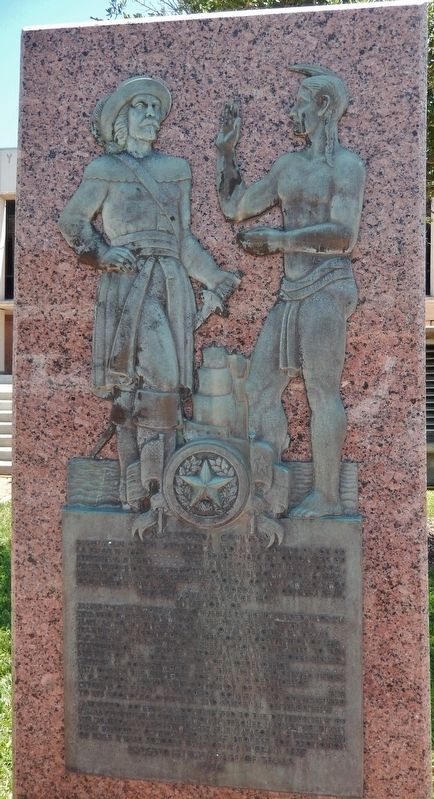
Photographed by Cosmos Mariner, May 15, 2018
1. Matagorda County Marker
Early home of the Karankawa Indians. Landing place of LaSalle in 1685. Settled 1822-1836 by colonists of Stephen F. Austin. The municipality of Matagorda organized under the Mexican Government on March 6, 1834. Became on March 17, 1836, Matagorda County, which was organized in July 1837. Matagorda, was the county seat, 1837-1894, Bay City since 1894.
Matagorda County has contributed to the development of Texas culture. The pioneer woman teacher Mary S. Wrightman Helms,1829; an early newspaper The Matagorda Bulletin, 1837; First Episcopal Church, 1839; first request for promotion of free school, that of Ira Ingram, 1837.
Erected 1936 by The State of Texas. (Marker Number 18864.)
Topics and series. This historical marker is listed in these topic lists: Indigenous Peoples and Communities • Settlements & Settlers • War, Texas Independence. In addition, it is included in the Texas 1936 Centennial Markers and Monuments series list.
Location. 28° 58.972′ N, 95° 58.178′ W. Marker is in Bay City, Texas, in Matagorda County. It is on 7th Street (State Highway 35) east of Avenue F (State Highway
this page online

Regionally, this marker is in the American South and on the Gulf Coast. Globally, it is in North America, a Gulf of Mexico state, the Western Hemisphere, the Western World, and the Anglosphere. Historically, it finds itself in what was once New Spain, the Republic of Texas, one of the Confederate States of America, and the Antebellum South.
Other nearby markers. At least 8 other markers are within walking distance of this marker: Matagorda County Veterans War Memorial (a few steps from this marker); Ira Ingram (within shouting distance of this marker); a different marker also named Matagorda County (within shouting distance of this marker); Bay City Post Office (within shouting distance of this marker); Sugar Cane Mill (within shouting distance of this marker); Old Bay City Bank (within shouting distance of this marker); Bouldin Building (within shouting distance
Photographed by Cosmos Mariner, May 15, 2018
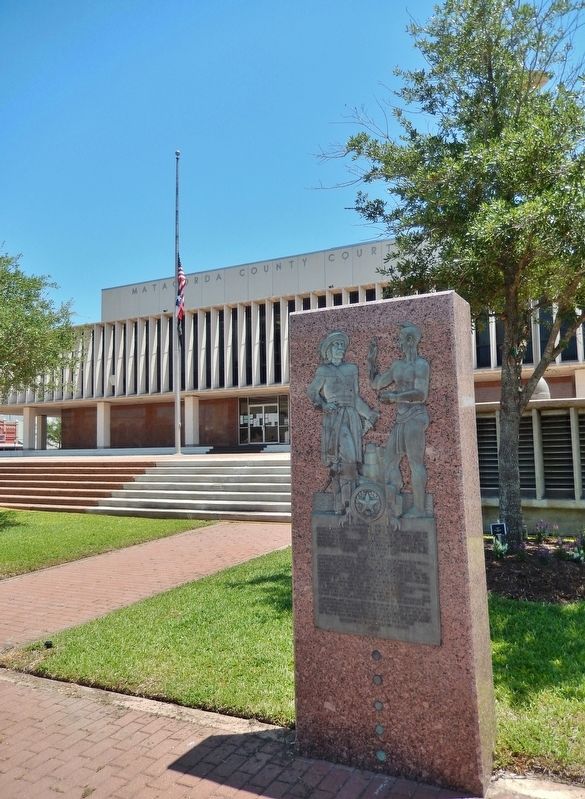
2. Matagorda County Marker (tall view)
More about this marker. Marker is a large metal plaque mounted on a large, 5-foot tall polished granite monument stone. Top half of marker features a bas-relief sculpture of Robert de La Salle and a Karankawa. Marker is significantly weathered and difficult to read.
Also see . . .
1. The Karankawa Indians. The Karankawa Indians lived along the Texas coast of the Gulf of Mexico. Their territory was from the west end of Galveston Island down the coast to where Corpus Christi is today. By the time American settlers came in contact with the Karankawa the Karankawa had already had some pretty bad experiences with Europeans. Early on, Spanish slave traders cruised along the coast of Texas and they would kidnap Karankawas by force or trickery and make slaves out of them. Later, the French, under the explorer LaSalle, were very unfriendly. From the Karankawa's point of view, every time the Europeans came around, the Europeans would try to steal from, kidnap, or kill the Karankawa.
Photographed by Cosmos Mariner, May 15, 2018
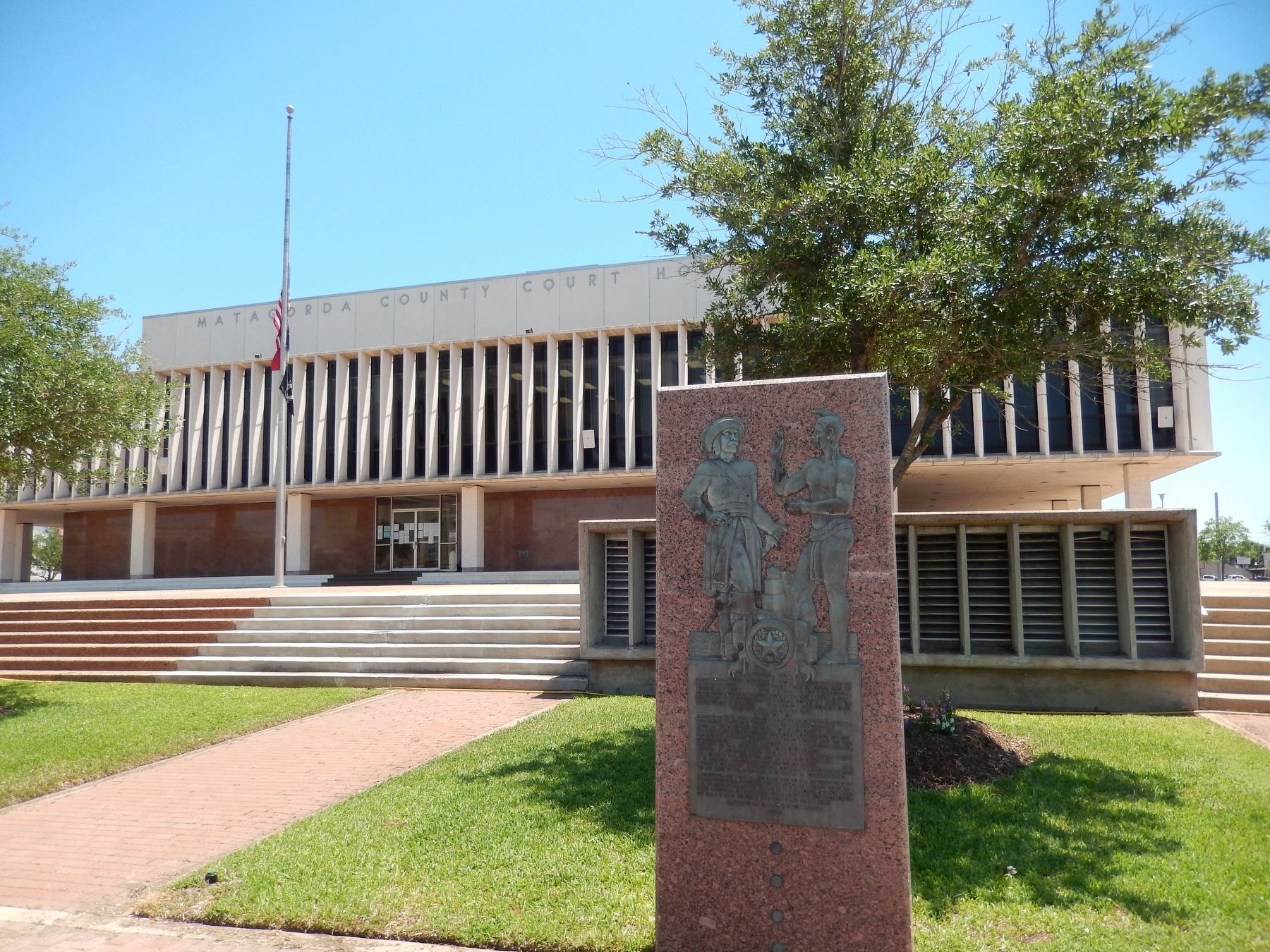
3. Matagorda County Marker (wide view; Matagorda County Courthouse in background)
2. La Salle Lands in Texas. In April 1682 the expedition of Rene Robert Cavelier, Sieur de La Salle, reached the mouth of the Mississippi River. Such a feat of exploration should have resulted in the correct cartographic placement of the mighty river, yet in 1684 when he was to return to the mouth of the Mississippi, his expedition landed over four hundred miles west in Matagorda Bay of present-day Texas. La Salle's foray brought East Texas into the conflicting world of European imperial and colonial politics, (Submitted on May 17, 2018, by Cosmos Mariner of Cape Canaveral, Florida.)
3. Austin's Colony. Austin's Colony was the first legal settlement of North American families in Mexican-owned Texas. Led by Stephen F. Austin, an initial grant for three hundred families --the "Old 300"-- in 1821 opened up Texas to a flood of American immigrants, as many as 30,000 by the time of the Texas Revolution in 1835. This colonial period that brought Anglo and African settlers from the United States into contact with the governmental and ranching traditions of Spain and Mexico helped set the course for much of Texas' history in the 19th century -- and was only overshadowed later by the discovery of oil in Texas in the 20th century. (Submitted on May 17, 2018, by Cosmos Mariner of Cape Canaveral, Florida.)
4. Mary Sherwood Wightman Helm. She began teaching at the age of sixteen and was teaching in a district school when she became reacquainted with her former teacher, Elias R. Wightman, who had recently returned from working as a surveyor for Stephen F. Austin in Texas. After a short courtship the two were married. The Wightmans gathered a group of approximately fifty colonists, a majority from New York, and on November 2, 1828, set out for Texas. They founded Matagorda, where they owned a salt works and much of the surrounding land. (Submitted on May 26, 2018, by Cosmos Mariner of Cape Canaveral, Florida.)
Credits. This page was last revised on July 24, 2018. It was originally submitted on May 17, 2018, by Cosmos Mariner of Cape Canaveral, Florida. This page has been viewed 781 times since then and 45 times this year. Last updated on July 24, 2018, by Brian Anderson of New Albany, Ohio. Photos: 1, 2, 3. submitted on May 17, 2018, by Cosmos Mariner of Cape Canaveral, Florida. • Andrew Ruppenstein was the editor who published this page.
