
Gettysburg in Adams County, Pennsylvania — The American Northeast (Mid-Atlantic)
Temples of Mercy
Photographed by Craig Swain, April 4, 2009
1. Temples of Mercy Marker

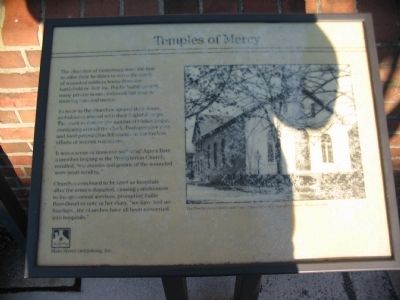
The churches of Gettysburg were the first to offer their facilities to serve the needs of wounded soldiers borne from the battlefield on July 1st. Public buildings and many private homes followed the lead in showing care and mercy.
As soon as the churches opened their doors, ambulances arrived with their fightful cargo. The work to restore the mutilated bodies began, continuing around the clock. Postoperative care and food preparation fell mainly to the tireless efforts of women volunteers.
It was a scene of immense suffering! Agnes Barr, a member helping at the Presbyterian Church, recalled, "the shrieks and groans of the wounded were heart rending."
Churches continued to be used as hospitals after the armies departed, causing parishioners to forego normal services, prompting Sallie Broadhead to note in her diary, "we have had no Sundays...the churches have all been converted into hospitals."
Erected by Main Street Gettysburg. (Marker Number 30.)
Topics and series. This historical marker is listed in this topic list: War, US Civil. In addition, it is included in the American Presbyterian and Reformed Historic Sites,
this page online
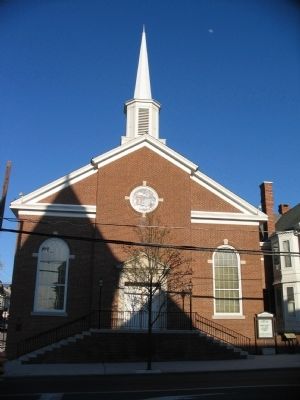
Location. This marker has been replaced by another marker nearby. It was located near 39° 49.701′ N, 77° 13.859′ W. Marker was in Gettysburg, Pennsylvania, in Adams County. It was at the intersection of Baltimore Street (Business U.S. 15) and East High Street, on the right when traveling north on Baltimore Street. The marker stands in front of the Gettysburg Presbyterian Church. Touch for map. Marker was at or near this postal address: 208 Baltimore Street, Gettysburg PA 17325, United States of America. Touch for directions.

Regionally, this marker was in South-Central Pennsylvania. It was also in the American Northeast, in the Mid-Atlantic, in Appalachia, and specifically in Northern Appalachia. Globally, it was in North America, the Western Hemisphere, the Western World, and the Anglosphere. Historically, it found itself in what was once the Haudenosaunee (Iroquois) Confederacy and also one of the original Thirteen Colonies.
Other nearby markers. At least 8 other
Photographed by Craig Swain, April 4, 2009
2. Presbyterian Church
The marker is on the right near the church message board.
More about this marker. On the right side of the marker is a photo of the church as it appeared around 1880. (Caption is rather worn and hard to read.)
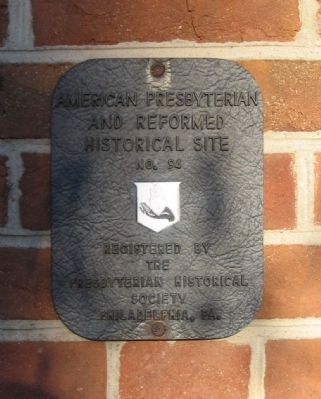
Regarding Temples of Mercy. Gettysburg Presbyterian Church is one of 445 American Presbyterian and Reformed Historical Sites registered between 1973 and 2003 by the Presbyterian Historical Society (PHS), headquartered in Philadelphia. Approved sites received a metal plaque featuring John Calvin’s seal and the site’s registry number (PHS marker location in front
Photographed by Craig Swain, April 4, 2009
3. American Presbyterian and Reformed Historical Site
The church is listed by the Presbyterian Historical Society as historical site number 94.
The following text is taken from the Presbyterian Historical Society website:
The Presbytery of Donegal recorded a church at Marsh Creek as early as 1740. The congregation of the Upper Presbyterian Church of Marsh Creek was incorporated on September 13, 1787. The congregation voted to move the church to the nearby town of Gettysburg in 1813. In 1842, the first building on the present site was erected. In 1968, the entire structure had to be replaced, but the design is similar to the original. The name of the church was changed to Presbyterian Church of Gettysburg in 1868. Abraham Lincoln worshipped in the church after dedicating the National Cemetery on November 19, 1863, and Dwight D. Eisenhower became a member of the congregation after leaving office in 1961.
Related marker. Click here for another marker that is related to this marker. To better understand the relationship, study each marker in the order shown.
Credits. This page was last revised on November 14, 2026. It was originally submitted on May 22, 2009, by Craig Swain of Leesburg, Virginia. This page has been viewed 1,197 times since then and 56 times this year. Last updated on August 24, 2018, by Douglass Halvorsen of Klamath Falls, Oregon. Photos: 1, 2, 3. submitted on May 22, 2009, by Craig Swain of Leesburg, Virginia. • Andrew Ruppenstein was the editor who published this page.
