Kross Keys in Polk County, North Carolina — The American South (South Atlantic)
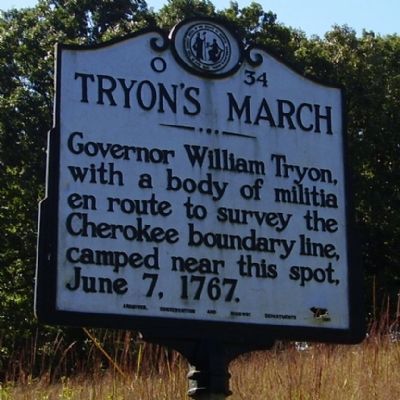
Tryon's March
Photographed by Stanley and Terrie Howard, October 4, 2008
1. Tryon's March Marker
Erected 1951 by Archives, Conservation and Highway Departments. (Marker Number O-34.)
Topics and series. This historical marker is listed in these topic lists: Colonial Era • Indigenous Peoples and Communities. In addition, it is included in the North Carolina Division of Archives and History series list. A significant historical month for this entry is June 1931.
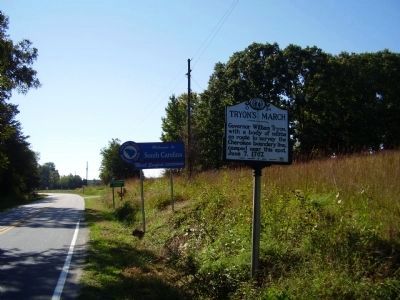
Location. 35° 11.385′ N, 82° 2.907′ W. Marker is in Kross Keys, North Carolina, in Polk County. It is on State Highway 9, on the right when traveling south. Just north of the North Carolina and South Carolina state line. Touch for map. Marker is in this post office area: Columbus NC 28722, United States of America. Touch for directions.

Regionally, this marker is in North Carolina’s Mountains. It is also in the American South, specifically in the Upper South, in Appalachia, and specifically in Southern Appalachia. Globally, it is in North America, the Western Hemisphere, the Western World, and the Anglosphere. Historically,
this page online
Other nearby markers. At least 8 other markers are within 6 miles of this marker, measured as the crow flies: North Carolina / South Carolina (a few steps from this marker); Ibra Charles Blackwood (within shouting distance of this marker in South Carolina); Little Africa (approx. 1.9 miles away in South Carolina); New Prospect Baptist Church (approx. 4.1 miles away in South Carolina); James F. Byrnes Memorial Freeway (approx. 5 miles away in South Carolina); The Battle of Earle’s Ford (approx. 5.4 miles away in South Carolina); Lake Bowen (approx. 5½ miles away in South Carolina); Earle's Ford and Fort (approx. 5.9 miles away in South Carolina).
Another marker is no longer nearby. Battle of Earle's Ford (was approx. 5.4 miles away in South Carolina but has been confirmed missing).
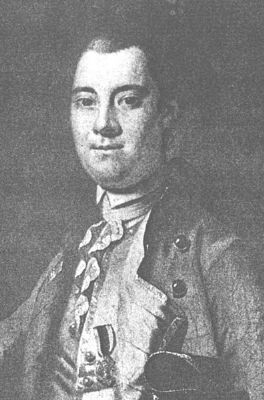
Regarding Tryon's March. William Tryon (1729–88) was an English colonial governor in North America. After a distinguished army
Photographed by Stanley and Terrie Howard, October 4, 2008
2. Tryon's March Marker
In 1771 he was appointed governor of New York, and at the outbreak of the American Revolution he was forced to remain on a British ship in the harbor. Tryon returned to power when William Howe took the city (1776), and later (1777, 1779) he led Tory raids in Connecticut.
October 4, 2008
3. William Tryon
Credits. This page was last revised on February 2, 2025. It was originally submitted on October 8, 2008, by Stanley and Terrie Howard of Greer, South Carolina. This page has been viewed 1,244 times since then and 26 times this year. Photos: 1, 2. submitted on October 8, 2008, by Stanley and Terrie Howard of Greer, South Carolina. 3. submitted on October 9, 2008, by Stanley and Terrie Howard of Greer, South Carolina. • Kevin W. was the editor who published this page.
