Mammoth in Yellowstone National Park in Park County, Wyoming — The American West (Mountains)
Obsidian Cliff
Volcanic Glass
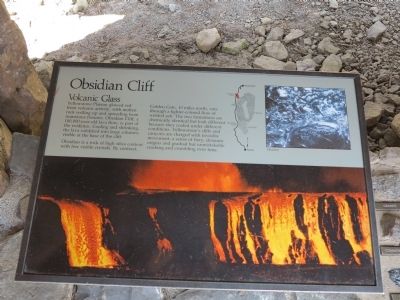
Photographed by Richard Denney, May 10, 2015
1. Obsidian Cliff Marker
Obsidian is a rock of high silica content with few visible crystals. By contrast, Golden Gate, 10 miles north, cuts through a lighter-colored flow of welded ash. The two formations are chemically identical but look different because they cooled under different conditions. Yellowstone's cliffs and canyons are charged with invisible movement: a sense of fiery, dynamic origin and gradual but unmistakable cracking and crumbling over time.
Topics. This historical marker is listed in these topic lists: Indigenous Peoples and Communities • Notable Places.
Location. 44° 49.44′ N, 110° 43.752′ W. Marker is in Yellowstone National Park, Wyoming, in Park County. It is in Mammoth. It is on Grand Loop Road (U.S. 89), on the right when traveling south. Marker is located about 11 miles south of Mammoth
this page online

Regionally, this marker is in the Bighorn Basin and in Greater Yellowstone. It is also in the American Mountain West and in the Lewis & Clark Corridor. Globally, it is in North America, the Rocky Mountains, the Western Hemisphere, the Western World, and the Anglosphere.
Other nearby markers. At least 8 other markers are within 7 miles of this marker, measured as the crow flies: Roaring Mountain (approx. 3 miles away); Fumaroles (approx. 3 miles away); Sheepeater Cliff (approx. 4.7 miles away); Norris Soldier Station (approx. 6.3 miles away); Living Thermometer (approx. 6.7 miles away); Porcelain Springs (approx. 6.8 miles away); Norris Geyser Basin (approx. 6.8 miles away); a different marker also named Fumaroles (approx. 6.8 miles away). Touch for a list and map of all markers in Yellowstone National Park.
Also see . . . Obsidian Cliff, Prehistoric Lithic Quarry - Wikipedia Article. Obsidian Cliff was an important source of obsidian, prized by Native Americans
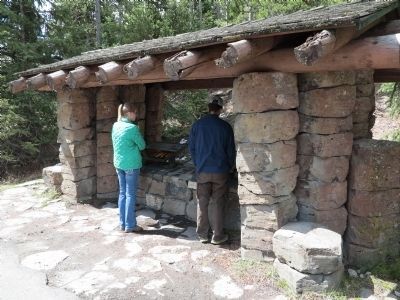
Photographed by Richard Denney, May 10, 2015
2. Obsidian Cliff Marker
Marker is housed in a shelter built in 1931, one of the first wayside exhibit shelters in the National Park system.
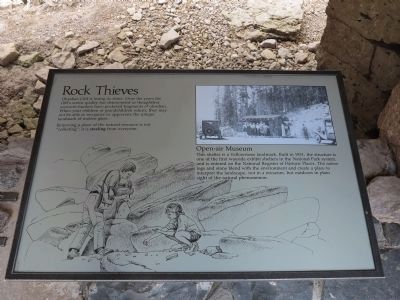
Photographed by Richard Denney, May 10, 2015
3. Obsidian Cliff Marker
Open-air Museum. This shelter is a Yellowstone landmark. Built in 1931, the structure is one of the first wayside exhibit shelters in the National Park System, and is entered on the National Register of Historic Places. The native logs and stone blend with the environment and create a place to interpret the landscape, not in a museum, but outdoors in plan sight of the natural phenomenon.
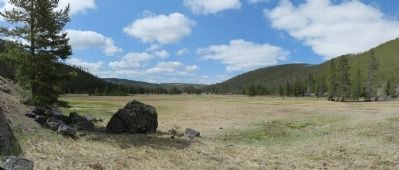
Photographed by Richard Denney
4. Valley Floor
View of obsidian boulders, and valley floor at the base of Obsidian Cliff, looking south. On maps this is known as Beaver Lake. Old photos from 1800s shows what the area looked like with water.
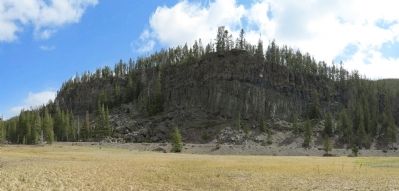
Photographed by Richard Denney
5. Obsidian Cliff
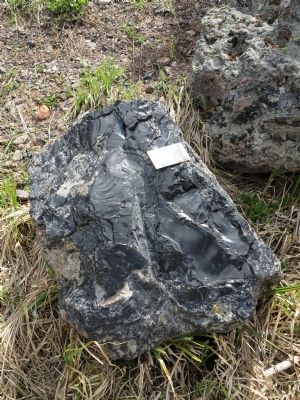
Photographed by Richard Denney, May 10, 2015
6. Obsidian Boulder
Photo of an obsidian boulder near the cliff. Credit card provides context for size.
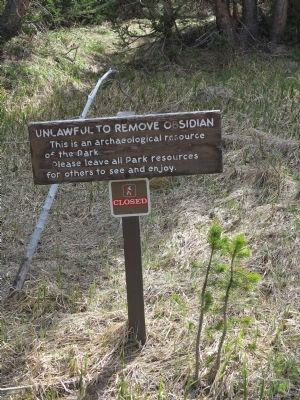
Photographed by Richard Denney, May 10, 2015
7. Collection of Obsidian is Unlawful
A sign reminds visitors that collecting obsidian from this archeological site is unlawful. Access to the cliff itself has been closed because of looting of obsidian.
Credits. This page was last revised on February 16, 2023. It was originally submitted on May 23, 2015, by Richard Denney of Austin, Texas. This page has been viewed 1,286 times since then and 63 times this year. Last updated on September 16, 2018, by Craig Baker of Sylmar, California. Photos: 1, 2, 3, 4, 5, 6, 7. submitted on May 23, 2015, by Richard Denney of Austin, Texas. • Bill Pfingsten was the editor who published this page.
