Fort Pierre in Stanley County, South Dakota — The American Midwest (Upper Plains)
American Indians and the Fur Trade
Photographed by Cosmos Mariner, August 18, 2016
1. American Indians and the Fur Trade Marker
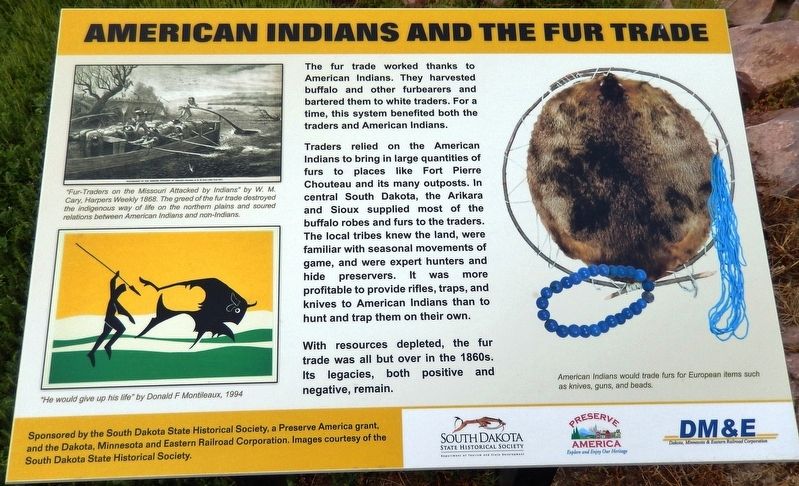
The fur trade worked thanks to American Indians. They harvested buffalo and other furbearers and bartered them to white traders. For a time, this system benefited both the traders and American Indians.
Traders relied on the American Indians to bring in large quantities of furs to places like Fort Pierre Chouteau and its many outposts. In central South Dakota, the Arikara and Sioux supplied most of the buffalo robes and furs to the traders. The local tribes knew the land, were familiar with seasonal movements of game, and were expert hunters and hide preservers. It was more profitable to provide rifles, traps, and knives to American Indians than to hunt and trap them on their own.
American Indians would trade furs for European items such as knives, guns, and beads. With resources depleted, the fur trade was all but over in the 1860s. Its legacies, both positive and negative, remain.
Images courtesy of the South Dakota State Historical Society.
Erected by The South Dakota
this page online
Topics. This historical marker is listed in these topic lists: Indigenous Peoples and Communities • Industry & Commerce.
Location. 44° 22.042′ N, 100° 22.305′ W. Marker is in Fort Pierre, South Dakota, in Stanley County. It can be reached from Island Drive 0.3 miles south of U.S. 83, on the right when traveling north. Marker is located along the river walk, east of Island Drive, overlooking the Missouri River. Touch for map. Marker is at or near this postal address: 312 Island Drive, Fort Pierre SD 57532, United States of America. Touch for directions.

Regionally, this marker is in the Crow Creek Sioux Tribe and in East River. It is also in the American Lewis & Clark Corridor, on the prairies, and on the Northern Plains. Globally, it is in North America, the Western Hemisphere, the Western World, and the Anglosphere. Historically, it finds itself in what was once Rupert’s Land and also the Louisiana Purchase.
Other nearby markers. At least 8 other markers
Sketch by W M. Cary, Harpers Weekly 1868
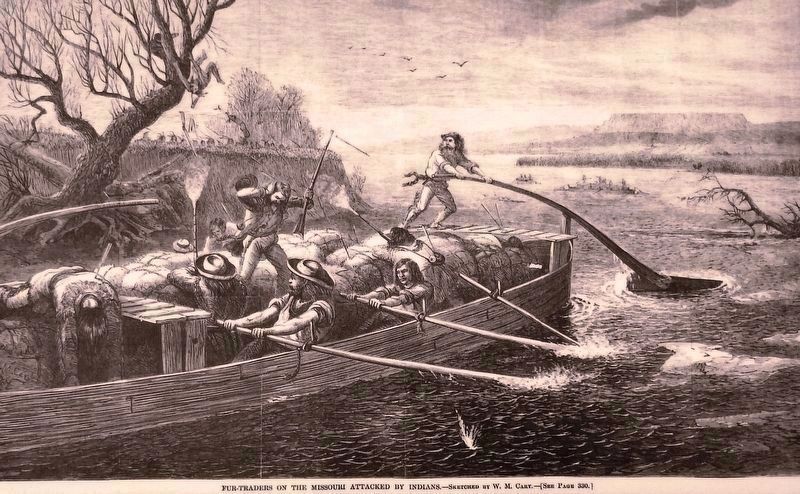
2. Marker detail: Fur-traders on the Missouri attacked by Indians
The greed of the fur trade destroyed the indigenous way of life on the northern plains and soured relations between American Indians and non-Indians.
More about this marker. Marker is a large composite plaque, mounted horizontally on waist-high posts.
Also see . . .
1. American Fur Trade. The Fur Trapper website homepage:
Native American Indians were the major source of beaver pelts and buffalo hides, for the Canadian, Great Lakes, and upper Missouri River fur trade from the late 17th to the early 19th century. During most of this period, Native Americans used nets, snares, deadfalls, clubs, etc. to obtain beaver pelts. At a New York fur auction, John Jacob Astor sold upwards of half a million muskrat pelts in one day. Mountaineers, Indians, and the early settlers traded
Photographed by Cosmos Mariner, August 18, 2016
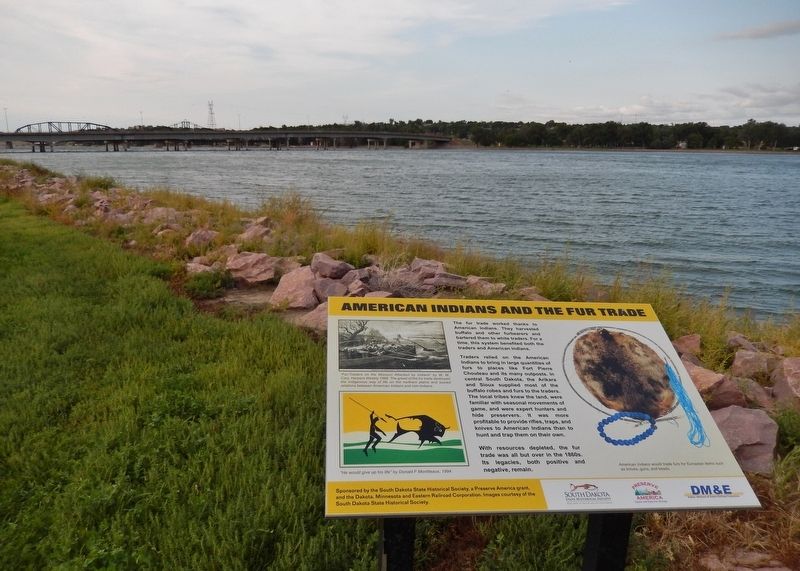
3. American Indians and the Fur Trade Marker (wide view; looking north across Missouri River)
2. Fort Pierre Chouteau, South Dakota – Largest Trading Post on the Great Plains. Legends of America website entry (Submitted on June 17, 2024, by Larry Gertner of New York, New York.)
Credits. This page was last revised on June 17, 2024. It was originally submitted on October 5, 2018, by Cosmos Mariner of Cape Canaveral, Florida. This page has been viewed 584 times since then and 40 times this year. Photos: 1, 2, 3. submitted on October 7, 2018, by Cosmos Mariner of Cape Canaveral, Florida. • Andrew Ruppenstein was the editor who published this page.
