Cabin John in Montgomery County, Maryland — The American Northeast (Mid-Atlantic)
The Lock-Keepers
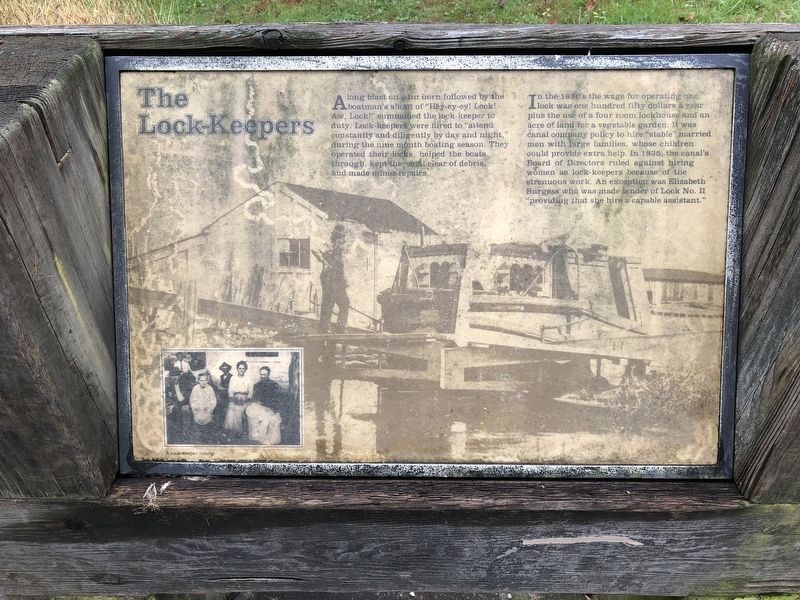
In the 1830's the wage for operating one lock was one hundred fifty dollars a year plus the use of a four room lockhouse and an acre of land for a vegetable garden. It was canal company policy to hire "stable" married men with large families, whose children could provide extra help. In 1835, the canal's Board of Directors ruled against hiring women as lock-keepers because of the strenuous work. An exception was Elizabeth Burgess who was made tender of Lock No. 11 "providing that she hire a capable assistant."
Erected by National Park Service, U.S. Department of the Interior.
Topics and series. This historical marker is listed in these topic lists: Industry & Commerce • Waterways & Vessels • Women. In addition, it is included in the Chesapeake and Ohio (C&O) Canal
this page online
Location. 38° 58.333′ N, 77° 10.308′ W. Marker is in Cabin John, Maryland, in Montgomery County. It can be reached from Clara Barton Parkway 2 miles east of Capital Beltway Inner Loop (Interstate 495), on the right. Touch for map. Marker is at or near this postal address: 6410 83rd Place, Cabin John MD 20818, United States of America. Touch for directions.

Regionally, this marker is in the Washington Metropolitan Area. It is also in the American Mid-Atlantic. Globally, it is in North America, the Western Hemisphere, the Western World, and the Anglosphere. Historically, it finds itself in what was once one of the original Thirteen Colonies and also the Antebellum South.
Other nearby markers. At least 8 other markers are within 2 miles of this marker, measured as the crow flies: Swing-Gate Locks (here, next to this marker); Drop Gate Locks (approx. 0.2 miles away); At All Hours (approx. 0.2 miles away); Lockhouse 10 (approx. 0.2 miles away); "…an extravagant expression of Victorian romanticism." (approx. 1.2 miles away); "The best scenery lies beyond the city, especially in the neighborhood of Cabin John Creek…"
Photographed by Devry Becker Jones (CC0), October 20, 2018
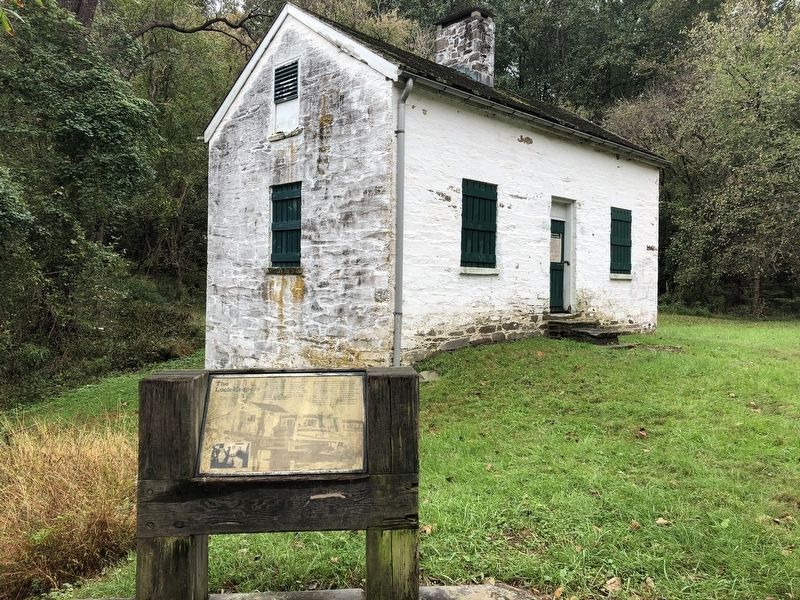
2. The Lock-Keepers Marker with Lockkeeper's House in the background
Photographed by Devry Becker Jones (CC0), October 20, 2018
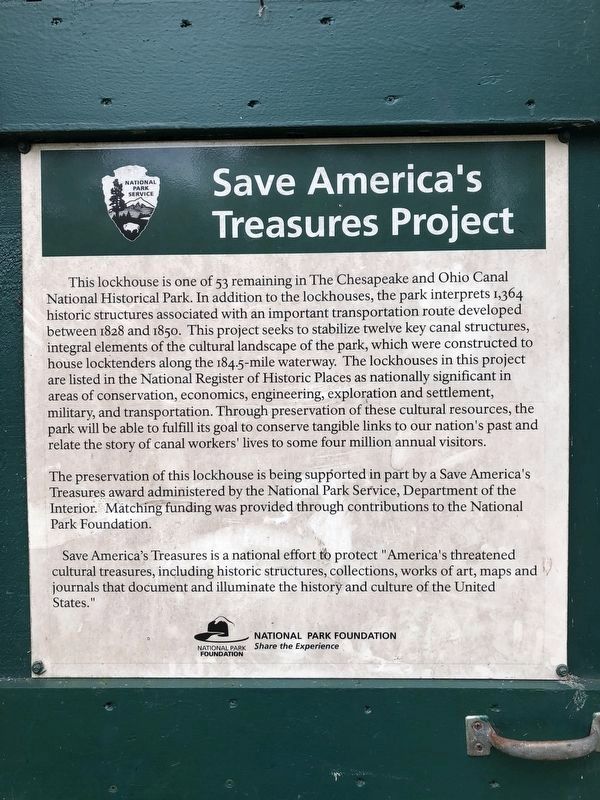
3. Sign on the front of the Lockkeeper's House
This lockhouse is one of 53 remaining in The Chesapeake and Ohio Canal National Historical Park. In addition to the lockhouses, the park interprets 1,364 historic structures associated with an important transportation route developed between 1828 and 1850. This project seeks to stabilize twelve key canal structures, integral elements of the cultural landscape of the park, which were constructed to house locktenders along the 184.5-mile waterway. The lockhouses in this project are in the National Register of Historic Places as nationally significant in areas of conservation, economics, engineering, exploration and settlement, military, and transportation. Through preservation of these cultural resources, the park will be able to fulfill its goal to conserve tangible links to our nation's past and relate the story of canal workers' lives to some four million annual visitors.
The preservation of this lockhouse is being supported in part by a Save America's Treasures award administered by the National Park Service, Department of the Interior. Matching funding was provided through contributions to the National Park Foundation.
Save America's Treasures is a national effort to protect "America's threatened cultural treasures, including historic structures, collections, works of art, maps and journals that document and illuminate the history and culture of the United States."
National Park Foundation
Share the Experience
Credits. This page was last revised on September 22, 2019. It was originally submitted on October 20, 2018, by Devry Becker Jones of Washington, District of Columbia. This page has been viewed 622 times since then and 41 times this year. Photos: 1, 2, 3. submitted on October 20, 2018, by Devry Becker Jones of Washington, District of Columbia. • Andrew Ruppenstein was the editor who published this page.
