St. Augustine in St. Johns County, Florida — The American South (South Atlantic)
Escape & Flight
| — | Fort Mose Historic State Park | — |
Photographed by Cosmos Mariner, December 10, 2014
1. Escape & Flight Marker
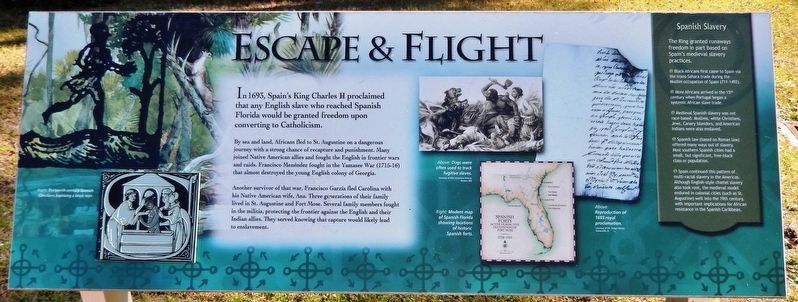
By sea and land, Africans fled to St. Augustine on a dangerous journey with a strong chance of recapture and punishment. Many joined Native American allies and fought the English in frontier wars and raids. Francisco Menéndez fought in the Yamasee War (1715-16) that almost destroyed the young English colony of Georgia.
Another survivor of that war, Francisco Garzia fled Carolina with his Native American wife, Ana. Three generations of their family lived in St. Augustine and Fort Mose. Several family members fought in the militia, protecting the frontier against the English and their Indian allies. They served knowing that capture would likely lead to enslavement.
(sidebar)
Spanish Slavery
The King granted runaways freedom in part based on Spain's medieval slavery practices.
• Black Africans first came to Spain via the trans-Sahara trade during the Muslim occupation of Spain (711-1492).
• More Africans arrived in the 15th century when Portugal began a systemic
this page online
• Medieval Spanish slavery was not race-based. Muslims, white Christians, Jews, Canary Islanders, and American Indians were also enslaved.
• Spanish law (based on Roman law) offered many ways out of slavery. Most southern Spanish cities had a small, but significant, free-black class or population.
• Spain continued this pattern of multi-racial slavery in the Americas. Although English-style chattel slavery also took root, the medieval model endured in colonial cities (such as St. Augustine) well into the 19th century, with important implications for African resistance in the Spanish Caribbean.
Erected by Fort Mose Historic State Park.
Topics. This historical marker is listed in these topic lists: African Americans • Colonial Era • Forts and Castles • Indigenous Peoples and Communities. A significant historical year for this entry is 1693.
Location. 29° 55.723′ N, 81° 19.515′ W. Marker is in St. Augustine, Florida, in St. Johns County. It is on Fort Mose Trail 0.2 miles east of North Ponce De Leon Boulevard (U.S. 1), on the right when traveling north. Marker located in Fort Mose Historic State
Courtesy of Afro-American History, Boston, MA
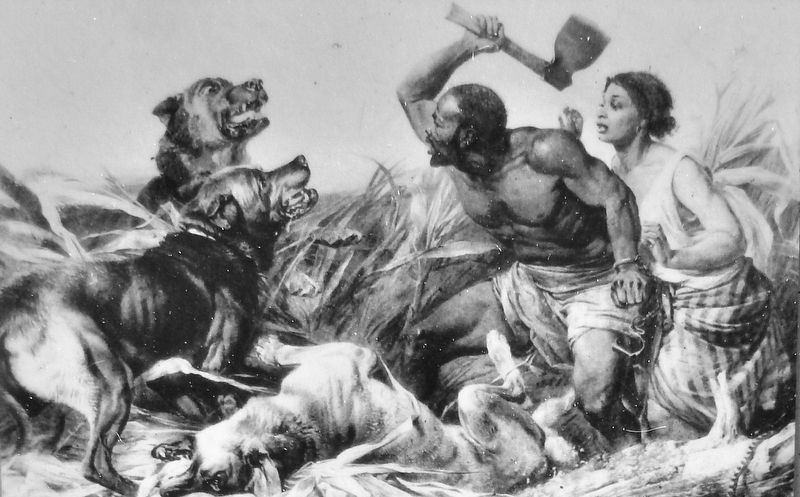
2. Marker detail: Dogs were often used to track fugitive slaves

Regionally, this marker is in First Coast and in Greater Jacksonville. It is also in the American South and on the Eastern Seaboard. Globally, it is in the North Atlantic Region, North America, a Gulf of Mexico state, the Western Hemisphere, the Western World, and the Anglosphere. Historically, it finds itself in what was once New Spain, the territory of the Mississippian Culture, one of the Confederate States of America, and the Antebellum South.
Other nearby markers. At least 8 other markers are within walking distance of this marker: El Pueblo de Gracia Real de Santa Teresa de Mose (a few steps from this marker); Bloody Mose (a few steps from this marker); Fort Mose Site (within shouting distance of this marker); Women of Fort Mose (within shouting distance of this marker); Barca Chata (about 300 feet away, measured in a direct line); On Watch (about 300 feet away); “Slave Catchers” (about
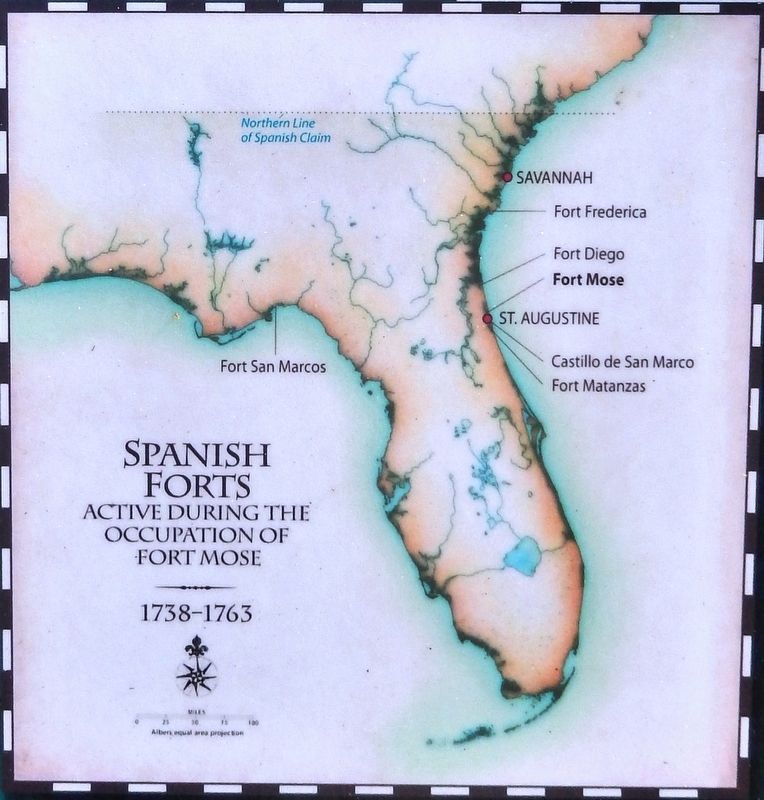
3. Marker detail: Map of Spanish Florida showing locations of historic Spanish forts
Other markers no longer nearby. British Enslavement (was a few steps from this marker but has been permanently removed); Fort Mose I (was a few steps from this marker but has been permanently removed); Middle Passage (was a few steps from this marker but has been permanently removed); African Origins (was within shouting distance of this marker but has been permanently removed); Fort Mose II (was within shouting distance of this marker but has been permanently removed); Evacuation (was within shouting distance of this marker but has been permanently removed).
Related markers. Click here for a list of markers that are related to this marker. Fort Mose Historic State Park
Also see . . .
1. Francisco Menéndez. Born in Africa, Francisco Menéndez was brought to America as a slave in the early 1700s. He escaped and fled from the British territories in 1724 to St. Augustine, Florida, which was then controlled by the Spanish. After converting to Catholicism and agreeing to join the St. Augustine militia,
Photographed by Cosmos Mariner, December 10, 2014
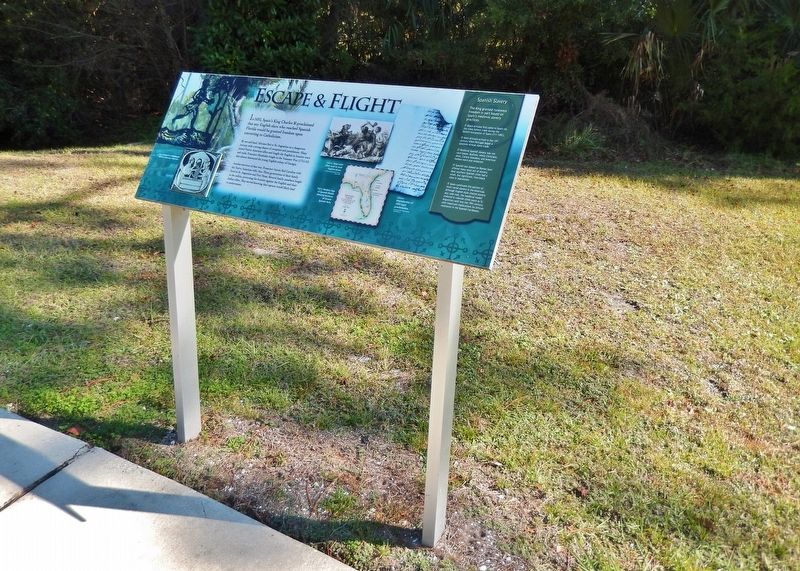
4. Escape & Flight Marker (wide view)
2. Gracia Real de Santa Teresa de Mose. Following the establishment of Charles Town (South Carolina) by the English in 1670, enslaved Africans began making their way down the Atlantic coast to the Spanish settlement at St. Augustine, where they were offered liberty and religious sanctuary. In 1681, African and African American runaways established Gracia Real de Santa Teresa de Mose, the first free black town within the present-day borders of the United States. Located two miles north of St. Augustine, "Fort Mose" was a frontier community of homesteaders who incorporated incoming fugitives, slaves from St. Augustine, and Indians from nearby villages into a complex family network. (Submitted on December 2, 2018, by Cosmos Mariner of Cape Canaveral, Florida.)
3. Fort Mose Historic State Park. Florida Department of Environmental Protection (Submitted on December 3, 2018.)
Credits. This page was last revised on December 4, 2025. It was originally submitted on December 1, 2018, by Cosmos Mariner of Cape Canaveral, Florida. This page has been viewed 884 times since then and 96 times this year. Photos: 1. submitted on December 1, 2018, by Cosmos Mariner of Cape Canaveral, Florida. 2, 3. submitted on December 2, 2018, by Cosmos Mariner of Cape Canaveral, Florida. 4. submitted on December 1, 2018, by Cosmos Mariner of Cape Canaveral, Florida. • Bernard Fisher was the editor who published this page.
