
Les pilotes
⎯⎯⎯
The pilots
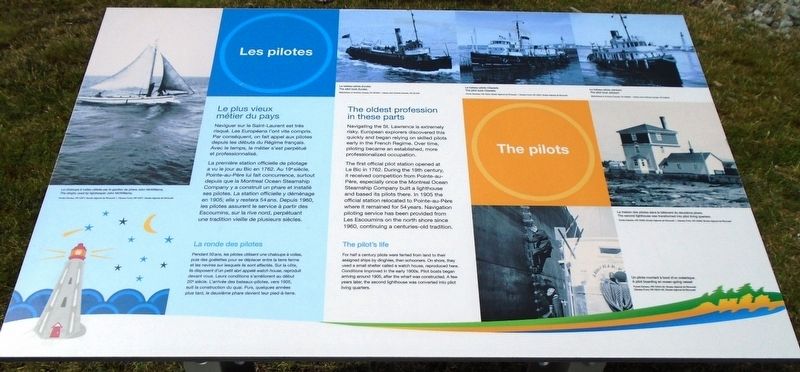

Le plus vieux métier du pays
Naviguer sur le Saint-Laurent est très risqué. Les Européens l'ont vite compris. Par conséquent, on fait appel aux pilotes depuis les débuts du Régime français. Avec le temps, le métier s'est perpétué et professionnalisé.
La première station officielle de pilotage a vu le jour au Bic en 1762. Au 19e siècle, Pointe-au-Père lui fait concurrence, surtout depuis que la Montreal Ocean Steamship Company y a construit un phare et installé ses pilotes. La station officielle y déménage en 1905; elle y restera 54 ans. Depuis 1960, les pilotes assurent le service à partir des Escoumins, sur la rive nord, perpétuant une tradition vieille de plusieurs siècles.
La ronde des pilotes
Pendant 50 ans, les pilotes utilisent une chaloupe à voiles, puis des goélettes pour se déplacer entre la terre ferme et les navires sur lesquels ils sont affectés. Sur la côte, ils disposent d'un petit abri appelé watch house, reproduit devant vous. Leurs conditions s'améliorent au début 20e siècle. L'arrivée des bateaux-pilotes, vers 1905, suit la construction du quai. Puis, quelques années plus tard, le deuxième
this page online
[Légendes photo, en haut à gauche, dans le sens des aiguilles d'une montre, lisez]
• La chaloupe à voiles utilisée par le gardien de phare John McWilliams.
• Le bateau-pilote Eureka.
• Le bateau-pilote Citadelle.
• Le bateau-pilote Jalobert.
• La maison des pilotes dans le bâtiment du deuxième phare.
• Un pilote montant à bord d'un océanique.
Navigating the St. Lawrence is extremely risky. European explorers discovered this quickly and began relying on skilled pilots early in the French Regime. Over time, piloting became an established, more professionalized occupation.
The first official pilot station opened at Le Bic in 1762. During the 19th century, it received competition from Pointe-au-Père, especially once the Montreal Ocean Steamship Company built a lighthouse and based its pilots there. In 1905 the official station relocated to Pointe-au-Père where it remained for 54 years. Navigation piloting service
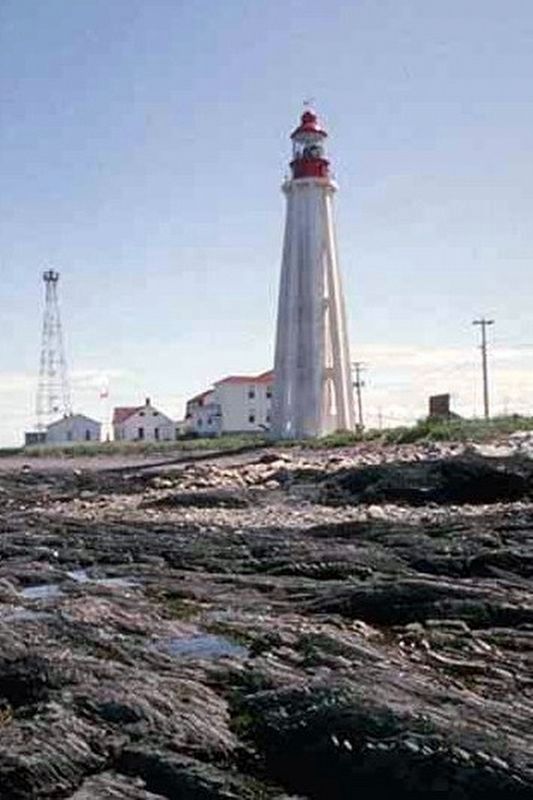
Click for more information.
The pilot's life
For half a century pilots were ferried from land to their assigned ships by dinghies, then schooners. On shore, they used a small shelter called a watch house, reproduced here. Conditions improved in the early 1900s. Pilot boats began arriving around 1905, after the wharf was constructed. A few years later, the second lighthouse was converted into pilot living quarters.
[Photo captions, clockwise from top left, read]
• The dinghy used by lightkeeper John McWilliams.
• The pilot boat Eureka.
• The pilot boat Citadelle.
• The pilot boat Jalobert.
• The second lighthouse was transformed into pilot living quarters.
• A pilot boarding an ocean-going vessel.
Topics and series. This historical marker is listed in these topic lists: Communications • Industry & Commerce • Waterways & Vessels. In addition, it is included in the Lighthouses series list. A significant historical year for this entry is 1762.
Location. 48° 31.045′ N, 68° 28.15′ W. Marker is in Rimouski, Québec, in Rimouski-Neigette. It is
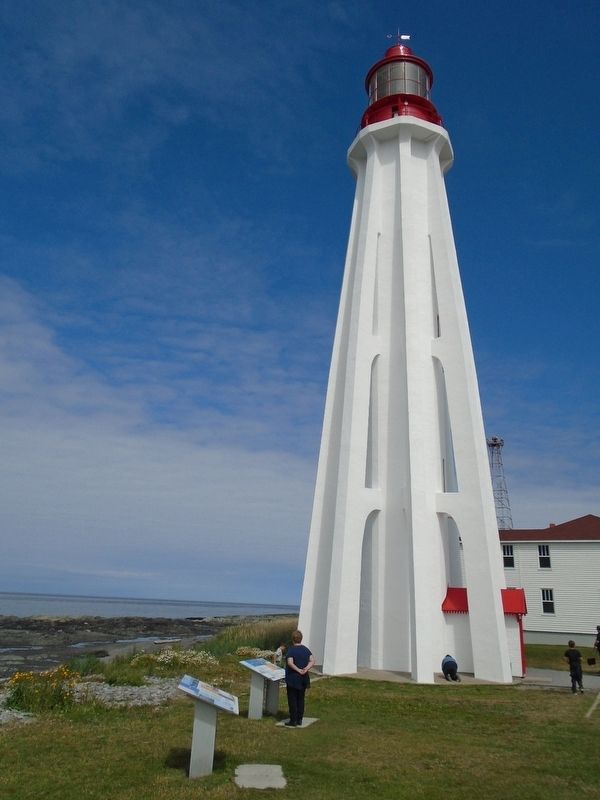
Parks Canada website entry
Click for more information.

Regionally, this marker is in Eastern Québec & Gaspésie and in Bas-Saint-Laurent. It is also in Central Canada. Globally, it is in North America, the Western Hemisphere, and the Western World. Historically, it finds itself in what was once a British colony, the Viceroyalty of New France, the Haudenosaunee (Iroquois) Confederacy, and Rupert’s Land.
Other nearby markers. At least 8 other markers are within walking distance of this marker: Polyvalence / Versatility (here, next to this marker); Les gardiens de phare / The lightkeepers (here, next to this marker); Les pilotes du Saint-Laurent / St. Lawrence Pilots (a few steps from this marker); Les Fusiliers du St-Laurent (a few steps from this marker); Le phare de Pointe-au-Père / Point-au-Père Lighthouse (a few steps from this marker); Père Nouvel (within shouting distance of this marker); La station de pilotage / The pilotage station (within shouting distance of this marker); Fumée de mer / Smoke from the Sea (within shouting distance of this marker). Touch for a list and map of all markers in Rimouski.
Also see . . . Pilotage in Canada: Laurentian Region. Canadian Marine Pilots' Association website entry (Submitted on December 6, 2018, by William Fischer, Jr. of Reynoldsburg, Ohio.)
Credits. This page was last revised on December 23, 2024. It was originally submitted on December 6, 2018, by William Fischer, Jr. of Reynoldsburg, Ohio. This page has been viewed 344 times since then and 21 times this year. Photos: 1. submitted on December 6, 2018, by William Fischer, Jr. of Reynoldsburg, Ohio. 2. submitted on November 12, 2023, by Larry Gertner of New York, New York. 3. submitted on December 6, 2018, by William Fischer, Jr. of Reynoldsburg, Ohio.
