Financial District in Manhattan in New York County, New York — The American Northeast (Mid-Atlantic)
Adriaen van der Donck’s Home
Birth of a City: Nieuw Amsterdam & Old New York
Photographed by Bill Coughlin, November 4, 2009
1. Adriaen van der Donck’s Home Marker
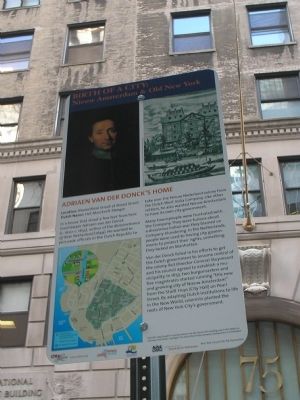
ADRIAEN VAN DER DONCK’S HOME
Location: Marketfield Street at Broad Street
Dutch Name: Het Marckvelt Steegie
In a house that stood a few feet from here lived lawyer Adriaen van der Donck (c. 1620 - c. 1655), author of the Remonstrance of New Netherland (1649). He wanted to persuade officials in the Dutch Republic to take over the Nieuw Nederland colony from the Dutch West India Company. Like other settlers, he also wanted Nieuw Amsterdam to have its own city government.
Many townspeople were frustrated with the Company. They were furious about a disastrous Indian war they blamed on Company blundering. In the Netherlands, people were used to having city governments to protect their rights, something they lacked on Manhattan.
Van der Donck failed in his efforts to get the Dutch government to assume control of the colony. But Director-General Stuyvesant and his council agreed to establish a municipality. In 1653, two burgomasters and five magistrates started running “this new and growing city of Nieuw Amsterdam” from the Stadt Huys (City Hall) on Pearl Street. By adapting Dutch institutions to life in the New World,
this page online
Erected 2009 by City Lore & NY 400.
Topics. This historical marker is listed in this topic list: Colonial Era. A significant historical year for this entry is 1620.
Location. Marker has been reported permanently removed. It was located near 40° 42.281′ N, 74° 0.694′ W. Marker was in Manhattan, New York, in New York County. It was in the Financial District. It was at the intersection of Broad Street and Marketfield Street, on the left when traveling north on Broad Street. Touch for map. Marker was in this post office area: New York NY 10004, United States of America.
We have been informed that this marker is no longer there and will not be replaced. This page is an archival view of what was.
Regionally, this marker was in New York City. It was also in the American Northeast, in the Mid-Atlantic, and on the Eastern Seaboard. Globally, it was in the North Atlantic Region, North America, the Western Hemisphere, the Western World, and the Anglosphere. Historically, it found itself in what was once New Netherland and also one of the original Thirteen Colonies.

Other nearby markers. At
Photographed by Bill Coughlin, November 4, 2009
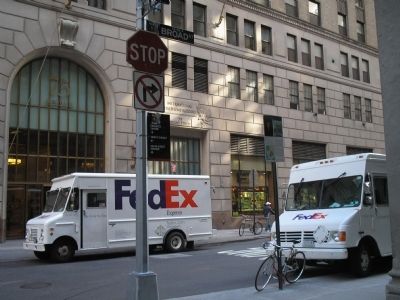
2. Marker on the Nieuw Amsterdam Trail
Other markers no longer nearby. New York Information Technology Center (was within shouting distance of this marker but has been confirmed missing); Stone Street Historic District and Colonial New York Street Plan (was about 300 feet away but has been permanently removed); Asser Levy’s Home (was about 400 feet away but has been permanently removed).
More about this marker. The top of the marker contains a painting that is “Long thought to portray Adriaen van der Donck, [but] may in fact depict an unknown Frenchman.” Next to this is
Photographed by Bill Coughlin, November 4, 2009
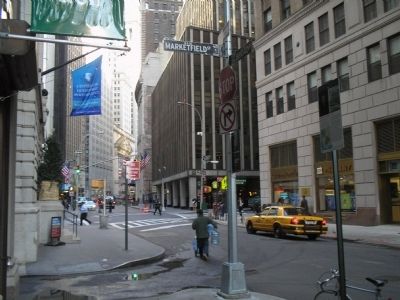
3. Broad Street Marker
NOTE: As of December 2018, all the markers in this series had been removed.
Related markers. Click here for a list of markers that are related to this marker. Learn about New York City’s colonial Dutch heritage by taking a virtual tour of the Nieuw Amsterdam Trail though lower Manhattan.
Also see . . . City Lore website. City Lore's mission is to foster New York's - and America's - living cultural heritage. (Submitted on November 5, 2009, by Bill Coughlin of Woodland Park, New Jersey.)
Photographed by Larry Gertner, December 11, 2018
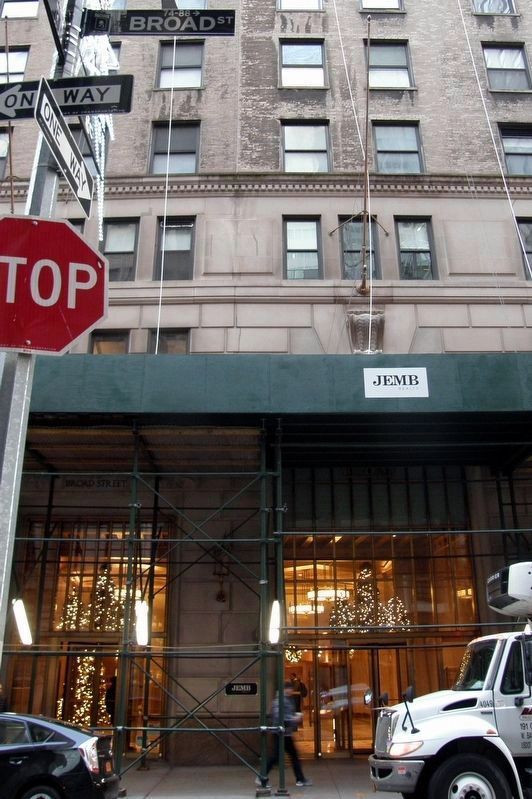
4. Adriaen van der Donck’s Home marker, former location
The marker had been removed, December 2018.
Credits. This page was last revised on January 31, 2023. It was originally submitted on November 5, 2009, by Bill Coughlin of Woodland Park, New Jersey. This page has been viewed 2,070 times since then and 31 times this year. Last updated on December 11, 2018, by Larry Gertner of New York, New York. Photos: 1, 2, 3. submitted on November 5, 2009, by Bill Coughlin of Woodland Park, New Jersey. 4. submitted on December 11, 2018, by Larry Gertner of New York, New York. • Andrew Ruppenstein was the editor who published this page.
