Historic District in St. Augustine in St. Johns County, Florida — The American South (South Atlantic)
Government House: National Significance
Casa Gubernamental: Significado Nacional
Photographed by Cosmos Mariner, December 12, 2018
1. Government House: National Significance Marker
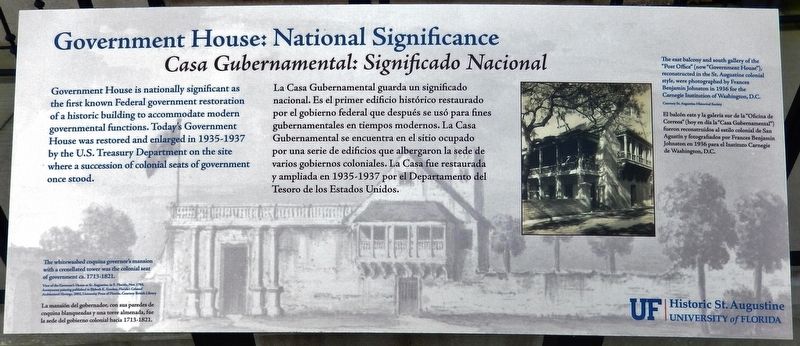
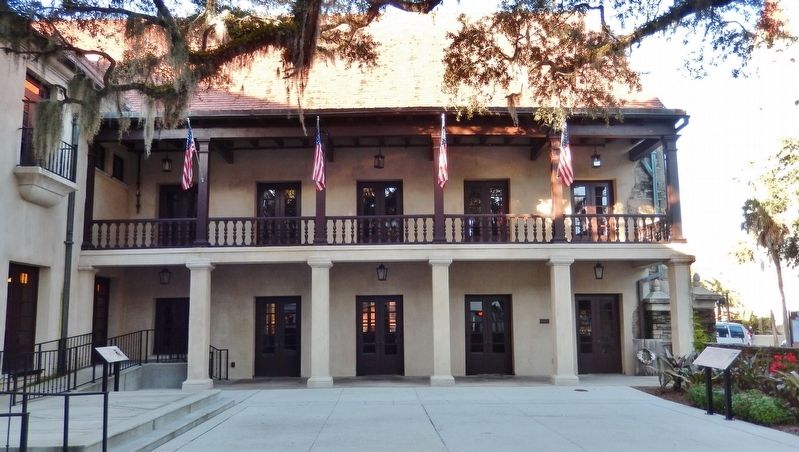
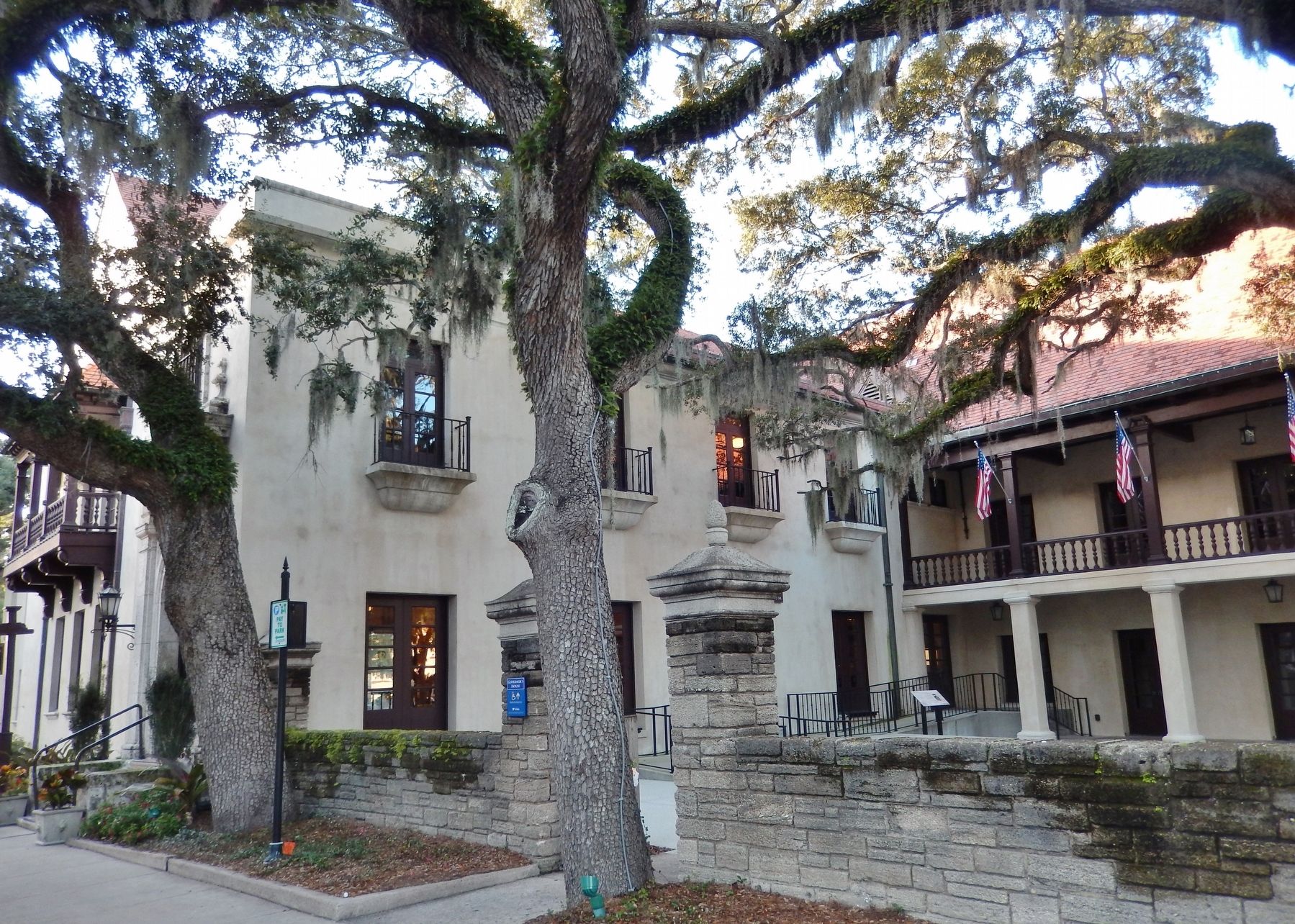
Government House is nationally significant as the first known Federal government restoration of a historic building to accommodate modern governmental functions. Today's Government House was restored and enlarged in 1935-1937 by the U.S. Treasury Department on the site where a succession of colonial seats of government once stood.
(marker background image)
The whitewashed coquina governor’s mansion with a crenellated tower was the colonial seat of government ca. 1713-1821.
View of the Governor’s House at St. Augustine, in E. Florida, Nov. 1764.
Anonymous painting published in Elizabeth K. Gordon, Florida’s Colonial Architectural Heritage, 2002, University Press of Florida.
Courtesy British Library
this page online
La mansión del gobernador, con sus paredes de coquina blanqueadas y una torre almenada, fue la sede del gobierno colonia hacia 1713-1821.
Erected by University of Florida Historic St. Augustine, Inc.
Topics. This historical marker is listed in these topic lists: Architecture • Colonial Era.
Location. 29° 53.547′ N, 81° 18.783′ W. Marker is in St. Augustine, Florida, in St. Johns County. It is in the Historic District. It is on Cathedral Place. Marker is located on the grounds of the Governor's House Cultural Center and Museum, in the small courtyard at the southeast corner of the Government House, near the building's east entrance. Touch for map. Marker is at or near this postal address: 48 King St, Saint Augustine FL 32084, United States of America. Touch for directions.

Regionally, this marker is in First Coast and in Greater Jacksonville. It is also in the American South and on the Eastern Seaboard. Globally, it is in the North Atlantic Region, North America, a Gulf of Mexico state, the Western Hemisphere,
Courtesy St. Augustine Historical Society
2. Marker detail: East balcony and south gallery; photographed by Frances Benjamin Johnston in 1936
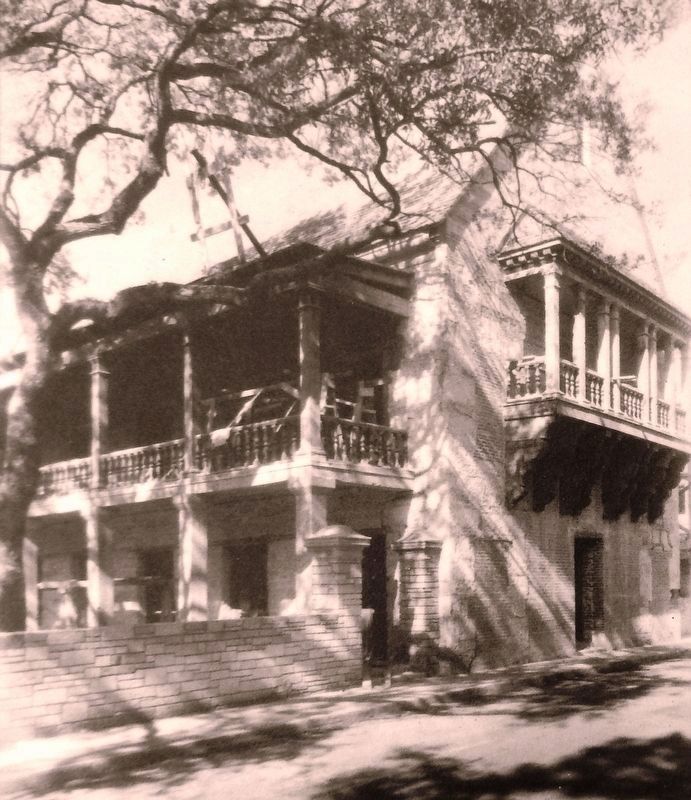
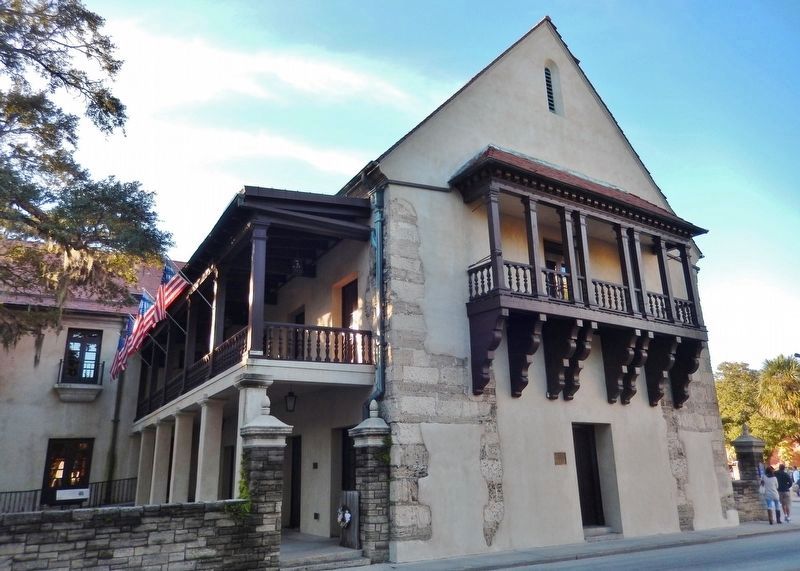
The east balcony and south gallery of the “Post Office” (now "Government House"), reconstructed in the St. Augustine colonial style, were photographed by Frances Benjamin Johnston in 1936 for the Carnegie Institution of Washington, D.C.
El balcón este y la galería sur de la “Oficina de Correos” (hoy en día la “Casa Gubernamental”) fueron reconstruidos al estilo colonial de San Agustín y fotografiados por Frances Benjamin Johnston en 1936 para el Instituto Carnegie de Washington, D.C.
El balcón este y la galería sur de la “Oficina de Correos” (hoy en día la “Casa Gubernamental”) fueron reconstruidos al estilo colonial de San Agustín y fotografiados por Frances Benjamin Johnston en 1936 para el Instituto Carnegie de Washington, D.C.
Other nearby markers. At least 8 other markers are within walking distance of this marker: Government House and the Plaza (a few steps from this marker); Governor’s House (a few steps from this marker); Clerk of Court’s Office (a few steps from this marker); Balcón de los Reyes (a few steps from this marker); Coquina in These Walls (within shouting distance of this marker); Government House: Legacy of Authority (within shouting distance of this marker); 8 inch Columbiad (within shouting distance of this marker); Andrew Young Crossing (within shouting distance of this marker). Touch for a list and map of all markers in St. Augustine.
More about this marker. Marker is a large rectangular composite plaque, mounted horizontally on waist-high metal posts.
Regarding Government House: National Significance. National Register of Historic Places (2013) #13000812
Related markers. Click here for a list of markers
Photographed by Cosmos Mariner, December 12, 2018
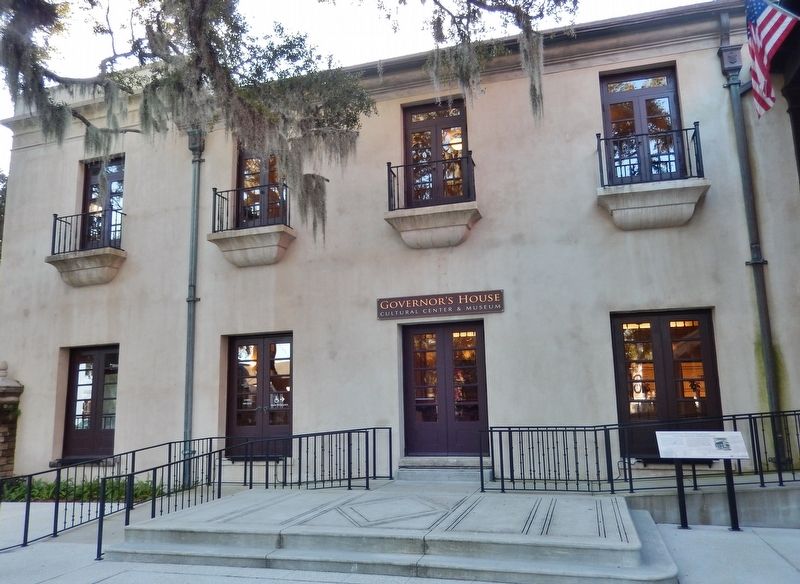
3. Government House (east side courtyard; marker visible right of entrance)
Also see . . .
1. Government House (St. Augustine). Wikipedia entry:
The last governor to use the house was Enrique White during the Second Spanish Period; he died in 1811. By the time Florida was annexed by the United States in 1821, the building was in ruins with only the walls remaining. In 1833-34 Government House was rebuilt with federal funds, following plans drawn up by architect Robert Mills, later famous for designing the Washington Monument. The structure incorporated existing walls and contained 16 rooms, including space for a post office, a courtroom, and other federal functions. (Submitted on December 17, 2018, by Cosmos Mariner of Cape Canaveral, Florida.)
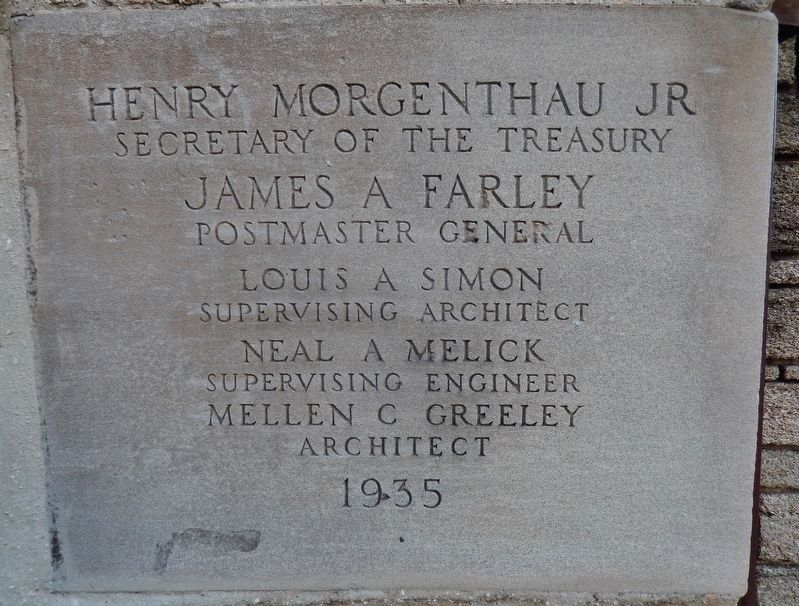
2. Government House. In 1937, the Works Progress Administration remodeled the courthouse as "United States Post Office & Customs House." The 1935 architectural plans depict "old coquina stone walls" which may date to St. Augustine's first Spanish colonial period. Outlines of windows and exposed coquina limestone of those old walls are visible on today's north, east, and
Photographed by Cosmos Mariner, December 12, 2018
4. Government House: East balcony and south gallery (as they appear today)
Photographed by Cosmos Mariner, December 12, 2018
5. Government House Courtyard & Gallery (marker visible on left; related marker on right)
NPGallery: Digital Asset Management System
Click for more information.
Click for more information.
Photographed by Cosmos Mariner, December 12, 2018
6. Government House Courtyard (northeast corner view; marker visible below gallery)
Photographed by Cosmos Mariner, December 12, 2018
7. Government House Cornerstone (for 1935 Renovation as a Works Progress Administration project)
Credits. This page was last revised on July 30, 2026. It was originally submitted on December 16, 2018, by Cosmos Mariner of Cape Canaveral, Florida. This page has been viewed 843 times since then and 44 times this year. Photos: 1. submitted on December 16, 2018, by Cosmos Mariner of Cape Canaveral, Florida. 2, 3, 4, 5, 6. submitted on December 17, 2018, by Cosmos Mariner of Cape Canaveral, Florida. 7. submitted on December 27, 2018, by Cosmos Mariner of Cape Canaveral, Florida. • Bill Pfingsten was the editor who published this page.
