Historic District in St. Augustine in St. Johns County, Florida — The American South (South Atlantic)
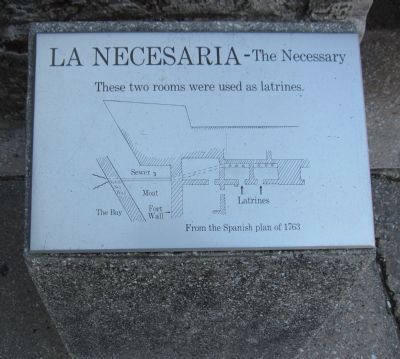
La Necesaria
The Necessary
Photographed by Craig Swain, August 2, 2011
1. La Necesaria Marker
From the Spanish plan of 1763.
Topics and series. This historical marker is listed in this topic list: Colonial Era. In addition, it is included in the If You've Got to Go... series list. A significant historical year for this entry is 1763.
Location. Marker is missing. It was located near 29° 53.869′ N, 81° 18.681′ W. Marker was in St. Augustine, Florida, in St. Johns County. It was in the Historic District. It could be reached from South Castillo Drive (State Road A1A), on the right when traveling north. Located inside the Castillo de San Marcos. Touch for map. Marker was at or near this postal address: 11 S Castillo Dr, Saint Augustine FL 32084, United States of America. Touch for directions.

Regionally, this marker was in First Coast and in Greater Jacksonville. It was also in the American South and on the Eastern Seaboard. Globally, it was in the North Atlantic Region, North America, a Gulf of Mexico state, the Western Hemisphere, the Western World, and the Anglosphere. Historically, it found itself in what was once New Spain, the territory of the Mississippian Culture,
this page online
Other nearby markers. At least 8 other markers are within walking distance of this location: Tidal Toilet / Limpiado por las mareas (a few steps from this marker); Matanzas Bay (a few steps from this marker); Reading the Cannon / Claves de cañones (a few steps from this marker); Pirate Attacks (a few steps from this marker); Plaza-Courtyard (a few steps from this marker); Cannon (a few steps from this marker); Ramp (a few steps from this marker); St. Augustine's Bastion (a few steps from this marker). Touch for a list and map of all markers in St. Augustine.
Also see . . . Castillo de San Marcos National Monument. NPS website. (Submitted on August 26, 2011, by Craig Swain of Leesburg, Virginia.)
Photographed by Craig Swain, August 2, 2011
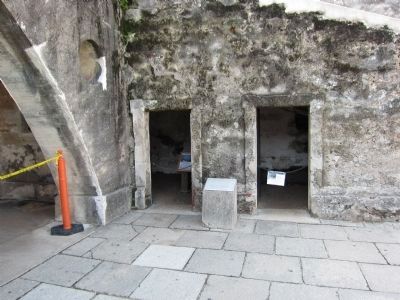
2. La Necesaria Marker and the "Necessary"
Photographed by Craig Swain, August 2, 2011
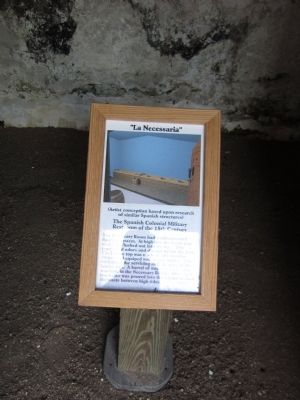
3. La Necesaria
Interpretive sign in the Necessary offers a depiction of the latrine and reads, The Spanish Colonial Military Restroom of the 18th Century. The Necessary room had a tide-operated flushing system. At high tide the waste pipe would be flushed out into the bay. This controlled odors and disease within the fort. The latrine top was made of two wooden covers and equipped with iron handles. This facilitated the servicing and cleaning of the latrine box. A barrel of water and a bucket was kept in the Necessary Room. After each use water was poured into the latrine to flush the waste between high tides.
Photographed by Cosmos Mariner, December 12, 2018
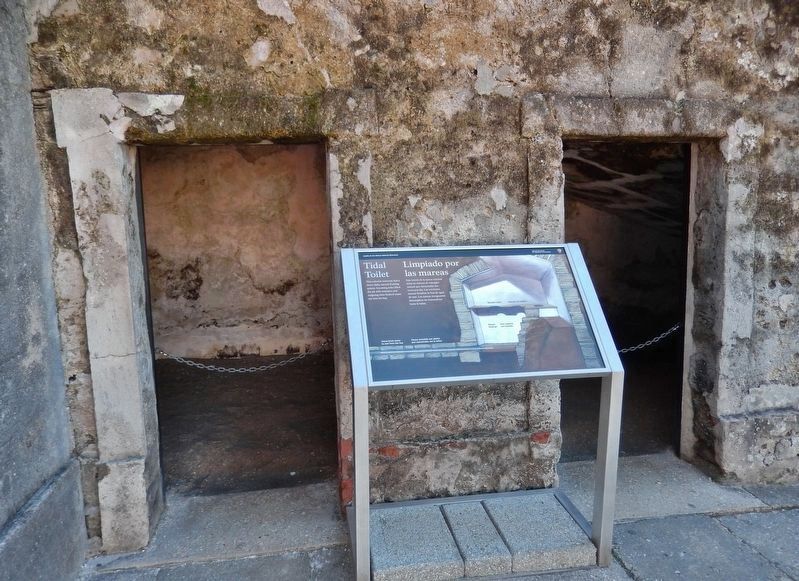
4. Tidal Toilet Marker (wide view; showing new marker)
Credits. This page was last revised on January 2, 2019. It was originally submitted on August 26, 2011, by Craig Swain of Leesburg, Virginia. This page has been viewed 795 times since then and 32 times this year. Last updated on December 21, 2018, by Cosmos Mariner of Cape Canaveral, Florida. Photos: 1, 2, 3. submitted on August 26, 2011, by Craig Swain of Leesburg, Virginia. 4. submitted on December 21, 2018, by Cosmos Mariner of Cape Canaveral, Florida. • Andrew Ruppenstein was the editor who published this page.
