St. Augustine in St. Johns County, Florida — The American South (South Atlantic)
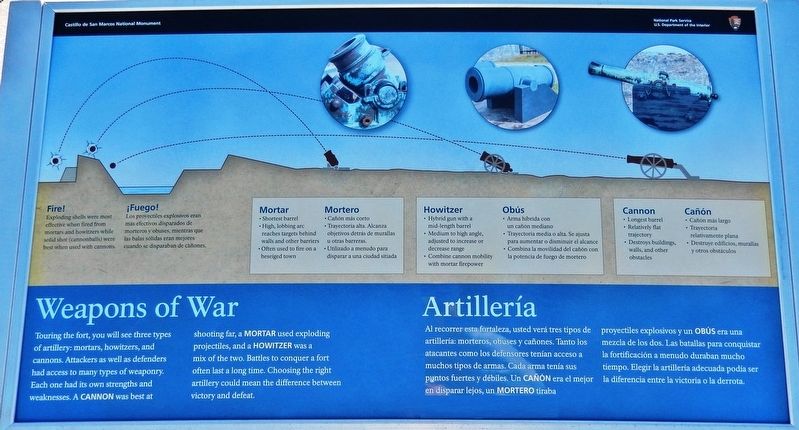
Weapons of War
⎯⎯⎯
Artillería
Castillo de San Marcos National Monument
Photographed by Cosmos Mariner, December 12, 2018
1. Weapons of War / Artillería Marker
Fire!
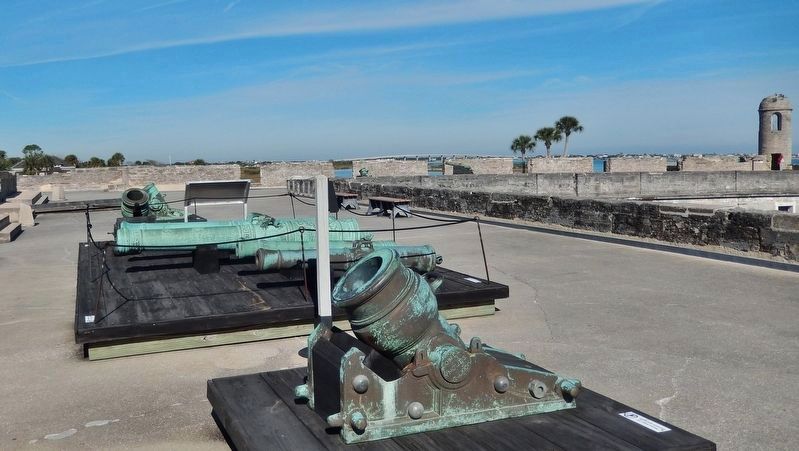
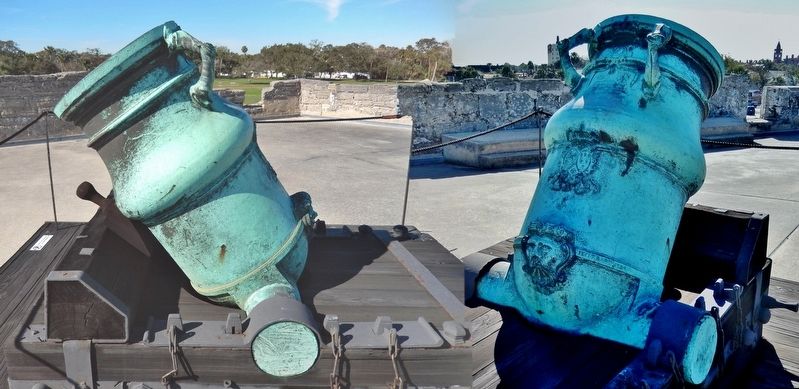
Exploding shells were most effective when fired from mortars and howitzers while solid shot (cannonballs) were best when used with cannons.
Mortar
• Shortest barrel
• High, lobbing arc reaches targets behind walls and other barriers
• Often used to fire on a besieged town
Howitzer
• Hybrid gun with a mid-length barrel
• Medium to high angle, adjusted to increase or decrease range
• Combine cannon mobility with mortar firepower
Cannon
• Longest barrel
• Relatively flat trajectory
• Destroys buildings, walls, and other obstacles
this page online
¡Fuego!
Los proyectiles explosivos eran más efectivos disparados de morteros y obuses, mientras que las balas sólidas eran mejores cuando se disparaban de cañones.
Mortero
• Cañón más corto
• Trayectoria alta. Alcanza objetivos detrás de murallas u otras barreras.
• Utilizado a menudo para disparar a una ciudad sitiada
Obús
• Arma híbrida con un cañón mediano
• Trayectoria media o alta. Se ajusta para aumentar o disminuir el alcance
• Combina la movilidad del cañón con la potencia de fuego de mortero
Cañón
• Cañón más largo
• Trayectoria relativamente plana
• Destruye edificios, murallas y otros obstáculos
Erected 2018 by National Park Service, U.S. Department of the Interior.
Topics. This historical marker is
Photographed by Cosmos Mariner, December 12, 2018
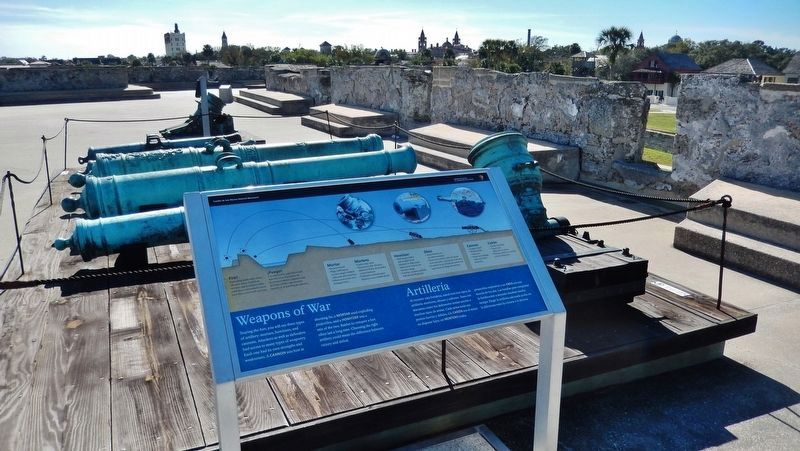
2. Weapons of War Marker (wide view; looking south across cannon exhibit to San Pedro Bastion)
Location. 29° 53.872′ N, 81° 18.705′ W. Marker is in St. Augustine, Florida, in St. Johns County. It can be reached from the intersection of South Castillo Drive (State Road A1A) (Business U.S. 1) and Cuna Street, on the right when traveling north. Marker is located on the Castillo de San Marcos National Monument grounds, atop the parapet over the east wall, between the fort's San Pedro and San Pablo Bastions. Touch for map. Marker is at or near this postal address: 1 South Castillo Drive, Saint Augustine FL 32084, United States of America. Touch for directions.

Regionally, this marker is in First Coast and in Greater Jacksonville. It is also in the American South and on the Eastern Seaboard. Globally, it is in the North Atlantic Region, North America, a Gulf of Mexico state, the Western Hemisphere, the Western World, and the Anglosphere. Historically, it finds itself in what was once New Spain, the territory of the Mississippian Culture, one of the Confederate States of America, and
Photographed by Cosmos Mariner, December 12, 2018
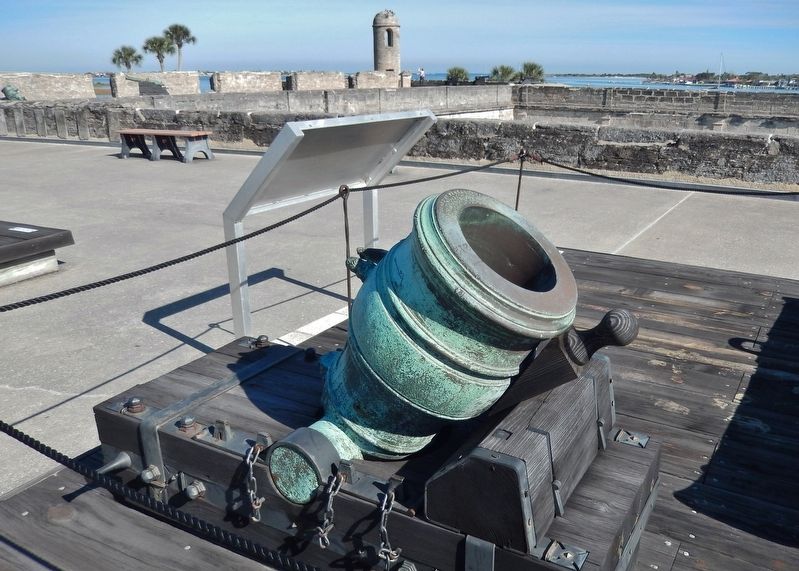
3. 12-inch Bronze Mortar, Barcelona, 1783 (marker visible behind mortar)
Other nearby markers. At least 8 other markers are within walking distance of this marker: Lines of Defense (here, next to this marker); British Quarters (a few steps from this marker); St. Paul's Bastion (a few steps from this marker); Deadly Crossfire / Fuego Cruzado (a few steps from this marker); Well (a few steps from this marker); Chapel of St. Mark (a few steps from this marker); Plaza-Courtyard (within shouting distance of this marker); St. Peter's Bastion (within shouting distance of this marker). Touch for a list and map of all markers in St. Augustine.
More about this marker. Marker is a large rectangular composite plaque, mounted horizontally on waist-high metal posts. There are two instances of this marker on the Castillo de San Marcos National Monument grounds, at two different locations, and near exhibits of two different collections of artillery.
Related markers. Click here for a list of markers that are related to this marker. Castillo de San Marcos National Monument
Also see . . .
1. Arms and Armament. Both bronze and iron were used to make cannons throughout the 18th
Photographed by Cosmos Mariner, December 12, 2018
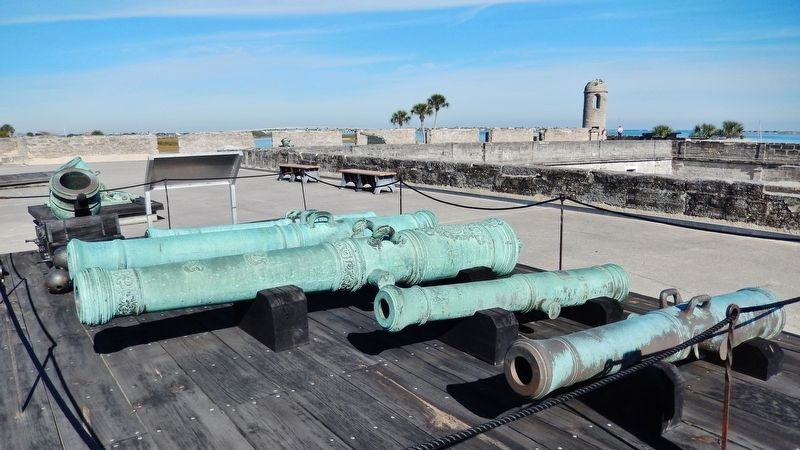
4. Cannon Exhibit (marker visible behind cannons)
• 8-pounder, bronze, Seville, 1798
• 6-pounder, bronze, Seville, 1762
• 18-pounder, bronze, Seville, 1735
• 12-pounder, bronze, Seville, 1798
• 4-pounder, bronze, Seville, 1795
• 6-pounder, bronze, Seville, 1762
• 18-pounder, bronze, Seville, 1735
• 12-pounder, bronze, Seville, 1798
• 4-pounder, bronze, Seville, 1795
2. Castillo de San Marcos Artillery Tour. Inventory and location of artillery on exhibit at Castillo de San Marcos. (Submitted on December 15, 2018, by Cosmos Mariner of Cape Canaveral, Florida.)
Photographed by Cosmos Mariner, December 12, 2018
5. 12-inch Bronze Mortar, Seville, 1784 (marker visible behind mortar & cannon exhibit)
Photographed by Cosmos Mariner, December 12, 2018
6. 15-inch Bronze Mortar, Barcelona, 1724 (located south of marker on San Pedro Bastion)
Credits. This page was last revised on August 20, 2020. It was originally submitted on December 15, 2018, by Cosmos Mariner of Cape Canaveral, Florida. This page has been viewed 459 times since then and 44 times this year. Last updated on December 23, 2018, by Cosmos Mariner of Cape Canaveral, Florida. Photos: 1, 2, 3, 4, 5, 6. submitted on December 15, 2018, by Cosmos Mariner of Cape Canaveral, Florida. • Andrew Ruppenstein was the editor who published this page.
