Butte in Silver Bow County, Montana — The American West (Mountains)
Butte-Anaconda Historic District
Photographed by Cosmos Mariner, July 18, 2016
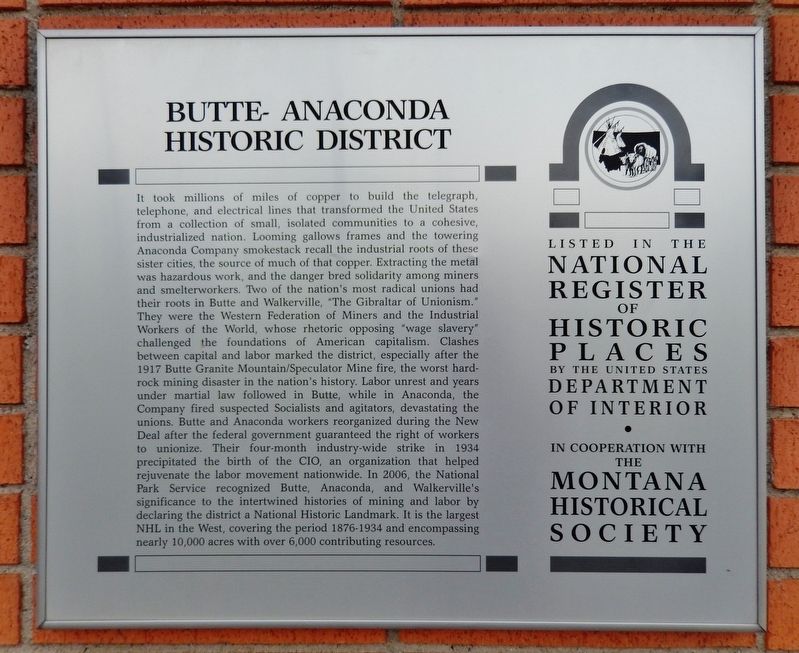
1. Butte-Anaconda Historic District Marker
It took millions of miles of copper to build the telegraph, telephone, and electrical lines that transformed the United States from a collection of small, isolated communities to a cohesive, industrialized nation. Looming gallows frames and the towering Anaconda Company smokestack recall the industrial roots of these sister cities, the source of much of that copper. Extracting the metal was hazardous work, and the danger bred solidarity among miners and smelterworkers. Two of the nation's most radical unions had their roots in Butte and Walkerville, “The Gibraltar of Unionism.” They were the Western Federation of Miners and the Industrial Workers of the World, whose rhetoric opposing “wage slavery” challenged the foundations of American capitalism. Clashes between capital and labor marked the district, especially after the 1917 Butte Granite Mountain/Speculator Mine fire, the worst hard-rock mining disaster in the nation's history. Labor unrest and years under martial law followed in Butte, while in Anaconda, the Company fired suspected Socialists and agitators, devastating the unions. Butte and Anaconda workers reorganized
this page online
Erected by Montana Historical Society.
Topics and series. This historical marker is listed in these topic lists: Communications • Industry & Commerce • Labor Unions • Natural Resources. In addition, it is included in the Montana National Register Sign Program, and the National Historic Landmarks series lists. A significant historical year for this entry is 1917.
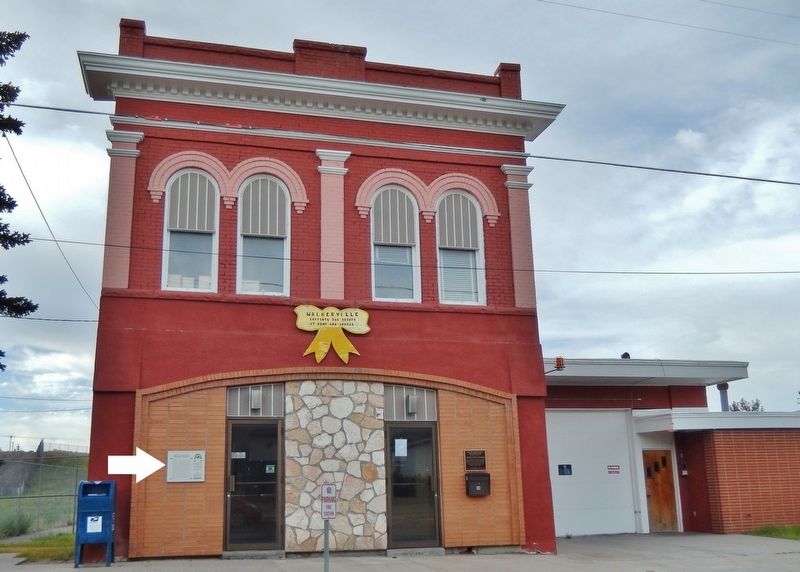
Location. 46° 1.79′ N, 112° 32.197′ W. Marker is in Butte, Montana, in Silver Bow County. It is on West Daly Street west of A Street, on the right when traveling east. Marker is mounted
Photographed by Cosmos Mariner, July 18, 2016
2. Butte-Anaconda Historic District Marker (wide view; marker visible on left side of building)

Regionally, this marker is in andspecifically outhwest Montana, in Gold West Country, in Mining Country. It is also in the American Mountain West and in the Lewis & Clark Corridor. Globally, it is in North America, the Rocky Mountains, the Western Hemisphere, the Western World, and the Anglosphere. Historically, it finds itself in what was once Rupert’s Land and also the Louisiana Purchase.
Other nearby markers. At least 8 other markers are within walking distance of this marker: Butte-Anaconda-Walkerville (here, next to this marker); Caplice & McCune Store (about 400 feet away, measured in a direct line); 1600 North Main (about 500 feet away); St. Lawrence O’Toole Church (approx. 0.2 miles away); Walkerville and the Lex (approx. ¼ mile away); The Con Hoist House (approx. half a mile away); Mines of Centerville (approx. half a mile away); The Irish of Centerville
Photographed by Cosmos Mariner, July 18, 2016
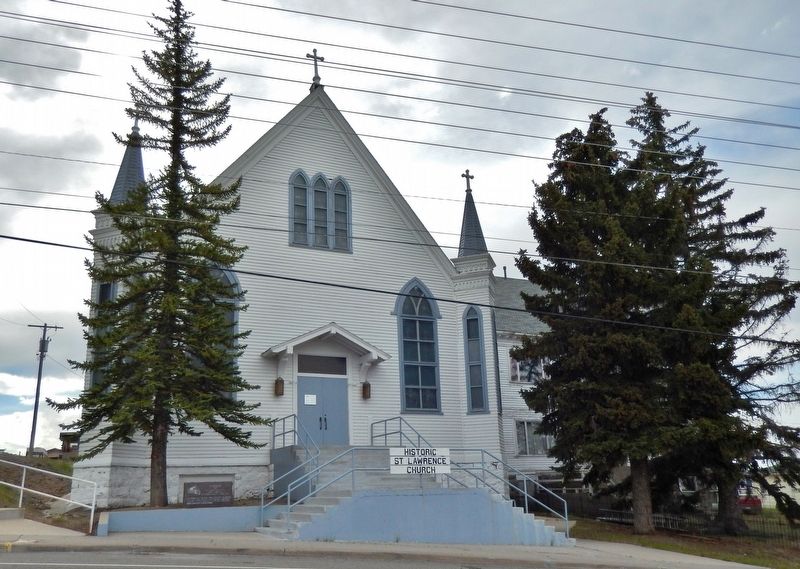
3. Saint Lawrence Church, Butte, Montana
More about this marker. Marker is a large, laser-printed metal plaque.
Related markers. Click here for a list of markers that are related to this marker. Butte-Anaconda National Historic Landmark District
Also see . . .
1. Butte–Anaconda Historic District. The district's national significance relates to its long history of copper production as well as to its role in the development of the labor union movement in the United States. As the source of nearly one-third of all the world's copper in the early 1900s, Butte's mines provided one of the metals that were critical to American industrialization. Walkerville represents some of the earliest mines in the district and preserves the early mining camp flavor present in the 1890s to 1910s. Butte itself is an urban metropolis where industrial relics such as mine yards and head frames are juxtaposed with a wide variety of residential and business structures. (Submitted on January 1, 2019, by Cosmos Mariner of Cape Canaveral, Florida.)
2. Western Federation of Miners. The Western Federation of Miners (WFM) was a radical labor union that organized the miners and smelter workers of the Rocky Mountain states. Created in 1893 by the merger of several local miners' unions, the WFM had a reputation for violent strikes and militant action from its beginning. On several occasions pitched battles occurred between union members and company guards, and state militia and federal troops were sometimes dispatched to keep order in strike areas. (Submitted on January 1, 2019, by Cosmos Mariner of Cape Canaveral, Florida.)
3. Industrial Workers of the World. Industrial Workers of the World (IWW), byname Wobblies, labour organization founded in Chicago in 1905 by representatives of 43 groups. The IWW opposed the American Federation of Labor’s acceptance of capitalism and its refusal to include unskilled workers in craft unions. Among the founders of the IWW were William D. (“Big Bill”) Haywood of the Western Federation of Miners (WFM), Daniel De Leon of the Socialist Labor Party, and Eugene V. Debs of the Socialist Party. Debs withdrew his support as the group grew more radical. (Submitted on January 1, 2019, by Cosmos Mariner of Cape Canaveral, Florida.)
Credits. This page was last revised on March 5, 2026. It was originally submitted on January 1, 2019, by Cosmos Mariner of Cape Canaveral, Florida. This page has been viewed 423 times since then and 32 times this year. Photos: 1, 2, 3. submitted on January 1, 2019, by Cosmos Mariner of Cape Canaveral, Florida. • Andrew Ruppenstein was the editor who published this page.
