Westlake Village in Ventura County, California — The American West (Pacific Coastal)
Triunfo Canyon
Conejo Valley
Photographed by Craig Baker, December 28, 2018
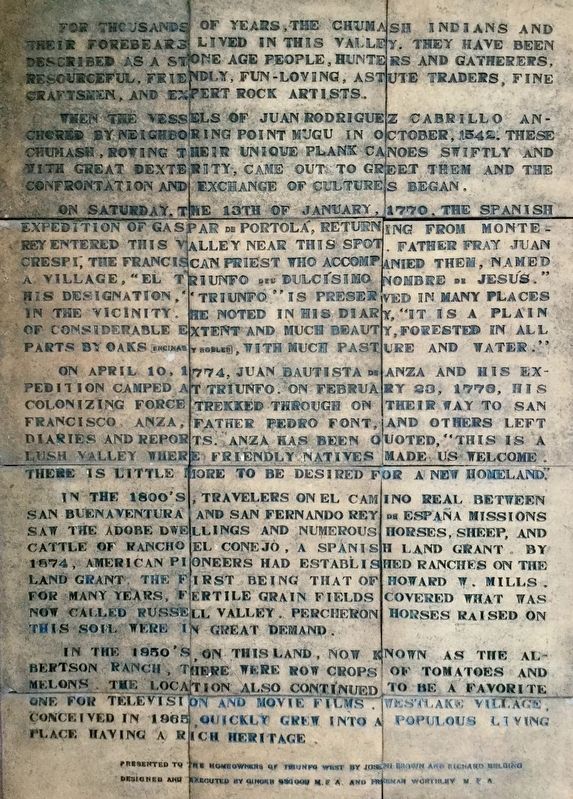
1. Triunfo Canyon Marker
For thousands of years, the Chumash Indians and their forebears lived in this valley. They have been described as a stone age people, hunters and gatherers, resourceful, friendly, fun-loving, astute traders, fine craftsmen, and expert rock artists.
When the vessels of Juan Rodriguez Cabrillo anchored by neighboring Point Mugu in October, 1542, these Chumash, rowing their unique plank canoes swiftly and with great dexterity, came out to greet them, and the confrontation and exchange of cultures began.
On Saturday, the 13th of January, 1770, the Spanish expedition of Gaspar de Portola returning from Monterey entered this valley near this spot. Father Frey Juan Crespi, the Franciscan priest who accompanied them, named a village, “El Triunfo del Dulcísimo Nombre de Jesús.” His designation, “Triunfo” is preserved in many places in the vicinity. He noted in his diary, “It is a plane of considerable extent and much beauty, forested in all parts by oaks (encinas y robles), with much pasture and water.”
On April 10, 1774, Juan Battista de Anza and his expedition camped at Triunfo.
this page online
In the 1800’s, travelers on El Camino Real between San Buenaventura and San Fernando Rey de España Missions saw the adobe dwellings and numerous horses, sheep, and cattle of Rancho el Conejo, a Spanish land grant. By 1874, American pioneers had established ranches on the land grant, the first being that of Howard W. Mills. For many years, fertile grain fields covered what was now called Russell Valley. Percheron horses raised on this soil were in great demand.
In the 1850’s, on this land, now known as the Albertson Ranch, there were row crops of tomatoes and melons. The location also continued to be a favorite one for television and movie films. Westlake Village, conceived in 1965, quickly grew into a popular living place having a rich heritage.
Presented to the homeowners of Triunfo West by Joseph Brown and Richard Belding. Designed and executed by Ginger Osgood MFA and Freeman Worthley MFA.
Topics and series.
Photographed by Craig Baker, December 28, 2018
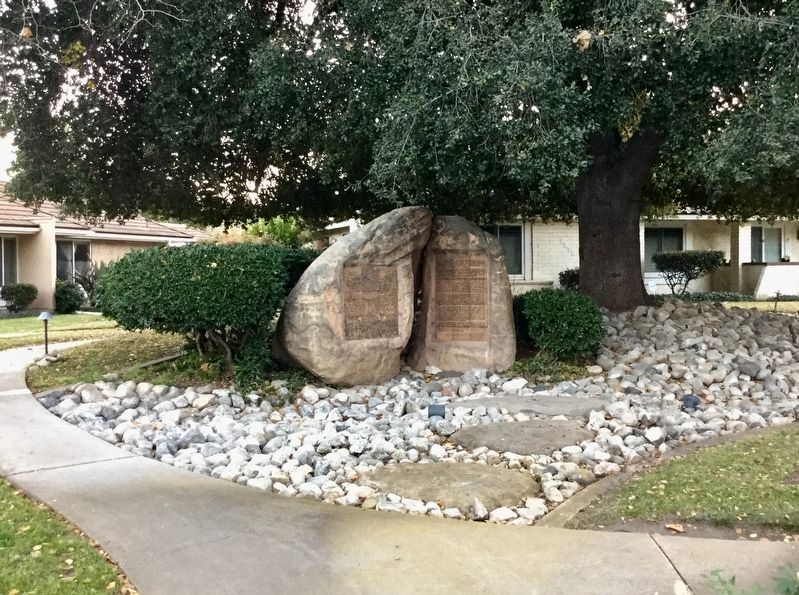
2. Triunfo Canyon Marker
Location. 34° 8.945′ N, 118° 50.338′ W. Marker is in Westlake Village, California, in Ventura County. It is at the intersection of Westlake Boulevard and Triunfo Canyon Road, on the left when traveling south on Westlake Boulevard. Touch for map. Marker is in this post office area: Thousand Oaks CA 91362, United States of America. Touch for directions.

Regionally, this marker is in Greater Los Angeles, on the Central Coast, and in the Transverse Ranges. It is also on the American Pacific Coast. Globally, it is in North America, on the Ring of Fire, in the Pacific Rim, in the Western Hemisphere, in the Western World, and in the Anglosphere. Historically, it finds itself in what was once New Spain and also Mexico’s Alta California.
Other nearby markers. At
Photographed by Craig Baker, December 28, 2018
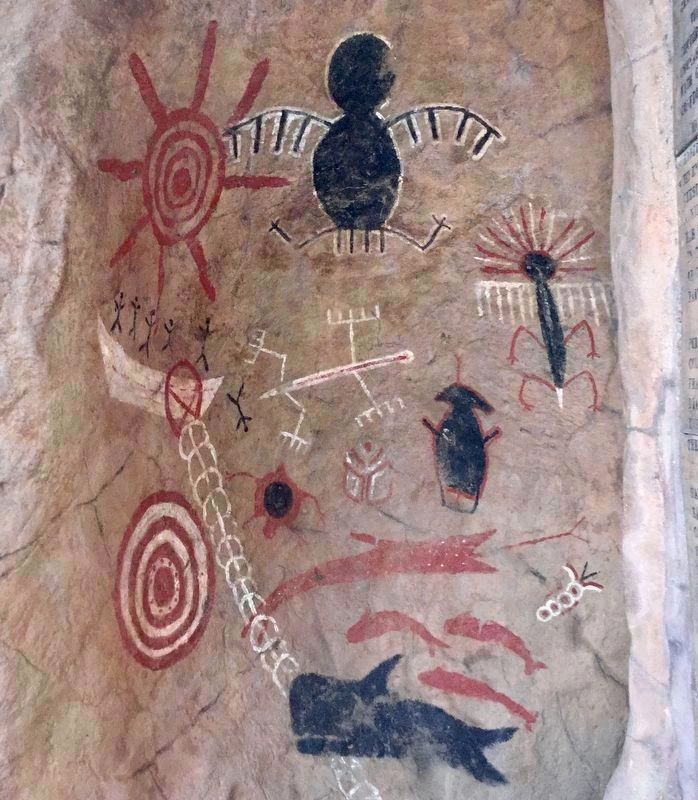
3. Rock Art
A re-creation of a cave with Chumash rock art, located next to the marker.
Credits. This page was last revised on January 9, 2019. It was originally submitted on January 9, 2019, by Craig Baker of Sylmar, California. This page has been viewed 1,311 times since then and 131 times this year. Photos: 1, 2, 3. submitted on January 9, 2019, by Craig Baker of Sylmar, California. • Andrew Ruppenstein was the editor who published this page.
