San Gabriel in Los Angeles County, California — The American West (Pacific Coastal)
Chapman’s Mill and Millrace
Then and Now
Photographed by Craig Baker, December 20, 2018
1. Chapman’s Mill and Millrace Marker
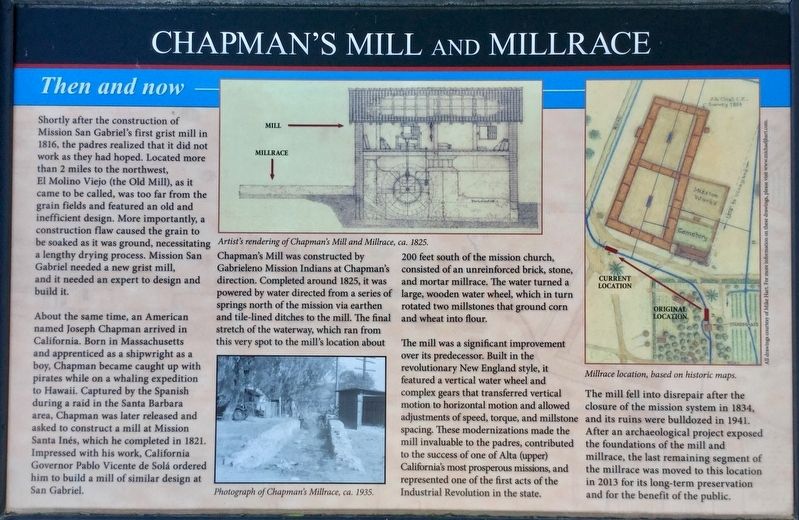
Shortly after the construction of Mission San Gabriel's first grist mill in 1816, the padres realized that it did not work as they had hoped. Located more than 2 miles to the northwest, El Molino Viejo (the Old Mill), as it came to be called, was too far from the grain fields and featured an old and inefficient design. More importantly, a construction flaw caused the grain to be soaked as it was ground, necessitating a lengthy drying process. Mission San Gabriel needed a new grist mill, and it needed an expert to design and build it.
About the same time, an American named Joseph Chapman arrived in California. Born in Massachusetts and apprenticed as a shipwright as a boy, Chapman became caught up with pirates while on a whaling expedition to Hawaii. Captured by the Spanish during a raid in the Santa Barbara area, Chapman was later released and asked to construct a mill at Mission Santa Ines, which he completed in 1821. Impressed with his work, California Governor Pablo Vicente de Solá ordered him to build a mill of similar design at San Gabriel.
Chapman's Mill was constructed by Gabrieleno Mission Indians at Chapman's
this page online
The mill was a significant improvement over its predecessor. Built in the revolutionary New England style, it featured a vertical water wheel and complex gears that transferred vertical motion to horizontal motion and allowed adjustments of speed, torque, and millstone spacing. These modernizations made the mill invaluable to the padres, contributed to the success of one of Alta (upper) California's most prosperous missions, and represented one of the first acts of the Industrial Revolution in the state.
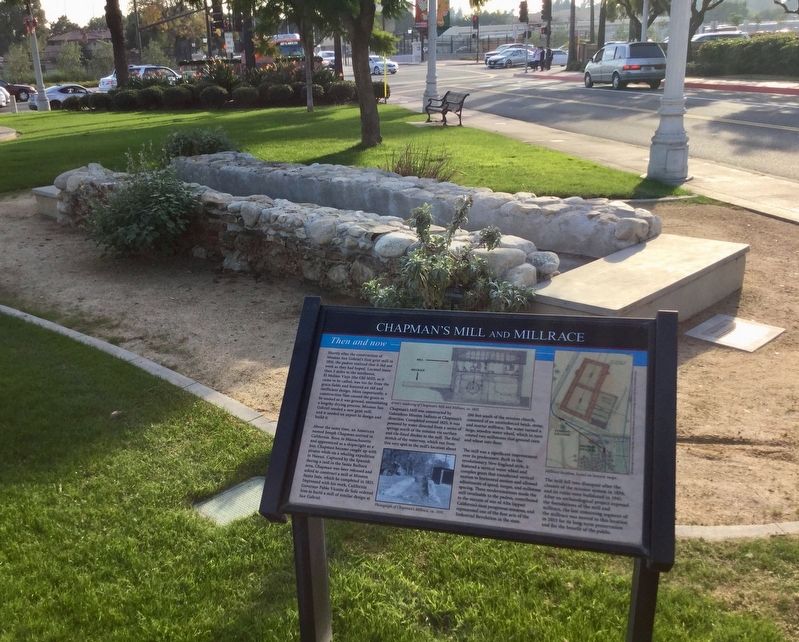
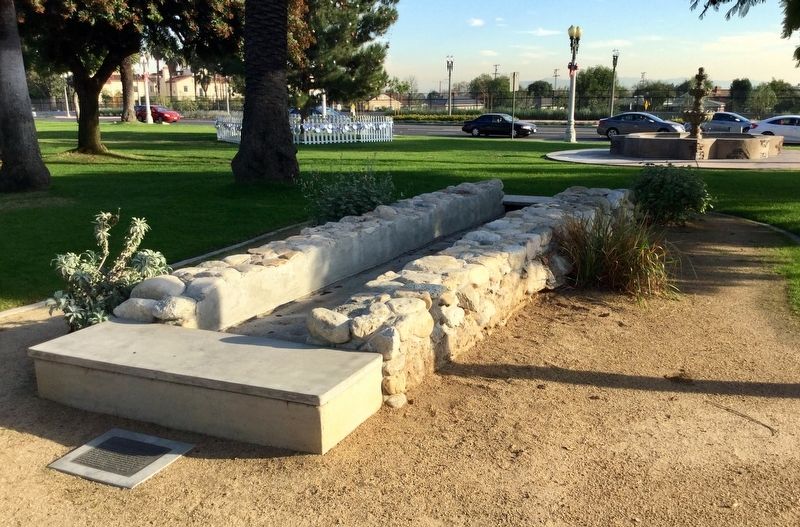
The mill fell into disrepair after the closure of the mission system in 1834, and its ruins were bulldozed in 1941. After an archaeological project exposed
Photographed by Craig Baker, December 20, 2018
2. Chapman’s Millrace & Marker
Erected 2013.
Topics. This historical marker is listed in these topic lists: Indigenous Peoples and Communities • Industry & Commerce • Settlements & Settlers.
Location. 34° 5.797′ N, 118° 6.457′ W. Marker is in San Gabriel, California, in Los Angeles County. It is at the intersection of Ramona Street and Mission Drive, on the right when traveling north on Ramona Street. Touch for map. Marker is at or near this postal address: 428 S Mission Drive, San Gabriel CA 91776, United States of America. Touch for directions.

Regionally, this marker is in Greater Los Angeles and in the Transverse Ranges. It is also on the American Pacific Coast. Globally, it is in North America, on the Ring of Fire, on the Pacific Rim, in the Western Hemisphere, in the Western World, and in the Anglosphere. Historically, it finds itself in what was once New Spain and also Mexico’s Alta California.
Photographed by Craig Baker, December 20, 2018
3. Chapman’s Millrace
Other nearby markers. At least 8 other markers are within walking distance of this marker: Joseph Chapman’s Millrace (a few steps from this marker); Los Pobladores (within shouting distance of this marker); Juan Bautista de Anza (within shouting distance of this marker); Mission San Gabriel Archangel / El Camino Real Door (within shouting distance of this marker); Lt. Colonel Juan Bautista de Anza (within shouting distance of this marker); A Welcome Destination (about 300 feet away, measured in a direct line); Arrival of Great Rejoicing (about 300 feet away); San Gabriel Mission (about 300 feet away). Touch for a list and map of all markers in San Gabriel.
Another marker is no longer nearby. Old Spanish Trail (was about 300 feet away but has been reported to have been replaced with another marker now near it).
Related marker. Click here for another marker that is related to this marker. - San Gabriel Mission Dam, built by Joseph Chapman.
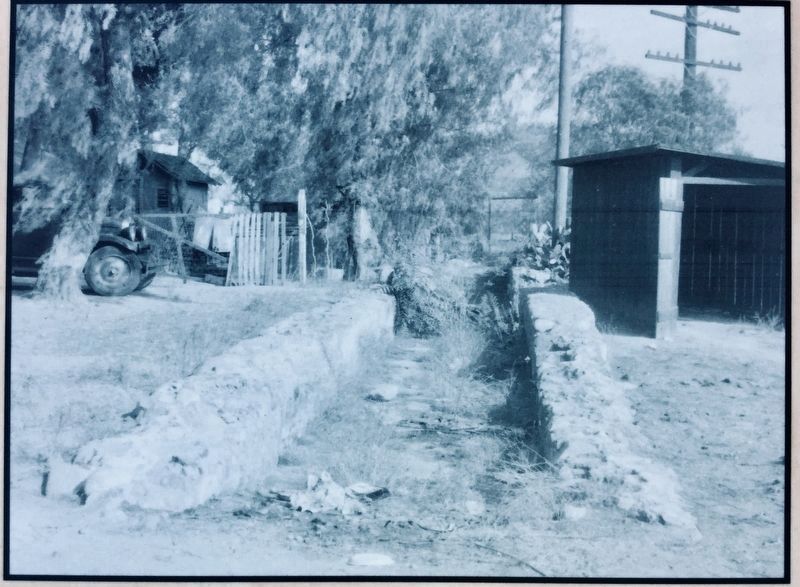
1935
4. Marker Detail
Photograph of Chapman's Millrace, ca. 1935.
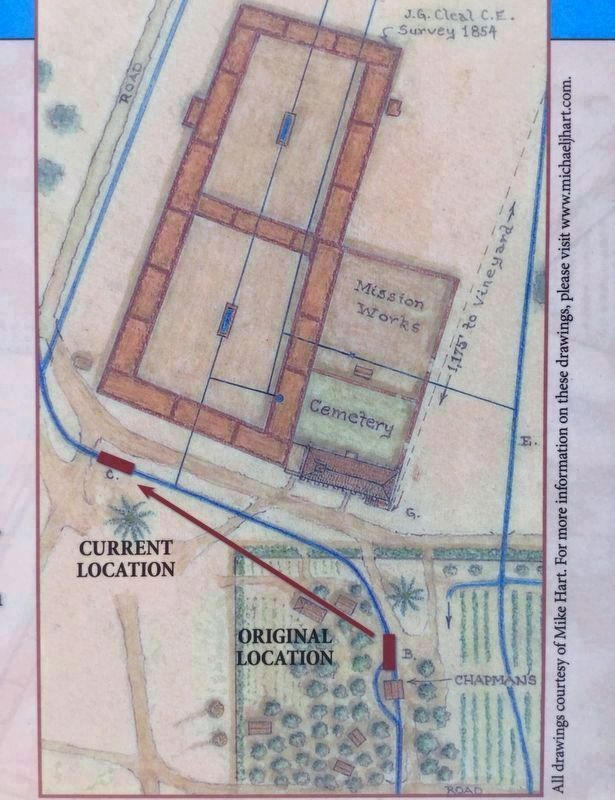
5. Marker Detail
Millrace location, based on historic maps.
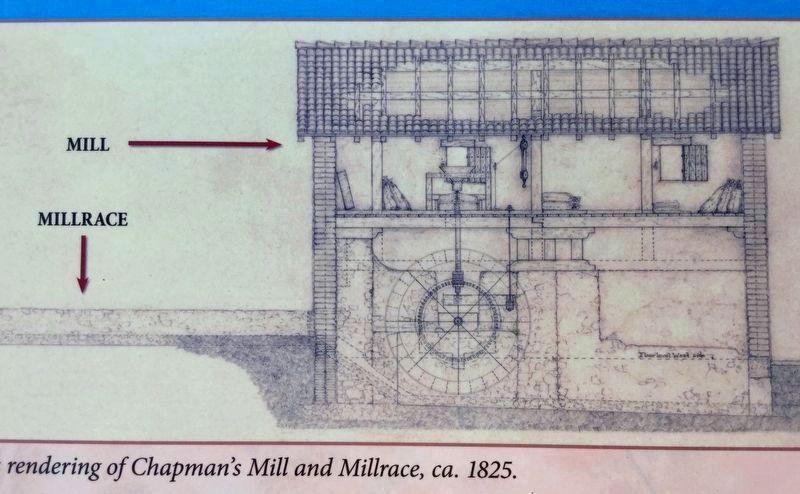
6. Marker Detail
Artist's rendering of Chapman's Mill and Millrace, ca. 1825.
Credits. This page was last revised on November 21, 2025. It was originally submitted on January 22, 2019, by Craig Baker of Sylmar, California. This page has been viewed 1,292 times since then and 135 times this year. Photos: 1, 2, 3, 4, 5, 6. submitted on January 22, 2019, by Craig Baker of Sylmar, California. • Andrew Ruppenstein was the editor who published this page.
