Near Centreville in Queen Anne's County, Maryland — The American Northeast (Mid-Atlantic)
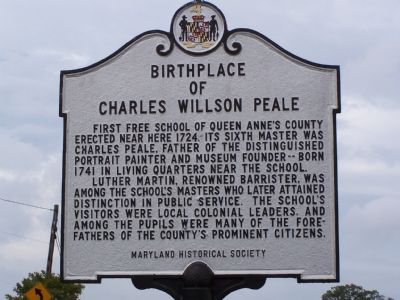
Birthplace of Charles Willson Peale
Photographed by Beverly Pfingsten, October 19, 2007
1. Birthplace of Charles Willson Peale Marker
Luther Martin, renowned barrister, was among the school’s masters who later attained distinction in public service. The school’s visitors were local colonial leaders and among the pupils were many of the forefathers of the County’s prominent citizens.
Erected 1971 by Maryland Historical Society.
Topics and series. This historical marker is listed in these topic lists: Arts, Letters, Music • Colonial Era. In addition, it is included in the Maryland Historical Trust series list. A significant historical year for this entry is 1724.
Location. 39° 1.643′ N, 76° 7.245′ W. Marker is near Centreville, Maryland, in Queen Anne's County. It is at the intersection of Maryland Route 18 and Wright’s Neck Road, on the left when traveling east on Maryland Route 18. This is found just ahead of the intersection. Touch for map. Marker is in this post office area: Centreville MD 21617, United States of America. Touch for directions.

Regionally,
this page online
Other nearby markers. At least 8 other markers are within 3 miles of this marker, measured as the crow flies: Queen Anne's County Museum of Eastern Shore Life (about 300 feet away, measured in a direct line); "All Gave Some - Some Gave All" (approx. 2.6 miles away); Veterans Memorial (approx. 2.6 miles away); U.S. Army M5/M6 Antitank Gun (approx. 2.7 miles away); The Gift of a Second Railroad (approx. 2.7 miles away); St. Paul's Episcopal Church (approx. 3 miles away); Centreville Wharf (approx. 3 miles away); Shuttled By Ship (approx. 3 miles away). Touch for a list and map of all markers in Centreville.
Also see . . . Charles Wilson Peale. Wikipedia entry (Submitted on April 23, 2025, by Larry Gertner of New York, New York.)

Photographed by Pete Skillman, May 6, 2025
2. Birthplace of Charles Willson Peale Marker - wide view
Photographed by Allen C. Browne, August 9, 2015
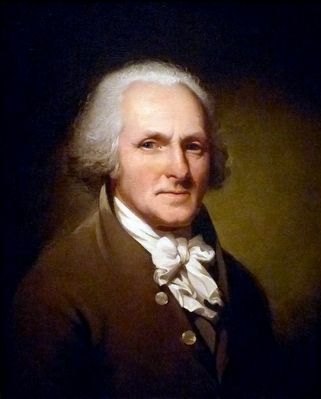
3. Charles Willson Peale
This self-portrait of Charles Willson Peale hangs in the National Portrait Gallery in Washington, DC.
“Charles Willson Peale is best remembered as an artist, but he was also the proprietor of the first important museum in America, the Philadelphia Museum of art and natural history. In his mid-forties, after painting hundreds of portraits of the powerful and elite, Peale began a lifelong undertaking: the creation of a new museum designed for a republic. While science museums in Europe placed their specimens in drawers, pinned flat to white cloth, Peale's museum, designed to involve large numbers of Americans in an educational experience, presented them to visitors in lifelike situations, labeled with their scientific names and ordered in the Linnaean classification. Anyone who could pay the twentyfive-cent admission fee could enter, unlike European institutions, which required special application. Peale also directed the first scientific expedition in America, which exhumed and assembled a mastodon skeleton, helping scientists prove the existence of prehistoric animals.
Three years after completing this self-portrait, Peale gave up portrait painting as his profession to focus on his museum.” — National Portrait Gallery
“Charles Willson Peale is best remembered as an artist, but he was also the proprietor of the first important museum in America, the Philadelphia Museum of art and natural history. In his mid-forties, after painting hundreds of portraits of the powerful and elite, Peale began a lifelong undertaking: the creation of a new museum designed for a republic. While science museums in Europe placed their specimens in drawers, pinned flat to white cloth, Peale's museum, designed to involve large numbers of Americans in an educational experience, presented them to visitors in lifelike situations, labeled with their scientific names and ordered in the Linnaean classification. Anyone who could pay the twentyfive-cent admission fee could enter, unlike European institutions, which required special application. Peale also directed the first scientific expedition in America, which exhumed and assembled a mastodon skeleton, helping scientists prove the existence of prehistoric animals.
Three years after completing this self-portrait, Peale gave up portrait painting as his profession to focus on his museum.” — National Portrait Gallery
Credits. This page was last revised on May 6, 2025. It was originally submitted on October 23, 2007, by Bill Pfingsten of Bel Air, Maryland. This page has been viewed 2,101 times since then and 34 times this year. Last updated on January 27, 2019, by Carl Gordon Moore Jr. of North East, Maryland. Photos: 1. submitted on October 23, 2007, by Bill Pfingsten of Bel Air, Maryland. 2. submitted on May 6, 2025, by Pete Skillman of Wilmington, Delaware. 3. submitted on August 29, 2015, by Allen C. Browne of Silver Spring, Maryland.
