Near Coulee City in Grant County, Washington — The American West (Northwest)
World's Greatest Waterfall... Without Water!
Photographed by Cosmos Mariner, July 31, 2015
1. World's Greatest Waterfall... Without Water! Marker
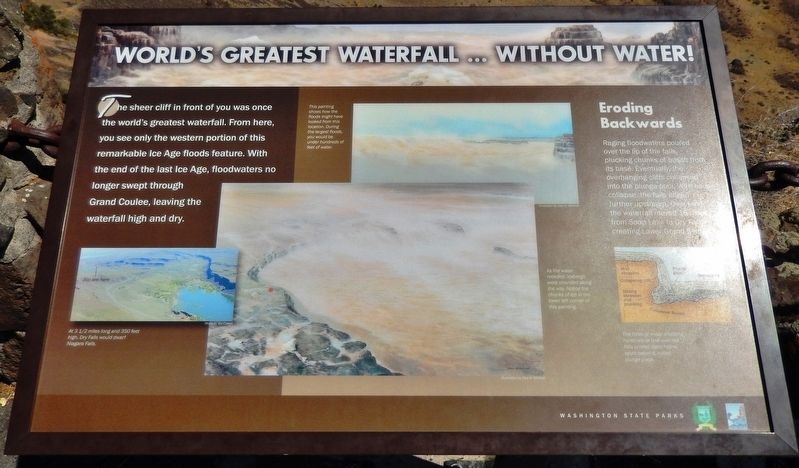
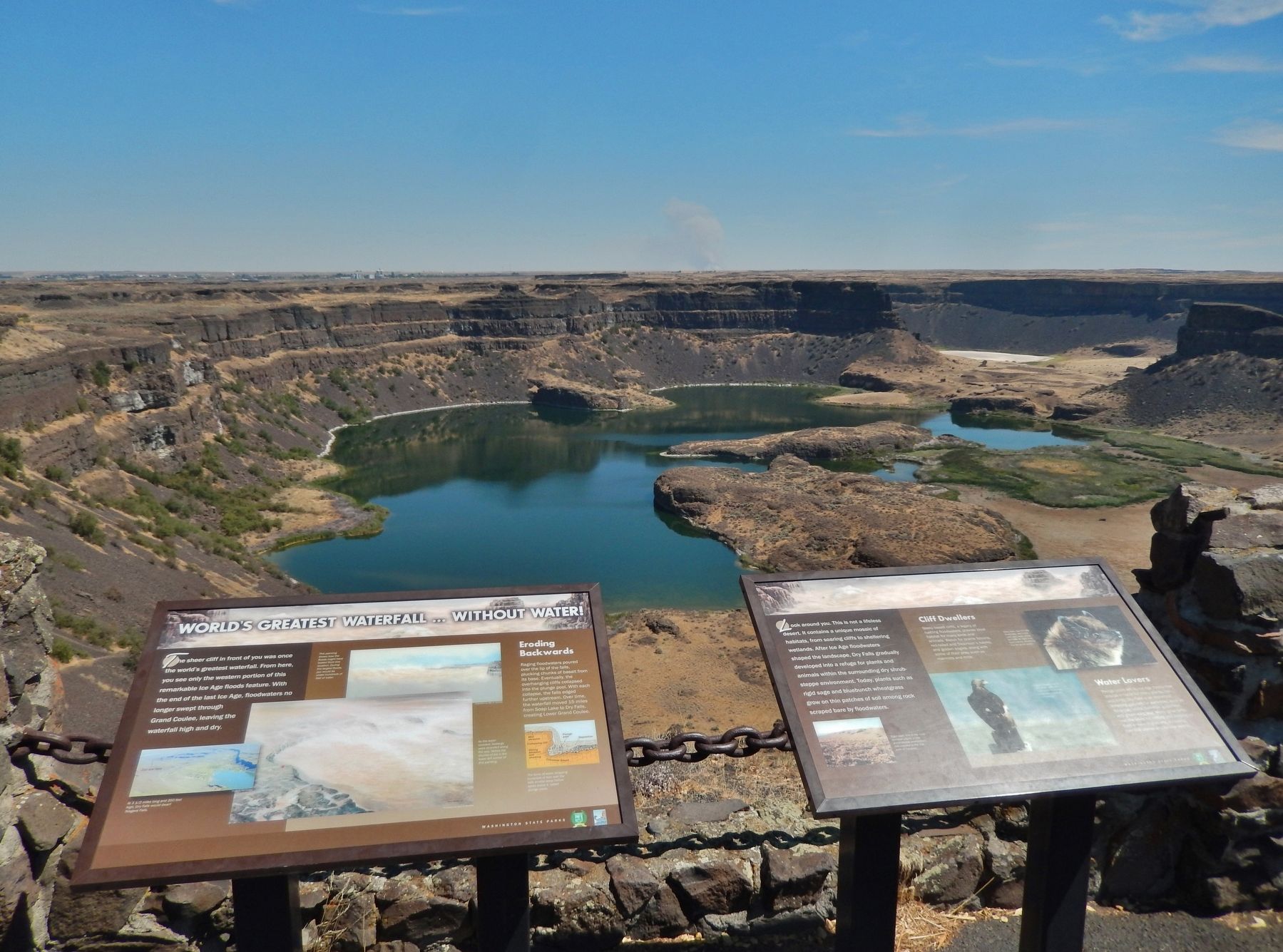
The sheer cliff in front of you was once the world's greatest waterfall. From here, you see only the western portion of this remarkable Ice Age floods feature. With the end of the last Ice Age, floodwaters no longer swept through Grand Coulee, leaving the waterfall high and dry.
Eroding Backwards
Raging floodwaters poured over the lip of the falls, plucking chunks of basalt from its base. Eventually, the overhanging cliffs collapsed into the plunge pool. With each collapse, the falls edged further upstream. Over time, the waterfall moved 18 miles from Soap Lake to Dry Falls, creating Lower Grand Coulee.
(top illustration caption)
This painting shows how the floods might have looked from this location. During the largest floods, you would be under hundreds of feet of water. Illustration by Stev H. Ominski
(right illustration caption)
The force of water dropping hundreds of feet over the falls eroded deep hollow spots below it, called plunge pools.
Erected by Washington State Parks.
Topics. This historical marker is listed in this topic list: Natural Features.
Location. 47° 36.429′ N,
this page online

Regionally, this marker is in the Columbia Basin. It is also in the American Mountain West and in the Lewis & Clark Corridor. Globally, it is in North America, on the Pacific Rim, in the Western Hemisphere, in the Western World, and in the Anglosphere.
Other nearby markers. At least 6 other markers are within 13 miles of this marker, measured as the crow flies: Explore Massive Floodscapes! (here, next to this marker); In the Path of Cataclysmic Floods (here, next to this marker); Dry Falls (a few steps from this marker); Story of Dry Falls (within shouting distance of this marker); The Cariboo Cattle Trail (approx. 6.7
Photographed by Cosmos Mariner, July 31, 2015
2. World's Greatest Waterfall... Without Water! Marker (wide view; Dry Falls Lake in background)
More about this marker. Marker is a metal-framed, composite plaque, mounted horizontally on waist-high metal posts.
Related markers. Click here for a list of markers that are related to this marker. Sun Lakes-Dry Falls State Park
Also see . . .
1. Sun Lakes-Dry Falls State Park. Washington State Parks website entry:
From lava flows to the Ice Age floods, and from the Native American legacy to the modern discovery of how Dry Falls was created, the Dry Falls story is revealed to tens of thousands of visitors each year. The Grand Coulee, of which Dry Falls is a central feature, has been designated as a National Natural Landmark by the National Park Service. (Submitted on February 8, 2019, by Cosmos Mariner of Cape Canaveral, Florida.)
2. Dry Falls. Wikipedia entry (Submitted on July 9, 2024, by Larry Gertner of New York, New York.)
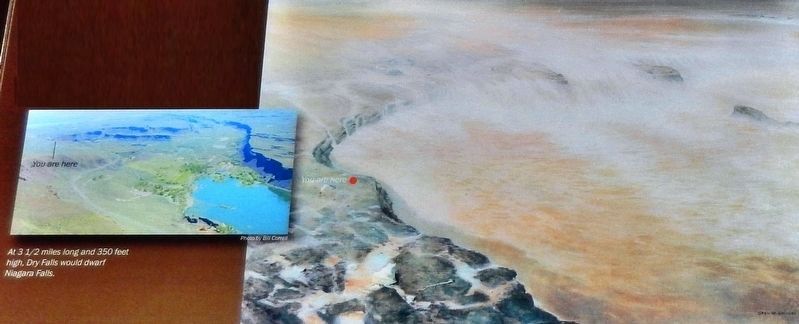
photo by Bill Correll; illustration by Stev H. Ominski
3. Marker detail: At 3 ½ miles long and 350 feet high, Dry Falls would dwarf Niagara Falls
As the water receded, icebergs were stranded along the way.
Photographed by Cosmos Mariner, July 31, 2015
4. Cliff Dwellers & Water Lovers (related adjacent marker)
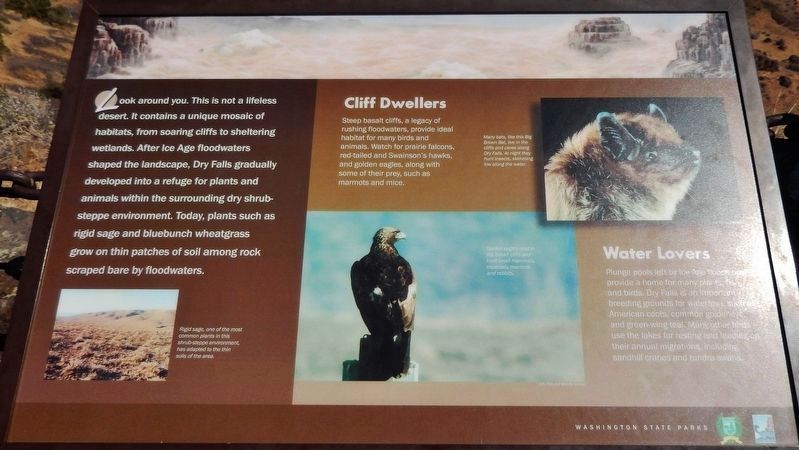
Look around you. This is not a lifeless desert. It contains a unique mosaic of habitats, from soaring cliffs to sheltering wetlands. After Ice Age floodwaters shaped the landscape, Dry Falls gradually developed into a refuge for plants and animals within the surrounding dry shrub-steppe environment. Today, plants such as rigid sage and bluebunch wheatgrass grow on thin patches of soil among rock scraped bare by floodwaters.
Cliff Dwellwers
Steep basalt cliffs, a legacy of rushing floodwaters, provide ideal habitat for many birds and animals. Watch for prairie falcons, red-tailed and Swainson's hawks, and golden eagles, along with some of their prey, such as marmots and mice.
Many bats, like this Big Brown Bat, live in the cliffs and caves along Dry Falls. At night they hunt insects, skimming low along the water.
Rigid sage, one of the most common plants in this shrub-steppe environment, has adapted to the thin soils of the area.
Golden eagles nest in the basalt cliffs and hunt small mammals, especially marmots and rabbits.
Water Lovers
Plunge pools left by Ice Age floods now provide a home for many plants, fish and birds. Dry Falls is an important breeding grounds for waterfowl, such as American coots, common goldeneye, and green-wing teal. Many other birds use the lakes for resting and feeding on their annual migrations, including sandhill cranes and tundra swans.
Cliff Dwellwers
Steep basalt cliffs, a legacy of rushing floodwaters, provide ideal habitat for many birds and animals. Watch for prairie falcons, red-tailed and Swainson's hawks, and golden eagles, along with some of their prey, such as marmots and mice.
Many bats, like this Big Brown Bat, live in the cliffs and caves along Dry Falls. At night they hunt insects, skimming low along the water.
Rigid sage, one of the most common plants in this shrub-steppe environment, has adapted to the thin soils of the area.
Golden eagles nest in the basalt cliffs and hunt small mammals, especially marmots and rabbits.
Water Lovers
Plunge pools left by Ice Age floods now provide a home for many plants, fish and birds. Dry Falls is an important breeding grounds for waterfowl, such as American coots, common goldeneye, and green-wing teal. Many other birds use the lakes for resting and feeding on their annual migrations, including sandhill cranes and tundra swans.
Credits. This page was last revised on December 28, 2024. It was originally submitted on February 8, 2019, by Cosmos Mariner of Cape Canaveral, Florida. This page has been viewed 1,270 times since then and 59 times this year. Photos: 1, 2, 3, 4. submitted on February 8, 2019, by Cosmos Mariner of Cape Canaveral, Florida. • Bill Pfingsten was the editor who published this page.
