Centro histórico de Morelia , Michoacán, Mexico — The Pacific Coast (and Central Highlands)
Garden of the Roses
Photographed by J. Makali Bruton, January 27, 2019
1. Garden of the Roses Marker

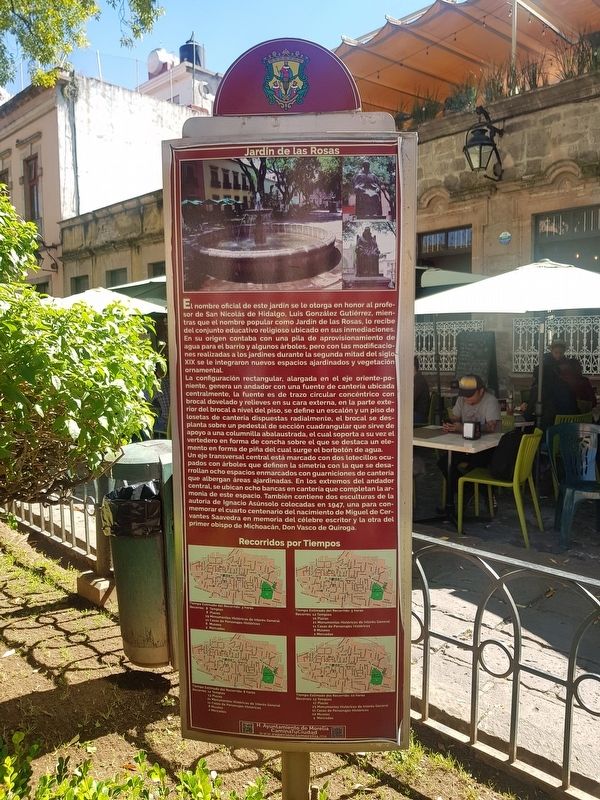
Jardín de las Rosas
El nombre oficial de este jardín se le otorga en honor al profesor de San Nicolás de Hidalgo, Luis González Gutiérrez, mientras que el nombre popular como Jardín de las Rosas, lo recibe del conjunto educativo religioso ubicado en sus inmediaciones. En su origen contaba con una pila de aprovisionamiento de agua para el barrio y algunos árboles, pero con las modificaciones realizadas a los jardines durante la segunda mitad del siglo XIX se le integraron nuevos espacios ajardinados y vegetación ornamental.
La configuración rectangular, alargada en el eje oriente-poniente, genera un andador con una fuente de cantería ubicada centralmente, la fuente es de trazo circular concéntrico con brocal dovelado y relieves en su cara externa, en la parte exterior del brocal a nivel del piso, se define un escalón y un piso de losetas de canteria dispuestas radialmente, el brocal se desplanta sobre un pedestal de sección cuadrangular que sirve de apoyo a una columnilla abalaustrada, el cual soporta a su vez el vertedero en forma de concha sobre el que se destaca un elemento en forma de piña del cual surge el borbotón
this page online
Un eje transversal central está marcado con dos lotecillos ocupados con árboles que definen la simetria con la que se desarrollan ocho espacios enmarcados con guarniciones de cantería que albergan áreas ajardinadas. En los extremos del andador central, se ubican ocho bancas en canteria que completan la armonía de este espacio. También contiene dos esculturas de la autoría de Ignacio Asúnsolo colocadas en 1947, una para conmemorar el cuarto centenario del nacimiento de Miguel de Cervantes Saavedra en memoria del célebre escritor y la otra del primer obispo de Michoacán, Don Vasco de Quiroga.
Garden of the Roses
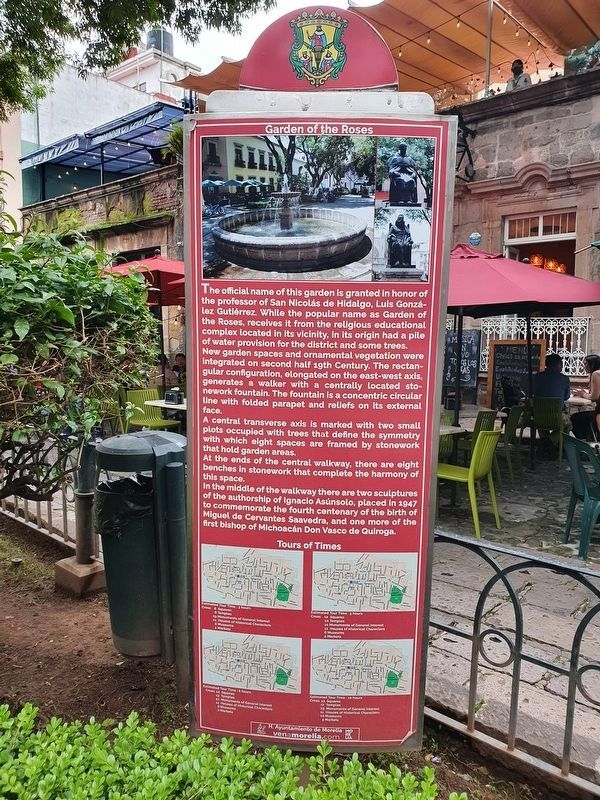
The official name of this garden is granted in honor of the professor of San Nicolás de Hidalgo, Luis González Gutiérrez. While the popular name as Garden of the Roses, receives it from the religious educational complex located in its vicinity, in its origin had a pile of water provision for the district and some trees. New garden spaces and ornamental vegetation were integrated on second half 19th Century. The rectangular configuration, elongated on the east-west axis, generates a walker with a centrally
Photographed by J. Makali Bruton, September 28, 2021
2. Garden of the Roses Marker English text
A central transverse axis is marked with two small plots occupied with trees that define the symmetry with which eight spaces are framed by stonework that hold garden areas.
At the ends of the central walkway, there are eight benches in stonework that complete the harmony of this space.
In the middle of the walkway there are two sculptures of the authorship of Ignacio Asúnsolo, placed in 1947 to commemorate the fourth centenary of the birth of Miguel de Cervantes Saavedra, and one more of the first bishop of Michoacán Don Vasco de Quiroga.
Erected by El Honorable Ayuntamiento de Morelia.
Topics. This historical marker is listed in this topic list: Parks & Recreational Areas. A significant historical year for this entry is 1947.
Location. 19° 42.273′ N, 101° 11.67′ W. Marker is in Morelia, Michoacán. It is in Centro histórico de Morelia. It is on Calle de Santiago Tapia just east of El Nigromante, on the right when traveling east. Touch for map. Marker is in this post office area: Morelia MIC 58000,
Photographed by J. Makali Bruton, January 27, 2019
3. Garden of the Roses Marker
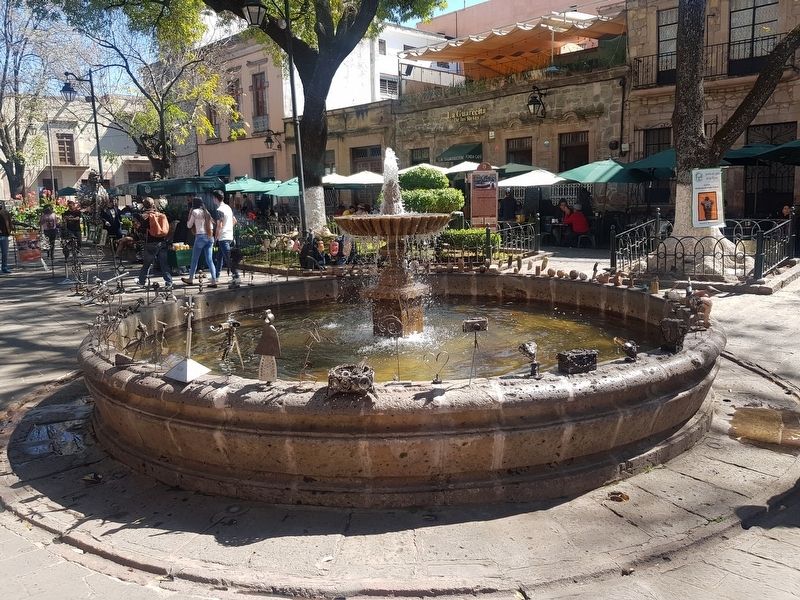
The marker can be seen in the distance behind the fountain described in the marker text.

Regionally, this marker is in Western Mexico, in the Bajío, and on the Pacific Coast. Globally, it is in North America, specifically in Mesoamerica, on the Ring of Fire, on the Pacific Rim, and in the Western Hemisphere. Historically, it finds itself in what was once New Spain, a Spanish colony, and the Aztec Empire.
Other nearby markers. At least 8 other markers are within walking distance of this marker: José Rubén Romero Theater (within shouting distance of this marker); Dr. Ignacio Chávez (about 150 meters away, measured in a direct line); El Colegio Primitivo y Nacional de San Nicolás de Hidalgo (about 180 meters away); General Mariano Matamoros (about 180 meters away); Public Library of Morelia (about 180 meters away); Sorinne Font (about 180 meters away); University Public Library (about 180 meters away); Dr. Manuel Martínez Solórzano (about 180 meters away). Touch for a list and map of all markers in Morelia.
Photographed by J. Makali Bruton, January 27, 2019
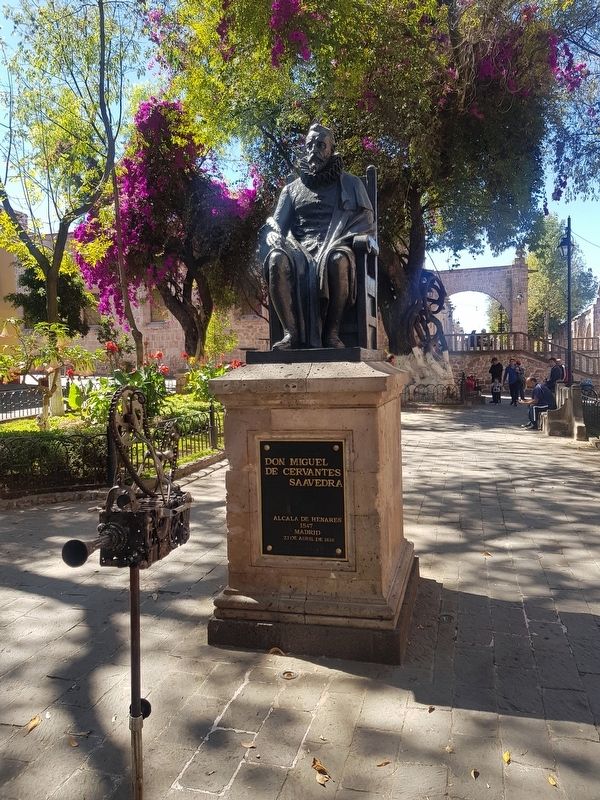
4. The statue celebrating the 400th anniversary of the birth of Miguel Cervantes
Alcala de Henares 1547
Madrid 23 de abril de 1616
Al crear la locura de Don Quijote de la Mancha, labro el monumento eterno del genio hispano. Morelia, castellana y nobilísima, rinde homenaje a la grandeza del inmortal soldado de Lepanto en el cuarto centenario de su natalicio.
18 de mayo de 1947
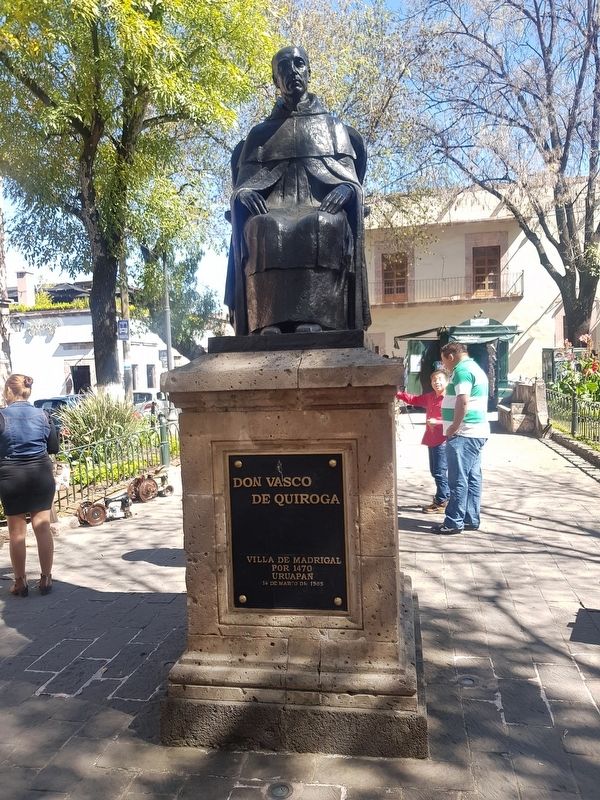
Photographed by J. Makali Bruton, January 27, 2019
5. The statue of Vasco de Quiroga mentioned in the marker text
Villa de Madrigal por 1470
Uruapan 14 de marzo de 1565
Viandante: Este es el Tata Vasco, Oidor de la Segunda Audiencia de Mexico, ilustre Obispo de Michoacan, humanista excelso y padre de los indios tarascos. ¡Descubrete!
18 de mayo de 1947
Credits. This page was last revised on April 4, 2025. It was originally submitted on February 9, 2019, by J. Makali Bruton of Washington, District of Columbia. This page has been viewed 394 times since then and 41 times this year. Photos: 1. submitted on February 9, 2019, by J. Makali Bruton of Washington, District of Columbia. 2. submitted on October 22, 2021, by J. Makali Bruton of Washington, District of Columbia. 3, 4, 5. submitted on February 9, 2019, by J. Makali Bruton of Washington, District of Columbia.
