DelSo in Albany in Albany County, New York — The American Northeast (Mid-Atlantic)
First Plastic
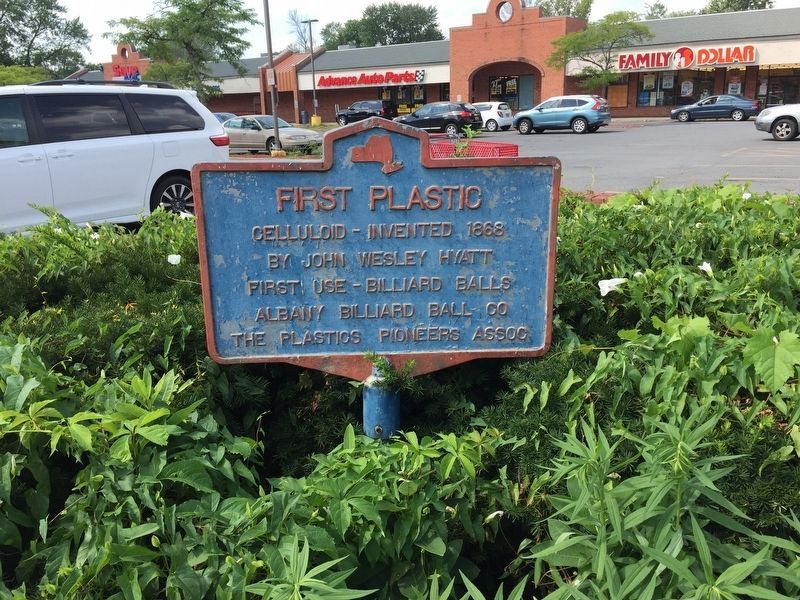
Photographed by Steve Stoessel, September 3, 2018
1. First Plastic Marker
Celluloid-invented 1868
by John Wesley Hyatt
First Use- Billiard Balls
Albany Billiard Ball Co.
Erected by Plastic Pioneers Assoc.
Topics. This historical marker is listed in these topic lists: Industry & Commerce • Science & Medicine. A significant historical year for this entry is 1868.
Location. 42° 38.382′ N, 73° 47.174′ W. Marker is in Albany, New York, in Albany County. It is in DelSo. It is at the intersection of Delaware Avenue (New York State Route 443) and Southern Boulevard (U.S. 9W), on the right when traveling south on Delaware Avenue. Touch for map. Marker is at or near this postal address: 489 Delaware Avenue, Albany NY 12209, United States of America. Touch for directions.

Regionally, this marker is in Upstate New York and in the Capital District. It is also in the American Northeast and in the Mid-Atlantic. Globally, it is in North America, the Western Hemisphere, the Western World, and the Anglosphere. Historically, it finds itself in what was once New Netherland and also one of the original Thirteen Colonies.
Other nearby markers. At least 8 other markers are within 2 miles of
this page online
More about this marker. This is the site of the Albany Billiard Ball Co.
Regarding First Plastic. John Hyatt patented celluloid April 6, 1869. He intended to use it as a substitute for ivory in the production of billiard balls. It was a good match for ivory in elasticity and density; however, the combustibility of nitrocellulose, the principle ingredient of celluloid, could cause a small explosion when two balls collided violently.
In the mid-nineteenth century, billiard balls were made of ivory. The growing popularity of the game, along with a common belief that ivory was in short supply, led to a search for an ivory substitute. Phelan and Collender, a leading manufacturer of billiard supplies, offered a $10,000 reward to find one.
Celluloid is prepared by a complicated 23 step process that combined several ingredients including camphor, alcohol, acid with 70-80% nitrocellulose. Nitrocellulose, also known as pyroxylin, flash paper and gun cotton, is highly flammable, and certain conditions, explosive.
Occasionally, as Hyatt himself recalled, two balls hitting each other would produce “a mild explosion like a percussion guncap.” “We had a letter from a billiard saloon proprietor in Colorado, mentioning this fact and saying that he did not care so much about it, but that instantly every man in the room pulled his gun.”
Also see . . . Exploding billiard balls - Smithsonianmag.com. (Submitted on September 5, 2018, by Steve Stoessel of Niskayuna, New York.)
Credits. This page was last revised on September 2, 2026. It was originally submitted on September 3, 2018, by Steve Stoessel of Niskayuna, New York. This page has been viewed 908 times since then and 61 times this year. Last updated on February 16, 2019, by Steve Stoessel of Niskayuna, New York. Photo 1. submitted on September 3, 2018, by Steve Stoessel of Niskayuna, New York. • Andrew Ruppenstein was the editor who published this page.
