Waynesboro in Burke County, Georgia — The American South (South Atlantic)
Shell Bluff
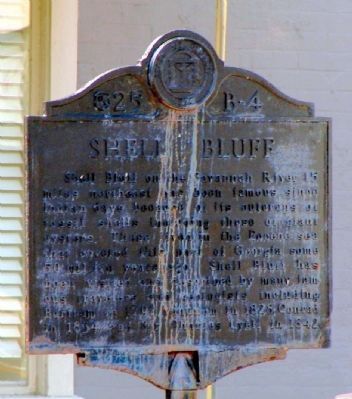
Photographed by David Seibert, July 17, 2005
1. Shell Bluff Marker
Erected by Works Progress Administration. (Marker Number 25 B-4.)
Topics and series. This historical marker is listed in these topic lists: Environment • Exploration • Science & Medicine. In addition, it is included in the Georgia Historical Society, the William Bartram Trails, and the Works Progress Administration (WPA) projects series lists. A significant historical year for this entry is 1791.
Location. 33° 5.485′ N, 82° 0.998′ W. Marker is in Waynesboro, Georgia, in Burke County. It is at the intersection of North Liberty Street (U.S. 25) and East 7th Street, on the right when traveling north on North Liberty Street. Marker is against a building on the southeast corner of the intersection;
this page online

Regionally, this marker is on the Coastal Plain. It is also in the American South and specifically in the Deep South. Globally, it is in North America, the Western Hemisphere, the Western World, and the Anglosphere. Historically, it finds itself in what was once the territory of the Mississippian Culture, one of the original Thirteen Colonies, one of the Confederate States of America, and the Antebellum South.
Other nearby markers. At least 8 other markers are within walking distance of this marker: Burke County's 8 Governors (about 400 feet away, measured in a direct line); Lost Burke County Men S.S. Otranto (about 400 feet away); Burke County (about 400 feet away); Burke County Veterans Memorial (about 500 feet away); Washington’s Southern Tour (about 500 feet away); Waynesborough (about 500 feet away); To Honor George Washington (approx. 0.2 miles away); First Presbyterian Church (approx. 0.2 miles away). Touch for a list and map of all markers in Waynesboro.
Additional commentary.
1. Noteworthy Shell Bluff Visitors
This marker’s list of noteworthy visitors begins with a name that represents two persons. John Bartram and his son William from Philadelphia visited the site in September 1765. Their visit occurred during an expedition through the Carolinas, Georgia and British East Florida from July 1765 until March 1766, This journey was undertaken following the elder Bartram’s appointment as the King’s Botanist for the British Colonies of North America. The year 1791 cited on the marker is the publication date for William Bartram’s Bartram’s Travels, an account of his extensive expedition through the southern colonies from 1773 until 1777. Although William probably did not revisited Shell Bluff during his return to the south, in Travels William describes Shell Bluff as a “curious phenomenon.” Bartram’s Travels remains in print and is also available online.
The next two listed visitors were early American geologists. Lardner Vanuxem, born Philadelphia, 1792, was educated as a geologist in Paris. He served as chair of chemistry and mineralogy at Columbia College in South Carolina from 1819 until 1826. Vaneuxem’s later career was as a professional geologist in New York state. Timothy Abbott Conrad, born Trenton, 1803, specialized in the study of shells. Conrad gave the name Ostrea georgiana to the type of large fossilized shell found at Shell Bluff.
Charles Lyell’s visit was during his journey through Canada and the United States from 1841 until 1842. Several destinations during his trip were sites that John or William Bartram visited and described during the 18th century. In 1845 Lyell published his account as Travels in North America. In Volume 1 of his Travels, Lyell wrote that he “fossilized for three days very diligently at Shell Bluff.” Lyell’s Travels are available online. Lyell was knighted in 1848, so during the visit he was not yet “Sir Charles,” as this marker identifies him.
During the 19th century the site on the Savannah River, locally known as “Shell Bluff Landing,” was a boarding point for commercial river traffic. The property is now privately owned and is not publicly accessible.
— Submitted August 12, 2012, by Harry Gatzke of Huntsville, Alabama.
Credits. This page was last revised on November 16, 2019. It was originally submitted on October 30, 2008, by David Seibert of Sandy Springs, Georgia. This page has been viewed 5,450 times since then and 251 times this year. Photo 1. submitted on October 30, 2008, by David Seibert of Sandy Springs, Georgia. • Kevin W. was the editor who published this page.
Editor’s want-list for this marker. A wide shot of the marker and its surroundings. • Can you help?
