The Dingolshausen Charburner and Gambrinus Invite You...
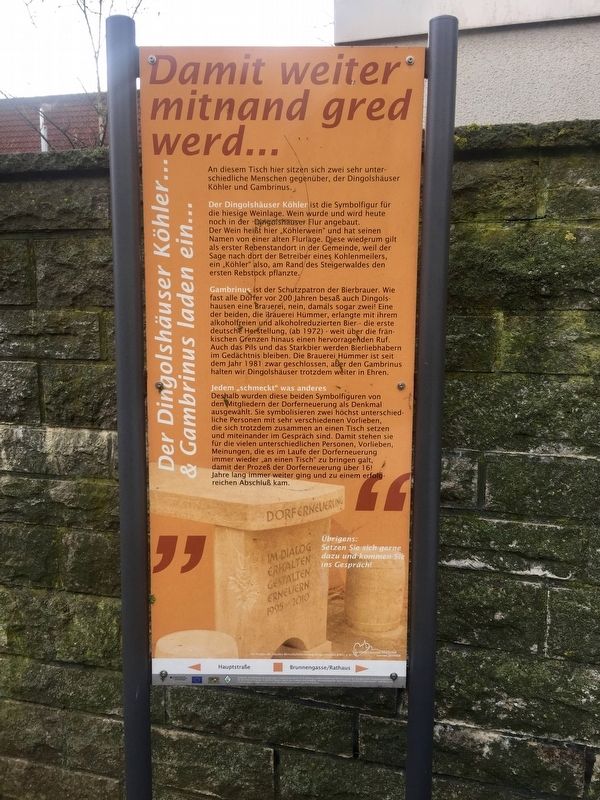

Der Dingolshäuser Köhler ist die Symbolfigur für die hiesige Weinlage. Wein wurde und wird heute noch in der Dingolshauser Flur angebaut. Der Wein heißt hier "Köhlerwein” und hat seinen Namen von einer alten Flurlage. Diese wiederum gilt als erster Rebenstandort in der Gemeinde, weil der Sage nach dort der Betreiber eines Kohlenmeilers ein "Köhler” also, am Rand des Steigerwaldes den ersten Rebstock pflanzte.
Gambrinus ist der Schutzpatron der Bierbrauer. Wie fast alle Dorfer vor 200 Jahren besaß auch Dingolshausen eine Brauerei, nein, damals sogar zwei! Eine der beiden, die Brauerei Hümmer, erlangte mit ihrem alkoholfreien und alkoholreduzierten Bier - die erste deutsche Herstellung, (ab 1972) - weit über die fränkischen Grenzen hinaus einen hervorragenden Ruf. Auch das Pils und das Starkbier werden Bierliebhabern im Gedächtnis bleiben. Die Brauerei Hümmer ist seit dem Jahr 1981 zwar geschlossen, aber den Gambrinus halten wir Dingolshäuser trotzdem weiter in Ehren.
Jedem "schmeckt” was anderes
Deshalb
this page online
-
At this table are sitting two very different people opposite each other, the Dingolshausen Charburner and Gambrinus.
The Dingolhausen charburner is the symbol of the local wine production. Wine was and is still grown today in the Dingolshauser area. The wine here is called "Köhlerwein" and is named after an old vineyard site, which in turn was the first vineyard location in the community because, according to legend, the operator of a coal mine located a "Köhler" (Charburner) on the edge of the Steigerwald.
Gambrinus is the patron saint of beer
To each, their own taste. Therefore, these two symbolic figures have been selected as a memorial by the members of the village renewal, symbolizing two very different people with very different preferences, who nevertheless sit down together and talk to each other. Many different people, preferences, opinions, which had to be brought to the table again and again in the course of the village renewal, so that the process of village renewal went on for over 16 years (!) and came to a successful conclusion.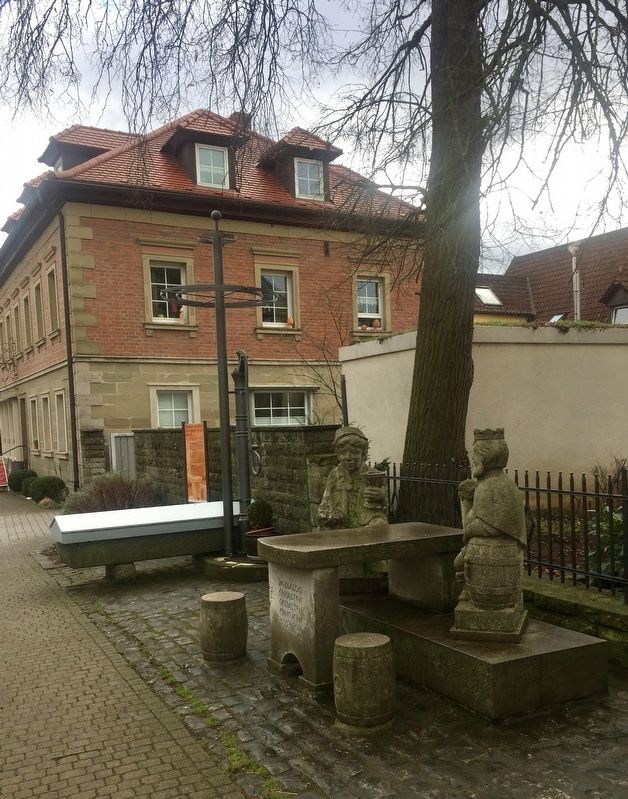
Topics. This historical marker is listed in these topic lists: Agriculture • Industry & Commerce. A significant historical year for this entry is 1981.
Location. 49° 54.374′ N, 10° 23.317′ E.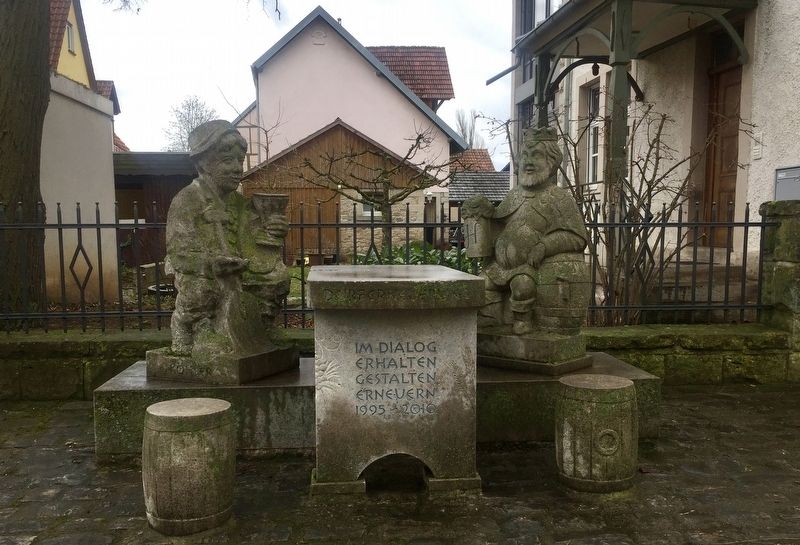

Regionally, this marker is in German Franconia. Globally, it is in Europe, the European Union, Atlantic Europe, Central Europe, the Schengen Area, Western Europe, and the Western World. Historically, it finds itself in what was once the Holy Roman Empire and also the former West Germany.
Other nearby markers. At least 8 other markers are within 3 kilometers of this marker, measured as the crow flies: Dingolshäuser Gate (approx. 2.6 kilometers away); The Decline of the Jewish Community of Gerolzhofen from January 30, 1933 (approx. 2.7 kilometers away); Prison Tower (approx. 2.7 kilometers away); Fachwerkhaus Teutsch / Teutsch Building (approx. 2.8 kilometers away); The Former Adminstrative Building (approx. 2.8 kilometers away); Schallfelder Tor / Schallfeld Gate (approx. 2.8 kilometers away); Rügshöfer Tor / Ruegshoefer Gate (approx. 2.8 kilometers away); Spital Gate (approx. 2.8 kilometers away).
Credits. This page was last revised on January 28, 2022. It was originally submitted on March 29, 2019, by Andrew Ruppenstein of Lamorinda, California. This page has been viewed 215 times since then and 18 times this year. Photos: 1, 2, 3. submitted on March 29, 2019, by Andrew Ruppenstein of Lamorinda, California.
