Blakeley in Baldwin County, Alabama — The American South (East South Central)
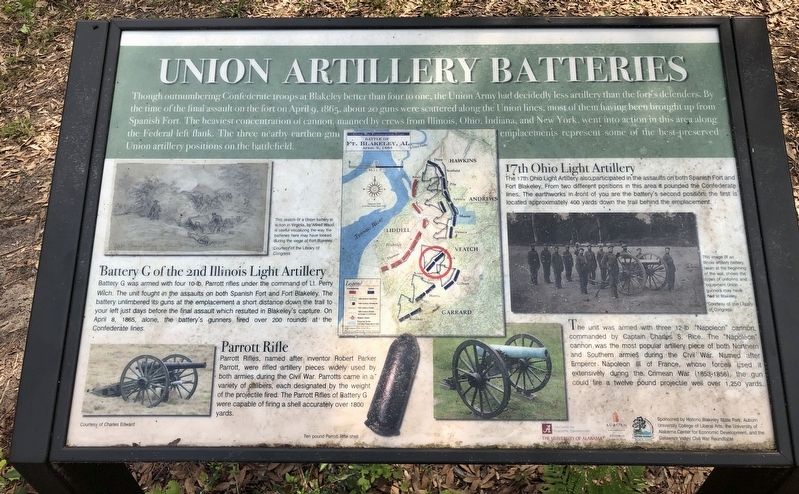
Union Artillery Batteries
Photographed by Mark Hilton, April 6, 2019
1. Union Artillery Batteries Marker
Battery G of the 2nd Illinois Light Artillery
Battery G was armed with four 10-lb. Parrott rifles under the command of Lt. Perry Wilch. The unit fought in the assaults on both Spanish Fort and Fort Blakeley. The battery unlimbered its guns at the emplacement a short.distance down the trail to your left just days before the final assault which resulted in Blakeley's capture. On April 8, 1865, alone, the battery's gunners fired over 200 rounds at the Confederate lines.
Parrott Rifle
this page online
Parrott Rifles, named after, inventor Robert Parker Parrott, were rifled artillery pieces widely used by both armies during the Civil War. Parrotts came in a variety of calibers, each designated by the weight of the projectile fired. The Parrott Rifles of Battery G were capable of firing a shell accurately over 1800 yards.
17th Ohio Light Artillery
The 17th Ohio Light Artillery also.participated in the assaults on both Spanish Fort and Fort Blakeley. From two different positions in this area it pounded the Confederate lines. The earthworks in front of you are the battery's second position; the first is located approximately 400 yards down the trail behind the emplacement.
The unit was armed with three 12-lb. "Napoleon" cannon, commanded by Captain Charles S. Rice. The "Napoleon" cannon was the most popular artillery piece of both Northern and Southern armies during the Civil War. Named after Emperor Napoleon III of France, whose forces used it extensively during the Crimean War (1853-1856), the gun could fire a twelve pound projectile well over 1,250 yards.
Photo captions:
Top left: This sketch of a Union battery in action in Virginia, by Alfred Waud, is useful visualizing the way the batteries here may have looked during the siege of Fort Blakeley.
Middle right: This image of an Illinois artillery battery, taken at the beginning of the war, shows the types of uniforms and equipment Union gunners may have had at Blakeley.
Erected 2017
Courtesy of American Battlefield Trust ©, 2019
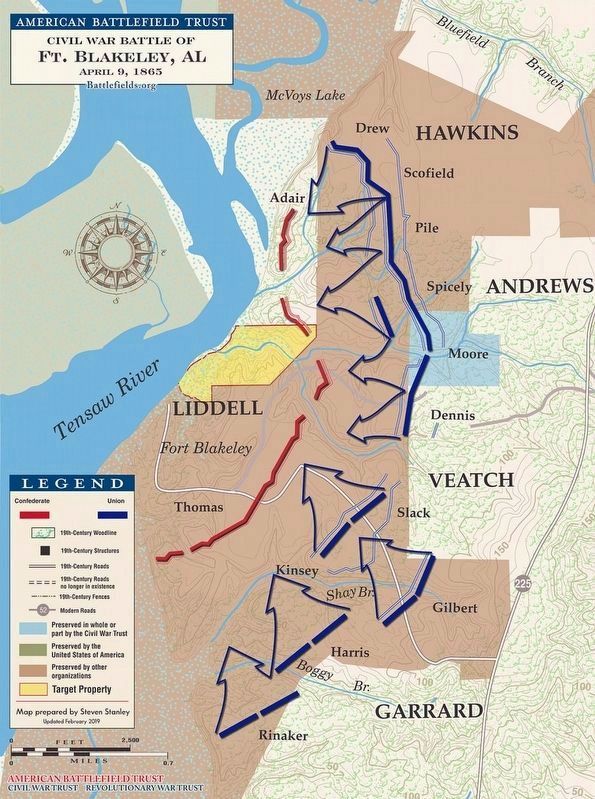
2. Civil War Trust map of the Battle of Ft. Blakeley (April 9, 1865).
Topics. This historical marker is listed in this topic list: War, US Civil. A significant historical date for this entry is April 9, 1865.
Location. 30° 44.274′ N, 87° 54.634′ W. Marker is in Blakeley, Alabama, in Baldwin County. It is on Union Trail Loop west of Old Blakeley Road, on the left. Located in Historic Blakeley Park. Touch for map. Marker is at or near this postal address: Union Trail Loop, Daphne AL 36527, United States of America. Touch for directions.

Regionally, this marker is on the Gulf Coast and in the Mobile Bay area. It is also in the American South, specifically in the Deep South, and on the Gulf Coast. Globally, it is in North America, a Gulf of Mexico state, the Western Hemisphere, the Western World, and the Anglosphere. Historically, it finds itself in what was once New Spain, the Viceroyalty of New France, the territory of the Mississippian Culture, one of the Confederate States of America, and the Antebellum South.
Other nearby markers. At
Photographed by Mark Hilton, April 6, 2019
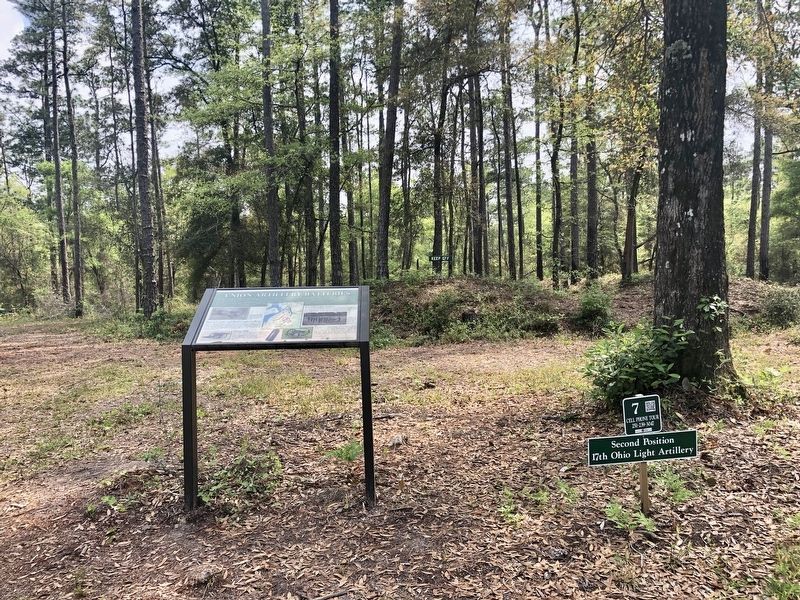
3. Union Artillery Batteries Marker with earthworks in background.
Also see . . . Battle of Fort Blakeley - The War Ends and the Battle Begins. (Submitted on April 7, 2019, by Mark Hilton of Montgomery, Alabama.)
Photographed by Mark Hilton, April 6, 2019
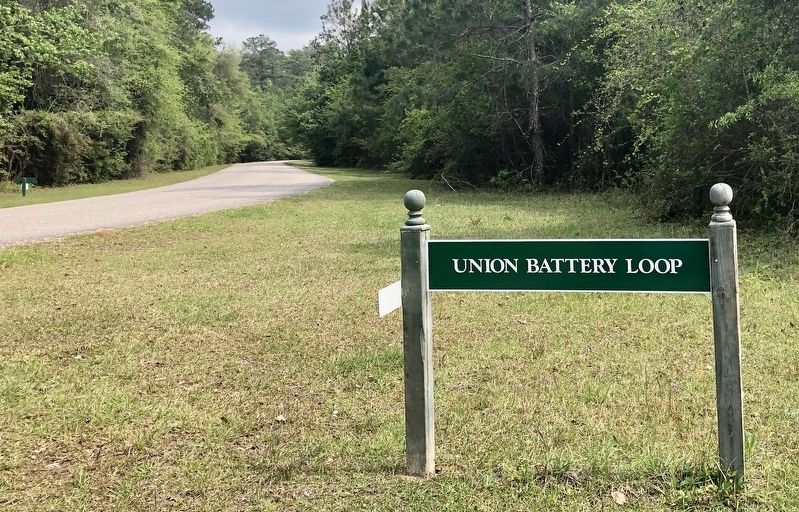
4. Trail loop leading to marker.
Credits. This page was last revised on May 2, 2019. It was originally submitted on April 7, 2019, by Mark Hilton of Montgomery, Alabama. This page has been viewed 1,092 times since then and 64 times this year. Photos: 1, 2, 3, 4. submitted on April 7, 2019, by Mark Hilton of Montgomery, Alabama.
