Penn Quarter in Northwest Washington in Washington, District of Columbia — The American Northeast (Mid-Atlantic)
The Church of the Epiphany
Civil War to Civil Rights
| — | Downtown Heritage Trail | — |
Photographed by Richard E. Miller, April 4, 2010
1. The Church of the Epiphany Marker
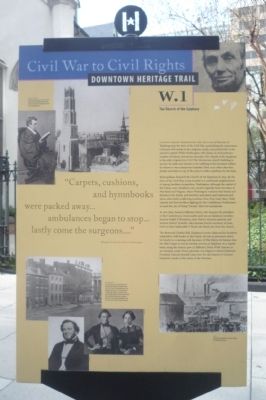
“Carpets, cushions,
and hymnbooks
were packed away…
ambulances began to stop…
lastly come the surgeons....”
Margaret Leech, Reveille in Washington.
Church spires dominated the skyline of the city of Washington at the time of the Civil War, symbolizing the importance of houses of worship in the religious, social and political life of the nation’s capital. While Washington still claims an extraordinary number of historic downtown churches, the Church of the Epiphany is the only original pre-Civil War downtown church building to survive. Its walls were witness to the suffering of the wounded soldiers for whom it was a temporary hospital. Here, as in other churches, planks were laid on top of the pews to make a platform for the beds.
Episcopalians founded the Church of the Epiphany in 1842. By the time of the Civil War, it was located in a residential neighborhood of strong Southern sympathies. Washington, although the capital of the Union, was a Southern city, carved originally from the states of Maryland and Virginia. Many Washington residents had family and friends in the South, and brothers and sisters and husbands and wives and wives often held conflicting loyalties. Even First Lady Mary Todd Lincoln had three brothers fighting for the Confederacy. Northerners accused the city of being “Secesh,” short for secessionist.
At one time, Senator Jefferson Davis, who became the president of the Confederacy, lived nearby and was an Epiphany member. Senator Judah P. Benjamin, later Davis’s attorney general, and Senator Robert Toombs, who became Davis’s secretary of state, lived on then-fashionable F Street one block over from the church.
The Reverend Charles Hall, Epiphany’s rector, balanced his Southern sympathies with loyalty to the Union. He was so persuasive about his loyalty in a meeting with Secretary
this page online
Erected by Cultural Tourism DC. (Marker Number W.1.)
Topics and series. This historical marker is listed in these topic lists: Government & Politics • Religion & Religious Structures • War, US Civil. In addition, it is included in the Downtown Heritage Trail, and the Former U.S. Presidents: #16 Abraham Lincoln series lists. A significant historical year for this entry is 1842.
Location. This marker has been replaced by another marker nearby. It was located near 38° 53.905′ N, 77° 1.822′ W. Marker was in Northwest Washington in Washington, District of Columbia. It was in the Penn Quarter. It was on G Street Northwest west of 13th Street Northwest, on the right when traveling west. Touch for map. Marker was at or near this postal address: 1317 G Street Northwest, Washington DC 20005,
Photographed by Richard E. Miller, April 4, 2010
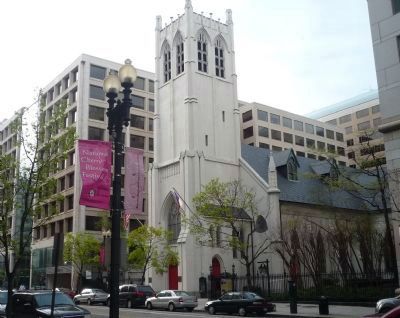
2. The Church of the Epiphany Marker
visible at sidewalk, to the right of main entrance.

Regionally, this marker was in the Washington Metropolitan Area. It was also in the American Northeast, in the Upper South, in the Mid-Atlantic, in the Tidewater, and in the Chesapeake Bay Region. Globally, it was in North America, the Western Hemisphere, the Western World, and the Anglosphere.
Other nearby markers. At least 8 other markers are within walking distance of this location: A different marker also named The Church of the Epiphany (here, next to this marker); Dorothea Dix 1802 - 1887 (a few steps from this marker); Jane Addams 1860 - 1935 (a few steps from this marker); Susan B. Anthony 1820 - 1906 (a few steps from this marker); Ida Wells-Barnett 1862 - 1921 (a few steps from this marker); W.E.B. DuBois 1868 - 1963 & Mary White Ovington 1865-1951 (within shouting distance of this marker); Luther and Charlotte Gulick (within shouting distance of this marker); Flora Molton (within shouting distance of this marker). Touch for a list and map of all markers in Northwest Washington.
Regarding The Church of the Epiphany. U.S. National Register of Historic Places
Photographed by Richard E. Miller, April 4, 2010
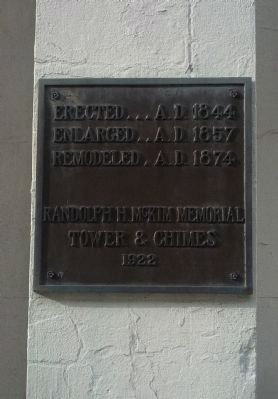
3. The Church of the Epiphany - plaque at main entrance
Enlarged ... A.D. 1857
Rebuilt ... A.D. 1874
Randolph H. McKim Memorial
Tower & Chimes - 1922
Related marker. Click here for another marker that is related to this marker. This marker has been replaced with the linked marker, which has slightly different text.
Also see . . . The Church of the Epiphany - history. Church website entry (Submitted on April 9, 2010, by Richard E. Miller of Oxon Hill, Maryland.)
Credits. This page was last revised on May 15, 2023. It was originally submitted on April 9, 2010, by Richard E. Miller of Oxon Hill, Maryland. This page has been viewed 1,644 times since then and 21 times this year. Last updated on April 7, 2019, by Bruce Guthrie of Silver Spring, Maryland. Photos: 1, 2, 3. submitted on April 9, 2010, by Richard E. Miller of Oxon Hill, Maryland. • Andrew Ruppenstein was the editor who published this page.
