Selma in Dallas County, Alabama — The American South (East South Central)
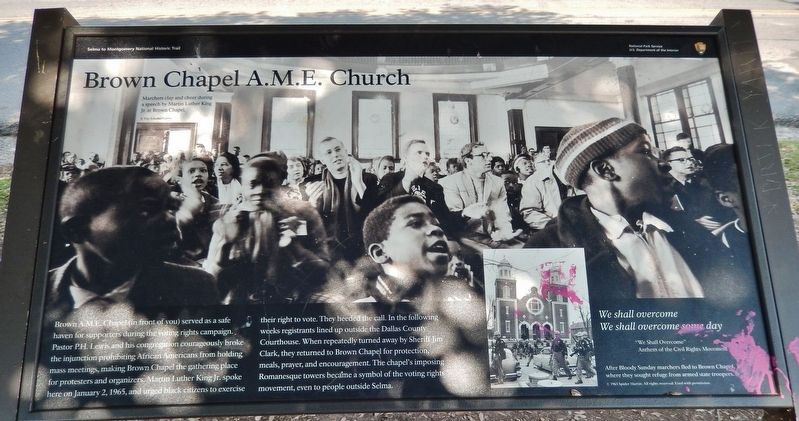
Brown Chapel A.M.E. Church
| — | Selma to Montgomery National Historic Trail | — |
Photographed by Cosmos Mariner, May 10, 2015
1. Brown Chapel A.M.E. Church Marker
We shall overcome
We shall overcome some day
"We Shall Overcome"
Anthem of the Civil Rights Movement
(photo captions)
• Marchers clap and cheer during a speech by Martin Luther King Jr. at Brown Chapel. © Flip Schulke/Cortes
• After Bloody Sunday marchers fled to Brown Chapel, where they sought refuge from armed state troopers. © 1965 Spider Martin. All rights
this page online
Erected by National Park Service, U.S. Department of the Interior.
Topics and series. This historical marker is listed in these topic lists: African Americans • Civil Rights • Religion & Religious Structures. In addition, it is included in the African Methodist Episcopal (AME) Church, the Martin Luther King, Jr., and the National Historic Landmarks series lists. A significant historical date for this entry is January 2, 1965.
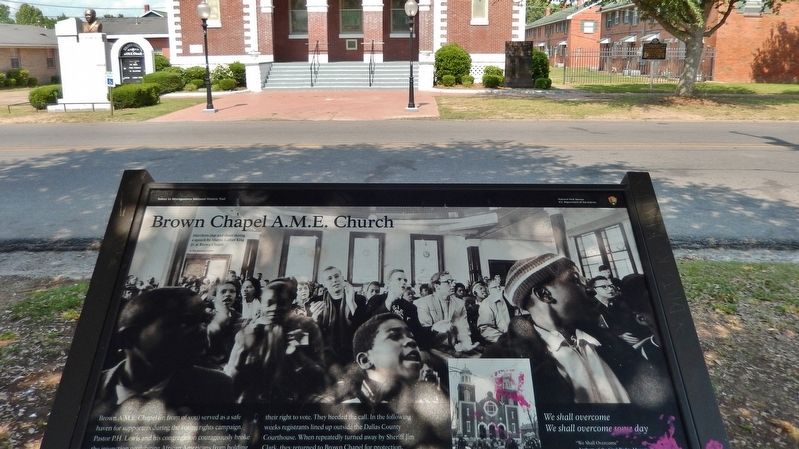
Location. 32° 24.741′ N, 87° 0.989′ W. Marker is in Selma, Alabama, in Dallas County. It is on Martin Luther King Street 0.1 miles south of Clark Avenue, on the right when traveling south. Marker is located directly across Martin Luther King Street from Brown A.M.E. Church. Touch for map. Marker is at or near this postal address: 410 Martin Luther King Street, Selma AL 36703, United States of America. Touch for directions.

Regionally, this marker is in the American South, specifically in the Deep South, and in the Black Belt. Globally, it is in North America, a Gulf of Mexico state, the Western Hemisphere, the Western World, and the Anglosphere. Historically, it finds
Photographed by Cosmos Mariner, May 10, 2015
2. Brown Chapel A.M.E. Church Marker
Other nearby markers. At least 8 other markers are within walking distance of this marker: Sanctuary to Stage (here, next to this marker); I Had A Dream (a few steps from this marker); George Washington Carver Homes Projects (within shouting distance of this marker); Lewis Scott (about 400 feet away, measured in a direct line); George Washington Carver Neighborhood (about 600 feet away); First Baptist Church (approx. 0.2 miles away); Turning Point (approx. 0.2 miles away); A Grassroots Movement (approx. 0.2 miles away). Touch for a list and map of all markers in Selma.
Regarding Brown Chapel A.M.E. Church.
Alabama Register of Landmarks and Heritage (1976)
National Register of Historic Places (1982)
National Historic Landmark (1997)
Also see . . .
1. Brown Chapel A.M.E. Church (Wikipedia). This church was a starting point for the Selma to Montgomery marches in 1965 and, as the meeting place and offices of the Southern Christian Leadership Conference (SCLC) during the Selma

Photographed by Cosmos Mariner, May 10, 2015
3. National Historic Landmark
2. Brown Chapel AME Church. On Sunday morning March 7, 1965, despite a ban on protest marches by Governor Wallace, about 600 black protestors gathered outside Brown Chapel to march from Selma to the state capital in Montgomery. On March 9, Martin Luther King, Jr., led a "symbolic" march to the bridge, and on March 21, after Governor Wallace's ban was overruled by Federal Judge Frank M. Johnson, Jr., King led the five-day march to the capital. (Submitted on April 12, 2019, by Cosmos Mariner of Cape Canaveral, Florida.)

Photographed by Cosmos Mariner, May 10, 2015
4. Brown Chapel A.M.E. Church
National Historic Landmark plaque at arrow.
Credits. This page was last revised on July 16, 2025. It was originally submitted on April 10, 2019, by Cosmos Mariner of Cape Canaveral, Florida. This page has been viewed 1,593 times since then and 58 times this year. Photos: 1, 2, 3, 4. submitted on April 11, 2019, by Cosmos Mariner of Cape Canaveral, Florida.
