
Near Hudson in Columbia County, New York — The American Northeast (Mid-Atlantic)
Icehouse
Photographed by Steve Stoessel, April 13, 2019
1. Icehouse Marker
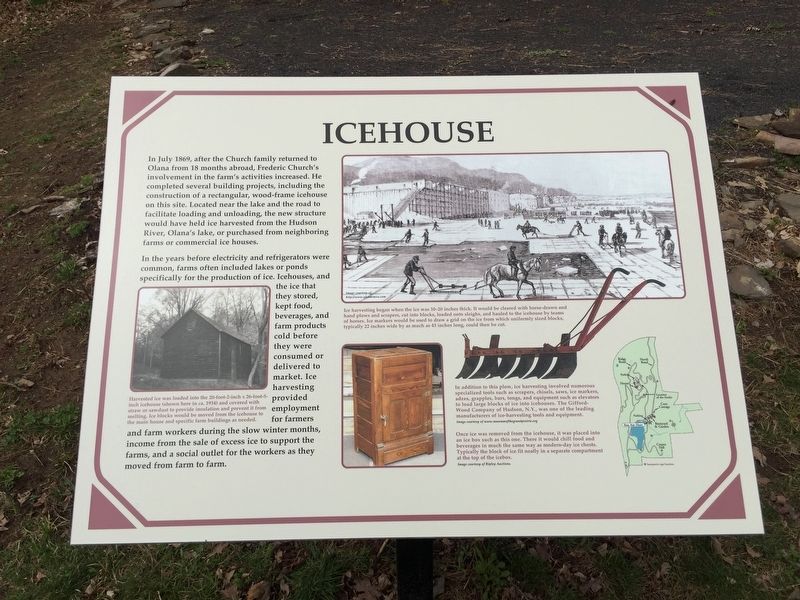
In the years before electricity and refrigerators were common, farms often included lakes or ponds specifically for the production of ice. Icehouses, and the ice they stored, kept food beverages, and farm products cold before they consumed or delivered to market. Ice harvesting provided employment for farmers and farm workers during the slow winter months, income from the sale of excess ice to support the farms, and a social outlet for the workers as they moved from farm to farm.
Top Picture Caption: Ice harvesting began when the ice was 10-20 inches thick. It would be cleared with horse-drawn and hand plows and scrapers, cut into blocks, loaded onto sleighs, and hauled to the icehouse by teams of horses. Ice markers would be used to draw a grid on the ice from which uniformly sized blocks, typically 22 inches wide by as much as
this page online
Top Middle Picture Caption: In addition to this plow, ice harvesting involved numerous specialized tools such as scrapers, chisels, saws, ice markers, adzes, grapples, bars, tongs, and equipment such as elevators to load large blocks of ice into icehouses. The Glifford-Wood Company of Hudson, N.Y., was one of the leading manufacturers of ice-harvesting tools and equipment.
Bottom Middle Picture Caption: Once ice was removed from the icehouse, it was placed into an ice box such as this one. There it would chill food and beverages in much the same way as modern-day ice chests. Typically, the block of ice fit neatly into a separate compartment at the top of the icebox.
Left Picture Caption: Harvested ice was loaded into the 20-foot-2-inch x 26-foot-5-inch icehouse (shown here in ca. 1934) and covered with straw or sawdust to provide insulation, and prevent it from melting. Ice blocks would be moved from the icehouse to the main house and specific farm buildings as needed.
Topics. This historical marker is listed in these topic lists: Agriculture • Industry & Commerce. A significant historical month for this entry is July 1869.
Location. 42° 12.768′ N, 73° 49.752′ W. Marker is near Hudson, New York, in Columbia County. It can be reached from Olana State Historic
Photographed by Steve Stoessel, April 13, 2019
2. Icehouse Site

Regionally, this marker is in Upstate New York and in the Hudson Valley. It is also in the American Northeast and in the Mid-Atlantic. Globally, it is in the North Atlantic Region, North America, the Western Hemisphere, the Western World, and the Anglosphere. Historically, it finds itself in what was once New Netherland and also one of the original Thirteen Colonies.
Other nearby markers. At least 8 other markers are within walking distance of this marker: Kitchen Garden (within shouting distance of this marker); Woodshed (within shouting distance of this marker); Barnyard (about 300 feet away, measured in a direct line); Cosy Cottage (about 400 feet away); Brezie Farm (about 600 feet away); Studio and Viewshed (approx. 0.2 miles away); Park and Lake (approx. ¼ mile away); Columbia County (approx. 0.3 miles away). Touch for a list and map of all markers in Hudson.
Also see . . . Olana State Historic Site. Wikipedia entry:
Links to National Register of Historic Places Nomination Form (Submitted on March 4, 2025, by Larry Gertner of New York, New York.)
Credits. This page was last revised on March 4, 2025. It was originally submitted on April 17, 2019, by Steve Stoessel of Niskayuna, New York. This page has been viewed 356 times since then and 18 times this year. Photos: 1, 2. submitted on April 17, 2019, by Steve Stoessel of Niskayuna, New York. • Andrew Ruppenstein was the editor who published this page.
