Downtown in Indianapolis in Marion County, Indiana — The American Midwest (Great Lakes)
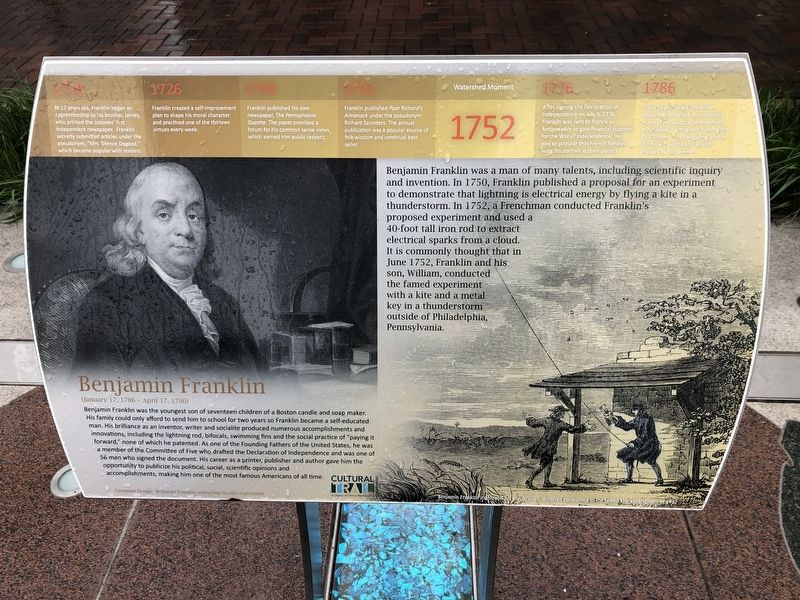
Benjamin Franklin
(January 17, 1706 - April 17, 1790)
1718
At 12 years old, Franklin began an apprenticeship to his brother, James, who printed the colonies' first independent newspaper. Franklin secretly submitted articles under the pseudonym, "Mrs. Silence Dogood," which became popular with readers.
1726
Franklin created a self-improvement plan to shape his moral
this page online
1730
Franklin published his own newspaper, The Pennsylvania Gazette. The paper provided a forum for his common sense views which earned him public respect.
1732
Franklin published Poor Richard's Almanack under the pseudonym Richard Saunders. The annual publication was a popular source of folk wisdom and continual best seller.
Watershed Moment
1752
Benjamin Franklin was a man of many talents, including scientific inquiry and invention. In 1750, Franklin published a proposal for an experiment to demonstrate that lighting is electrical energy by flying a kite in a thunderstorm. In 1752, a Frenchman conducted Franklin's proposed experiment and used a 40-foot tall iron rod to extract electrical sparks from a cloud. It is commonly thought that in June 1752, Franklin and his son, William, conducted the famed experiment with a kite and a metal key in a thunderstorm outside of Philadelphia, Pennsylvania.
1776
After signing the Declaration of Independence on July 4, 1776, Franklin was sent to France as an Ambassador to gain financial support for the War of Independence.
1786
Franklin published Maritime Observations which documented many of his nautical observations. It included charting and naming the Gulf Stream. His navigating advice shortened westbound Atlantic voyages by two weeks.
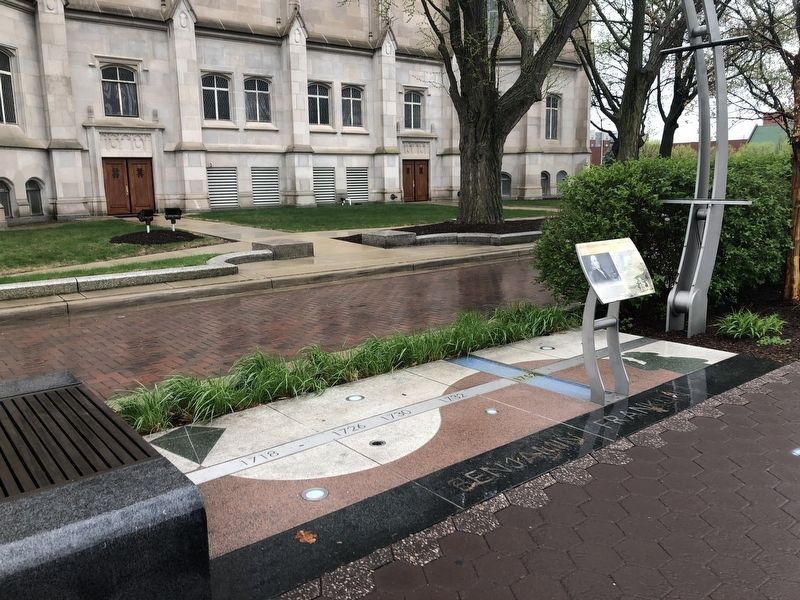
Erected by Cultural Trail Indianapolis.
Topics and series. This historical marker is listed in these topic lists: Colonial Era • Communications • Science & Medicine • War, US Revolutionary. In addition, it is included in the Indiana, Cultural Trail Indianapolis series list. A significant historical month for this entry is June 1752.
Location. 39° 46.607′ N, 86° 9.489′ W. Marker is in Indianapolis, Indiana, in Marion County. It is in Downtown. It is on West Walnut Street west of North Meridian Street, in the median. Touch for map. Marker is in this post office area: Indianapolis IN 46204, United States of America. Touch for directions.

Regionally, this marker is in Central Indiana. It is also in the American Midwest and in the Corn Belt. Globally, it is in North America, the Western Hemisphere, the Western World, and the Anglosphere. Historically, it finds itself in what was once the territory of the Mississippian Culture and also the Northwest Territory.
Other nearby markers. At least 8 other markers are within walking distance of this marker: Susan B. Anthony (a few steps from this marker); Mark Twain (within shouting distance of this marker); Scottish Rite Cathedral (within shouting distance of this marker); The American Legion (within shouting distance of this marker); Thomas Edison (within shouting distance of this marker); Booker T. Washington (about 300 feet away, measured in a direct line); Indiana Vietnam and Korean Wars Memorial (about 300 feet away); American Legion Mall (about 400 feet away). Touch for a list and map of all markers in Indianapolis.
Credits. This page was last revised on February 4, 2023. It was originally submitted on April 27, 2019, by Devry Becker Jones of Washington, District of Columbia. This page has been viewed 380 times since then and 19 times this year. Photos: 1, 2. submitted on April 27, 2019, by Devry Becker Jones of Washington, District of Columbia.
