Ansonborough in Charleston in Charleston County, South Carolina — The American South (South Atlantic)
Blake-Grimké House
Photographed by Cosmos Mariner, May 2, 2019
1. Blake-Grimké House Marker
(side 1 • faces east • George Street on left)
(side 1 • faces east • George Street on left)
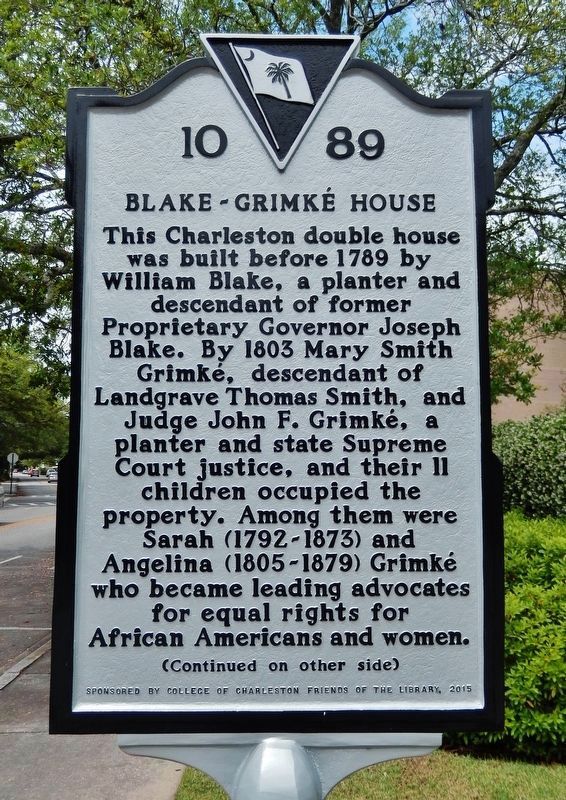
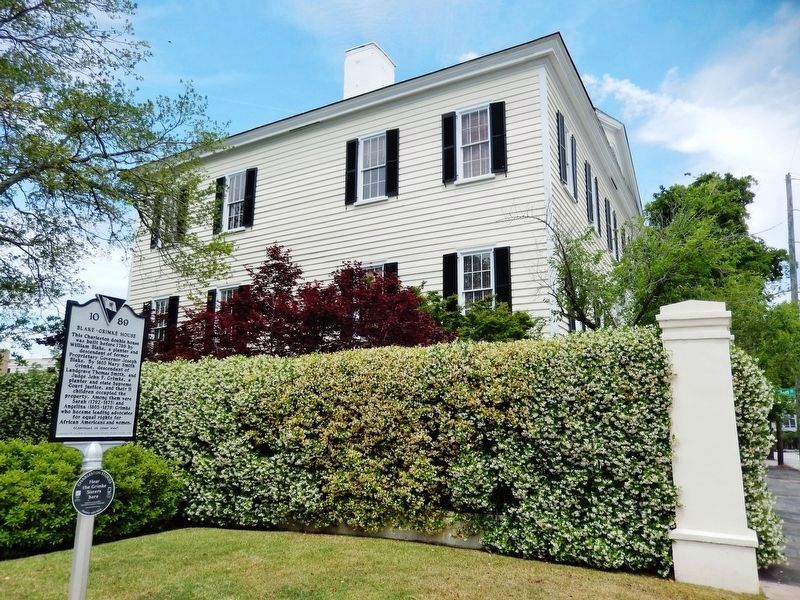
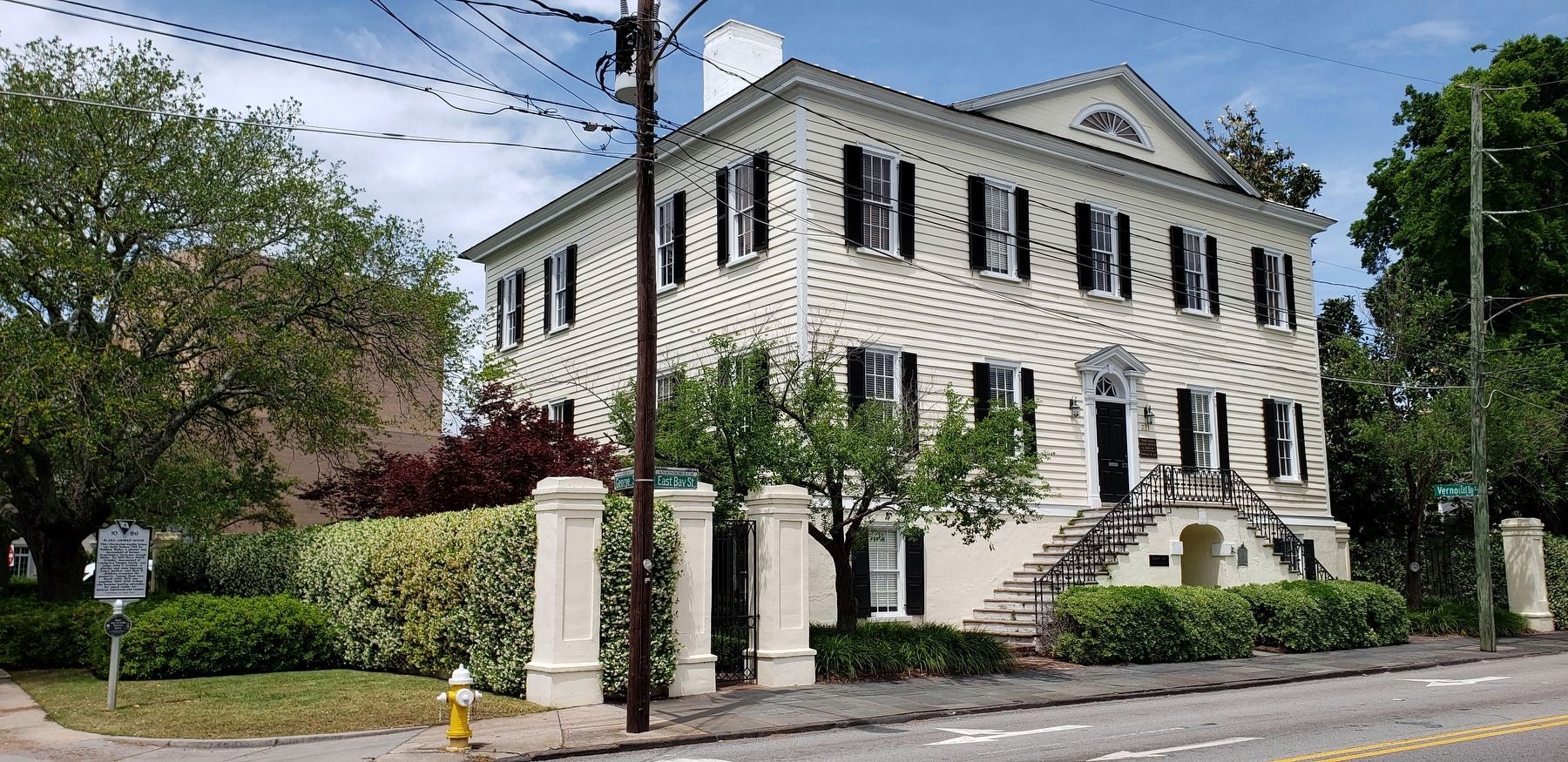
This Charleston double house was built before 1789 by William Blake, a planter and descendant of former Proprietary Governor Joseph Blake. By 1803 Mary Smith Grimké, descendant of Landgrave Thomas Smith, and Judge John F. Grimké, a planter and state Supreme Court justice, and their 11 children occupied the property. Among them were Sarah (1792-1873) and Angelina (1805-1879) Grimké who became leading advocates for equal rights for African Americans and women.
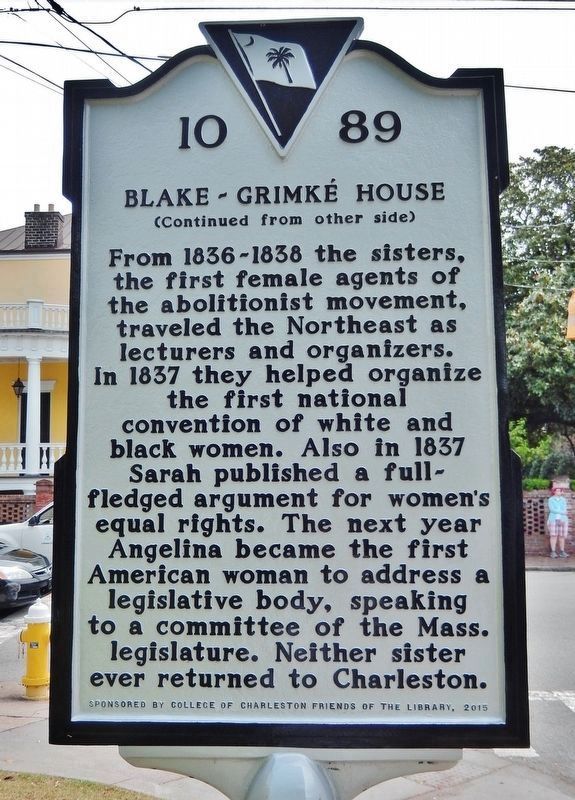
From 1836-1838 the sisters, the first female agents of the abolitionist movement, traveled the Northeast as lecturers and organizers. In 1837 they helped organize the first national convention of white and black women. Also in 1837 Sarah published a full-fledged argument for women's equal rights. The next year Angelina became the first American woman to address a legislative body, speaking to a committee of the Mass. legislature. Neither sister ever returned to Charleston.
Erected 2015 by College of Charleston Friends of the Library. (Marker Number 10-89.)
Topics. This historical marker
this page online
Location. 32° 47.215′ N, 79° 55.758′ W. Marker is in Charleston, South Carolina, in Charleston County. It is in Ansonborough. It is at the intersection of East Bay Street (Business U.S. 52) and George Street, on the right when traveling south on East Bay Street. Marker is located beside the sidewalk, near the southeast corner of the subject house. Touch for map. Marker is at or near this postal address: 321 East Bay Street, Charleston SC 29401, United States of America. Touch for directions.

Regionally, this marker is in Historic Charleston and in the Lowcountry. It is also in the American South, specifically in the Deep South, and on the Eastern Seaboard. Globally, it is in the North Atlantic Region, North America, the Western Hemisphere, the Western World, and the Anglosphere. Historically, it finds itself in what was once the territory of the Mississippian Culture, one of the original Thirteen Colonies, one of the Confederate States of America, and the Antebellum South.
Other nearby markers. At
Photographed by Cosmos Mariner, May 2, 2019
2. Blake-Grimké House Marker
(side 2 • faces west • Bay Street in background)
(side 2 • faces west • Bay Street in background)
Also see . . .
1. The Grimké Family Home (1803-1819). This house where the famous Grimké sisters grew up was a city house. The assumption is often made that they grew up on a plantation. In their childhoods, their father, like most professional men of Charleston, owned a number of plantations that generated wealth for his family through the production of rice and cotton. The sisters’ main experience of slavery, as they once said themselves, was not of enslaved workers on plantations, but of enslaved house servants. (Submitted on May 11, 2019, by Cosmos Mariner of Cape Canaveral, Florida.)
2. 321 East Bay Street: Blake-Grimké House.
Photographed by Cosmos Mariner, May 2, 2019
3. Blake-Grimké House Marker
(wide view • south side of house in background)
(wide view • south side of house in background)
Photographed by Cosmos Mariner, May 2, 2019
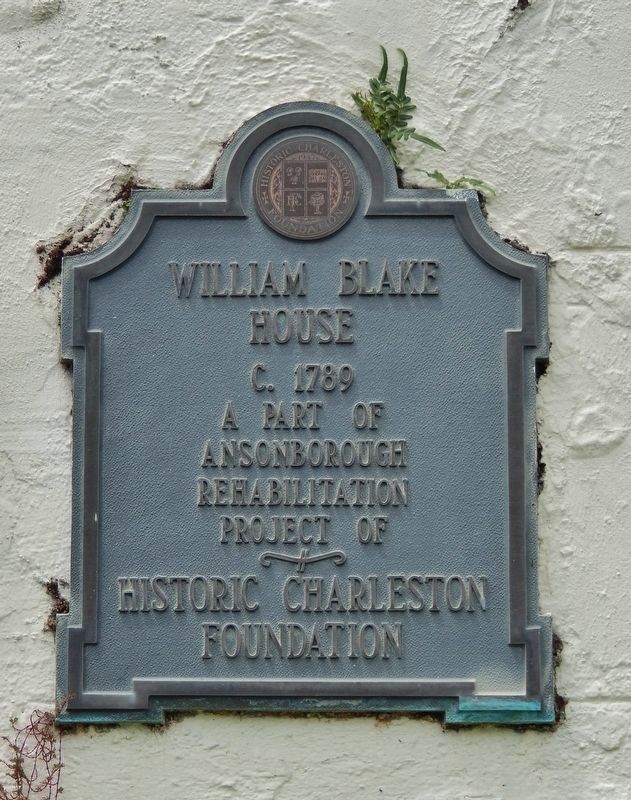
4. William Blake House Plaque (mounted at eye-level on east side of house near staircase)
c. 1789
A part of
Ansonborough
rehabilitation
project of
Historic Charleston Foundation
Photographed by Cosmos Mariner, May 2, 2019
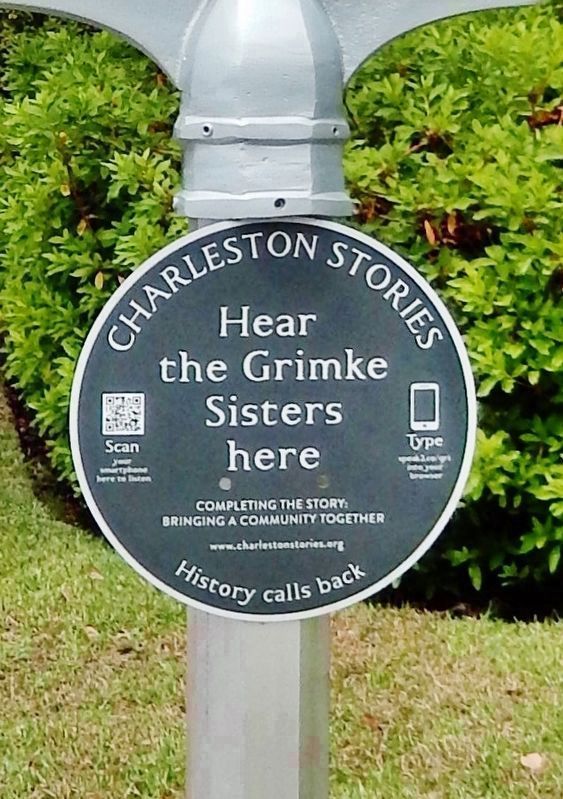
5. Charleston Stories: Hear the Grimké Sisters here (mounted on pole below historical marker)
Photographed by Cosmos Mariner, May 2, 2019
6. Blake-Grimké House (wide view from East Bay Street • marker visible on left)
Credits. This page was last revised on August 12, 2025. It was originally submitted on May 11, 2019, by Cosmos Mariner of Cape Canaveral, Florida. This page has been viewed 3,997 times since then and 277 times this year. Photos: 1, 2, 3, 4, 5, 6. submitted on May 11, 2019, by Cosmos Mariner of Cape Canaveral, Florida.
