Downingtown in Chester County, Pennsylvania — The American Northeast (Mid-Atlantic)
Downingtown Log House
- Circa 1701 -
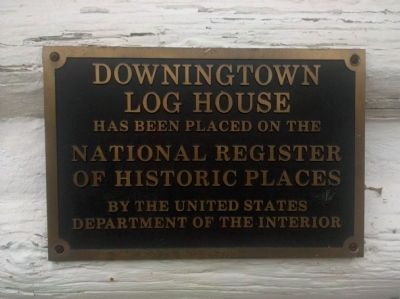
Photographed by Keith S Smith, November 15, 2011
1. Downingtown Log House Marker
Erected by The United States Department of the Interior.
Topics. This historical marker is listed in these topic lists: Colonial Era • Industry & Commerce • Notable Buildings • Settlements & Settlers.
Location. 40° 0.387′ N, 75° 42.265′ W. Marker is in Downingtown, Pennsylvania, in Chester County. It is on East Lancaster Avenue, on the left when traveling east. Touch for map. Marker is in this post office area: Downingtown PA 19335, United States of America. Touch for directions.

Regionally, this marker is in Southeast Pennsylvania and in Greater Philadelphia. It is also in the American Northeast and in the Mid-Atlantic. Globally, it is in North America, the Western Hemisphere, the Western World, and the Anglosphere. Historically, it finds itself in what was once the Haudenosaunee (Iroquois) Confederacy, New Netherland, and one of the original Thirteen Colonies.
Other nearby markers. At least 8 other markers are within 5 miles of this marker, measured
this page online
Also see . . . Downingtown Log House - Wikipedia. (Submitted on November 15, 2011, by Keith S Smith of West Chester, Pennsylvania.)
Additional commentary.
1. A Brief History of Downingtown:
Downingtown’s origins are of a small village located midway between Philadelphia and Lancaster. The village was first known as Milltown since it was the location of the last mills on the edge of the unsettled western frontier.
Around the time of the American Revolution, Milltown began being known as Downing’s Town. During the Revolution, the town was used as a location for storage of food supplies; a forage magazine was constructed in Downing’s Town to hold provisions for
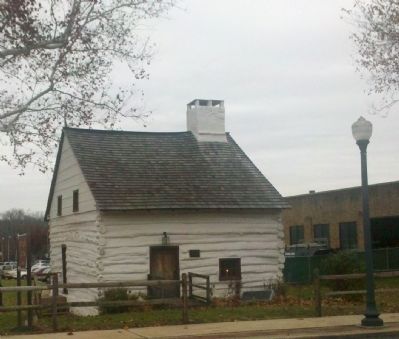
Photographed by Keith S Smith, November 15, 2011
2. Downingtown Log House
— Submitted January 22, 2012, by Keith S Smith of West Chester, Pennsylvania.
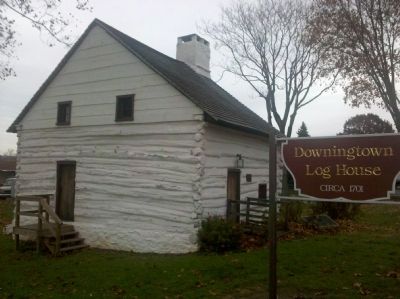
Photographed by Keith S Smith, November 15, 2011
3. The West Side of the Downingtown Log House
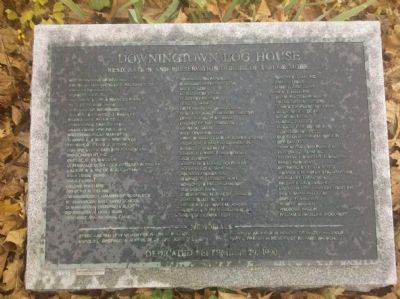
Photographed by Keith S Smith, November 15, 2011
4. Donors Plaque on front lawn
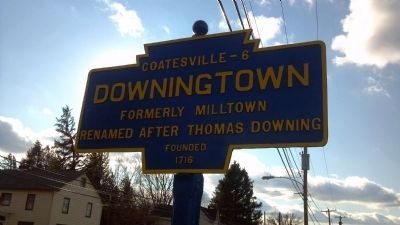
Photographed by Keith S Smith
5. Downingtown Keystone Marker
Downingtown
Formerly Milltown
Renamed after Thomas Downing
Founded
1716
Credits. This page was last revised on May 24, 2019. It was originally submitted on November 15, 2011, by Keith S Smith of West Chester, Pennsylvania. This page has been viewed 1,688 times since then and 92 times this year. Last updated on May 22, 2019, by Carl Gordon Moore Jr. of North East, Maryland. Photos: 1, 2, 3, 4. submitted on November 15, 2011, by Keith S Smith of West Chester, Pennsylvania. 5. submitted on January 2, 2012, by Keith S Smith of West Chester, Pennsylvania. • Andrew Ruppenstein was the editor who published this page.
