Staunton, Virginia — The American South (Mid-Atlantic)
Staunton National Cemetery
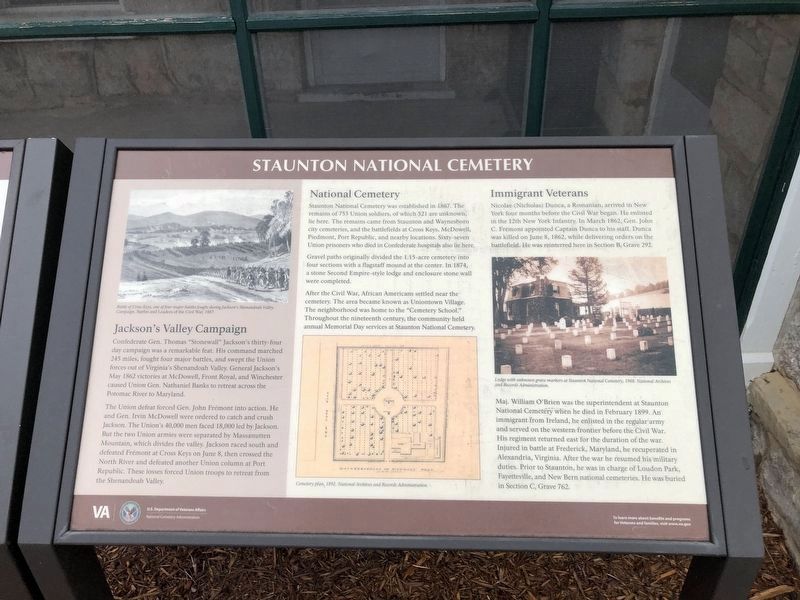
National Cemetery
Staunton National Cemetery was established in 1867. The remains of 753 Union soldiers, of which 521 are unknown, lie here. The remains came from Staunton and Waynesboro city cemeteries, and the battlefields at Cross Keys, McDowell, Piedmont, Port Republic, and nearby locations. Sixty-seven Union prisoners who died in Confederate hospitals also lie here.
Gravel paths originally divided the 1.15-acre cemetery into four sections with a flagstaff mound at the center. In 1874, a stone Second Empire-style lodge and enclosure stone wall were completed.
After the Civil War, African Americans settled near the cemetery. The area became known as Uniontown Village. The neighborhood was home to the "Cemetery School." Throughout the nineteenth century, the community held annual Memorial Day services at Staunton National Cemetery.
Jackson's Valley Campaign (left panel)
Confederate Gen. Thomas "Stonewall" Jackson's thirty-four day campaign was a remarkable feat. His command marched 245 miles, fought four major battles, and swept the Union forces out of Virginia's Shenandoah Valley. General Jackson's May 1862 victories
this page online
The Union defeat forced Gen. John Frémont into action. He and Gen. Irvin McDowell were ordered to catch and crush Jackson. The Union's 40,000 men faced 18,000 led by Jackson. But the two Union armies were separated by Massanutten Mountain, which divides the valley. Jackson raced south and defeated Frémont at Cross Keys on June 8, then crossed the North River and defeated another Union column at Port Republic. These losses forced Union troops to retreat from the Shenandoah Valley.
Immigrant Veterans (right panel)
Nicolae (Nicholas) Dunca, a Romanian, arrived in New York four months before the Civil War began. He enlisted in the 12th New York Infantry. In March 1862, Gen. John C. Frémont appointed Captain Dunca to his staff. Dunca was killed on June 8, 1862, while delivering orders on the battlefield. He was reinterred here in Section B, Grave 292.
Maj. William O'Brien was the superintendent at Staunton National Cemetery when he died in February 1899. An immigrant from Ireland, he enlisted in the regular army and
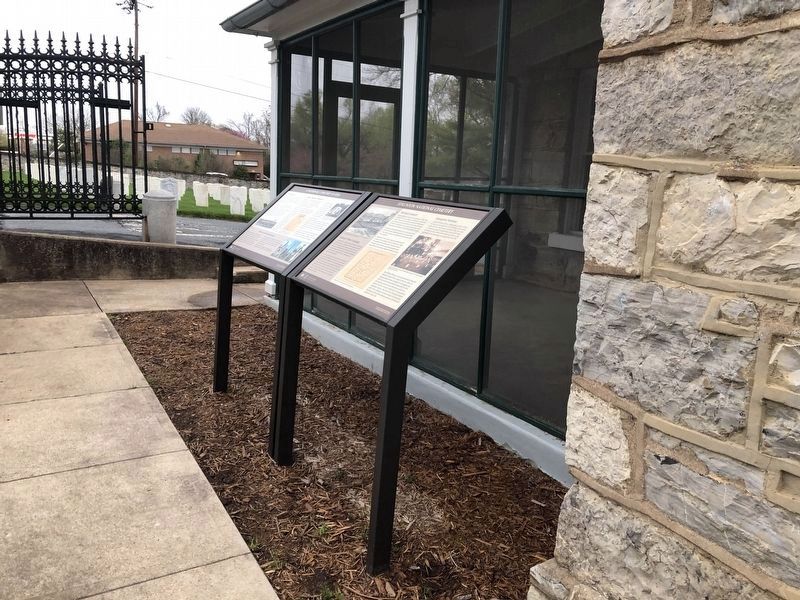
Erected by U.S. Department of Veterans Affairs, National Cemetery Administration.
Topics and series. This historical marker is listed in these topic lists: African Americans • Cemeteries & Burial Sites • Patriots & Patriotism • War, US Civil. In addition, it is included in the National Cemeteries series list. A significant historical month for this entry is February 1899.
Location. 38° 8.415′ N, 79° 2.993′ W. Marker is in Staunton, Virginia. It can be reached from Richmond Avenue (U.S. 250) east of National Avenue, on the right when traveling west. Marker is located just inside the main gate, at the northwest corner of the cemetery office building. Touch for map. Marker is at or near this postal address: 901 Richmond Avenue, Staunton VA 24401, United States
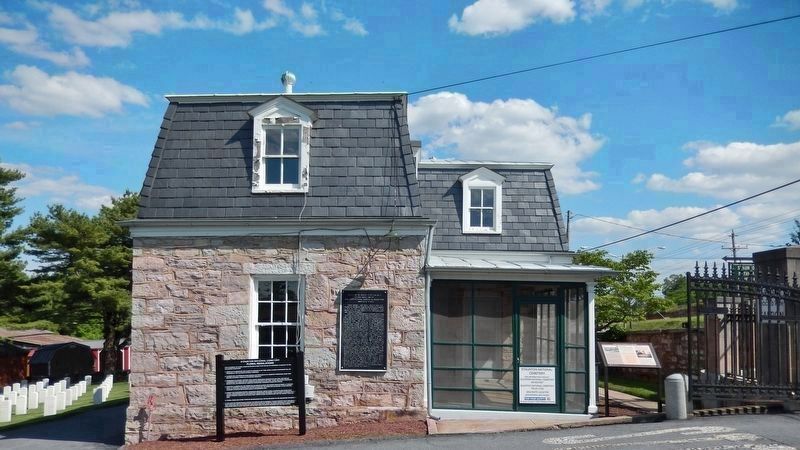
Photographed by Cosmos Mariner, May 16, 2019
3. Staunton National Cemetery Marker
This is a photo of the marker in its previous location.

Regionally, this marker is in Virginia’s Shenandoah Valley. It is also in the American South and specifically in the Upper South. Globally, it is in North America, the Western Hemisphere, the Western World, and the Anglosphere. Historically, it finds itself in what was once the territory of the Mississippian Culture, one of the original Thirteen Colonies, one of the Confederate States of America, and the Antebellum South.
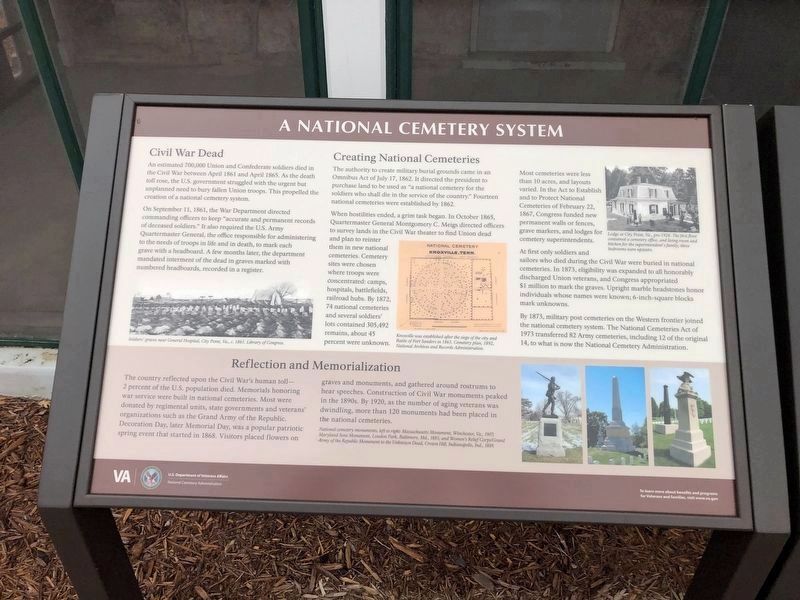
Other nearby markers. At least 8 other markers are within walking distance of this marker: A National Cemetery System (here, next to this marker); Address by President Lincoln (here, next to this marker); Medal of Honor Memorial (a few steps from this marker); Veterans Memorial (a few steps from this marker); United States National Military Cemetery - Staunton (a few steps from this marker); First Settler's Grave (approx. 0.6 miles away); Avenue of Trees (approx. 0.6 miles away); The Virginia School for the Deaf and the Blind (approx. 0.9 miles away). Touch for a list and map of all markers in Staunton.
Regarding Staunton National Cemetery. National Register
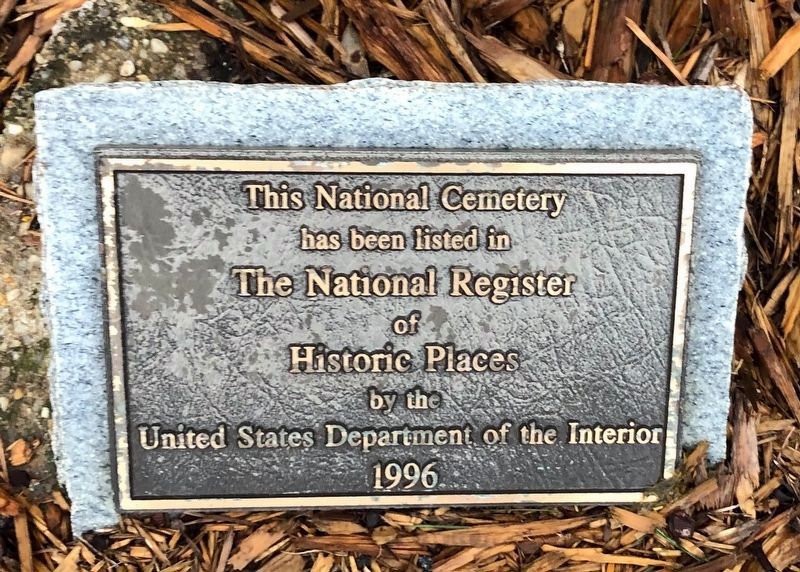
Photographed by Devry Becker Jones (CC0), April 9, 2021
4. National Register of Historic Places plaque on the grounds of the cemetery
Related markers. Click here for a list of markers that are related to this marker. Staunton National Cemetery
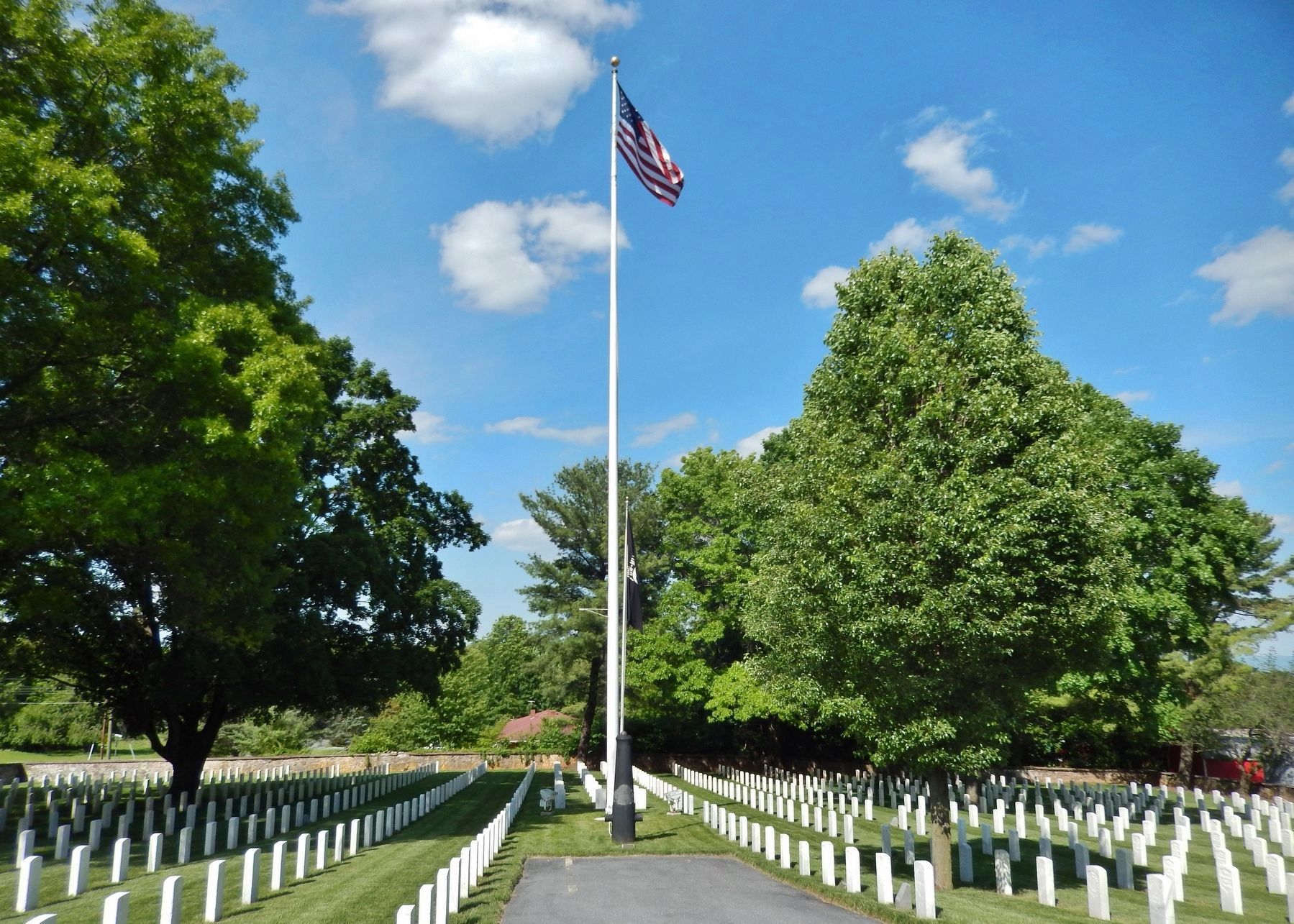
Photographed by Cosmos Mariner, May 16, 2019
5. Staunton National Cemetery Flagstaff (at center of cemetery • view from near marker)
Credits. This page was last revised on November 3, 2024. It was originally submitted on May 26, 2019, by Cosmos Mariner of Cape Canaveral, Florida. This page has been viewed 790 times since then and 42 times this year. Photos: 1, 2. submitted on April 10, 2021, by Devry Becker Jones of Washington, District of Columbia. 3. submitted on May 27, 2019, by Cosmos Mariner of Cape Canaveral, Florida. 4. submitted on April 10, 2021, by Devry Becker Jones of Washington, District of Columbia. 5. submitted on May 27, 2019, by Cosmos Mariner of Cape Canaveral, Florida. 6. submitted on April 10, 2021, by Devry Becker Jones of Washington, District of Columbia.
