Irvine Park
⎯⎯⎯
Irvine Park Historic District
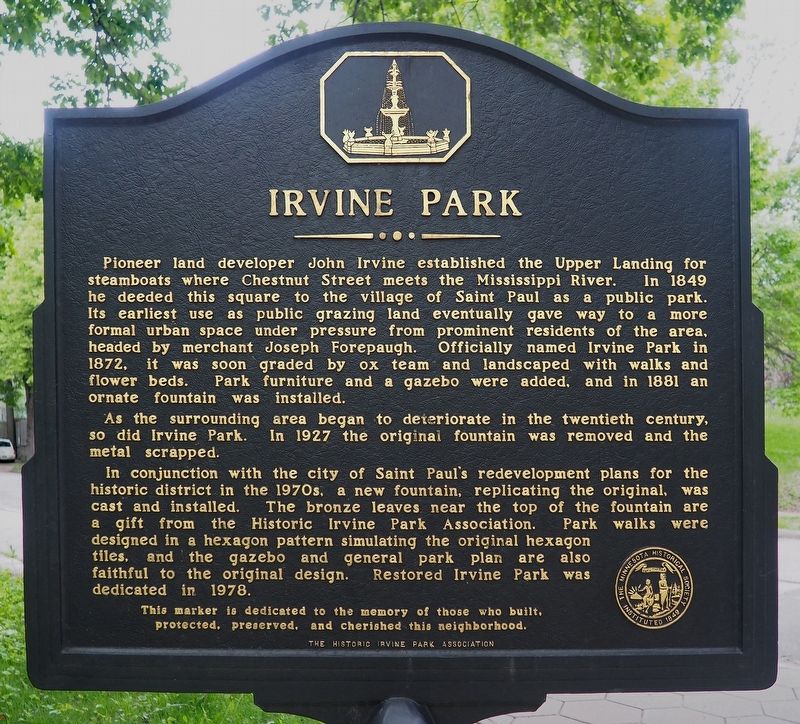
As the surrounding area began to deteriorate in the twentieth century, so did Irvine Park. In 1927 the original fountain was removed and the metal scrapped.
In conjunction with the city of Saint Paul's redevelopment plan for the historic district in the 1970s, a new fountain, replicating the original, was cast and installed. The bronze leaves near the top of the fountain are a gift from the Historic Irvine Park Association. Park walks were designed in a hexagon pattern simulating the original hexagon tiles, and the gazebo and general park plan
this page online
This marker is dedicated to the memory of those who built, protected, preserved, and cherished this neighborhood.
[reverse]
Saint Paul's only remaining frontier neighborhood, the Irvine Park Historic District, was built in the area overlooking the Upper Landing on the Mississippi River. Among the district's historic structures are eight homes built before 1853, including the city's oldest surviving building, the Symonds House at 234 Ryan Avenue (1850). From 1870 to 1890 the district saw not only the development of the park but the construction of homes in the Italianate, Queen Anne, Romanesque, and Stick styles. After the turn of the century, a number of homes in the Midwest Square style were added.
As the area aged its buildings deteriorated, and by the 1970's the larger homes had become tenements and were slated for urban renewal clearance. Named to the National Register of Historic Places in 1973, the Irvine Park district was preserved and restored in a cooperative program between private individuals and the city of Saint Paul. New residential
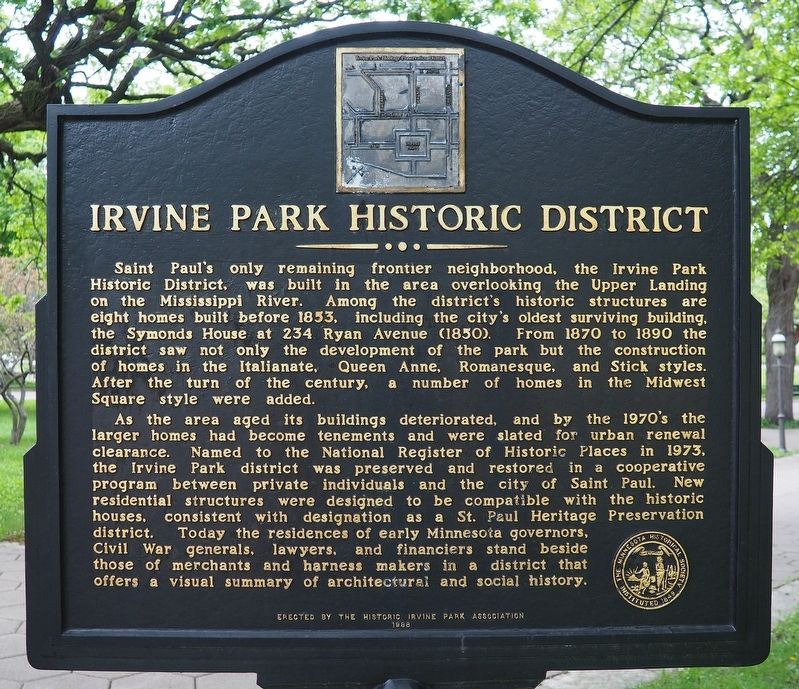
Erected 1988 by Historic Irvine Park Association.
Topics. This historical marker is listed in these topic lists: Architecture • Parks & Recreational Areas • Settlements & Settlers. A significant historical year for this entry is 1849.
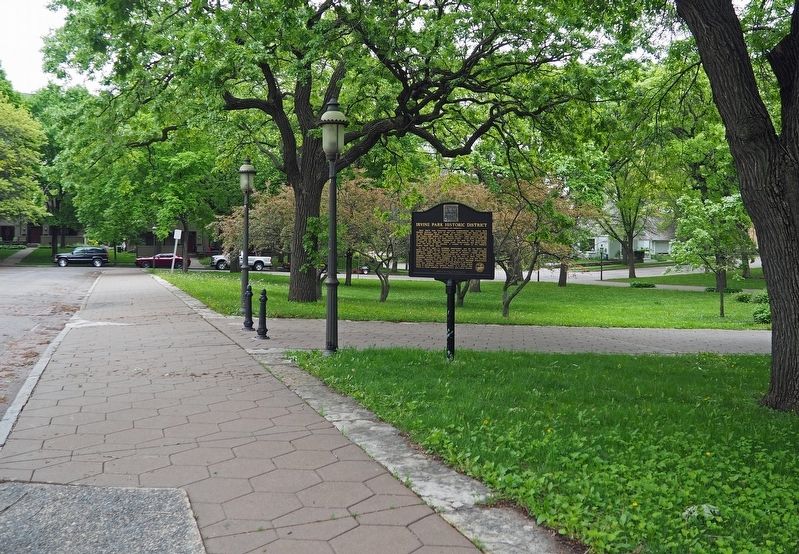
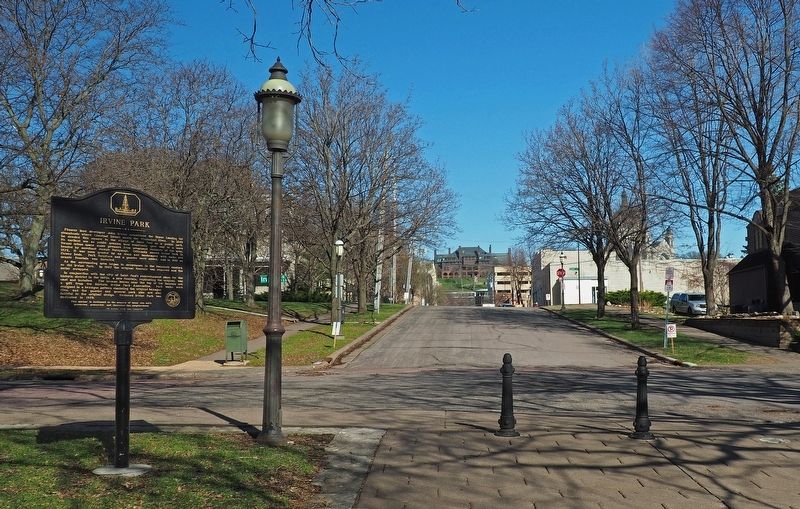
Location. 44° 56.465′ N, 93° 6.185′ W. Marker is in Saint Paul, Minnesota, in Ramsey County. It is in West Seventh - Fort Road. It is at the intersection of N. Walnut Street and Irvine Park when traveling south on N. Walnut Street. Touch for map. Marker is at or near this postal address: 251 Walnut Street, Saint Paul MN 55102, United States of America. Touch for directions.
Regionally, this marker is in the Twin Cities Metropolitan Area. It is also in the American Midwest, in the Corn Belt, and in the Great River Road
Other nearby markers. At least 8 other markers are within walking distance of this marker: Alexander Ramsey House (about 300 feet away, measured in a direct line); Freedom House Station 51 (approx. 0.2 miles away); Beating Back Pests and Diversifying Tree Populations (approx. 0.2 miles away); Welcome to the Saint Paul Municipal Grain Terminal (approx. 0.2 miles away); A River in Decline (approx. 0.2 miles away); An Era of Restoration (approx. 0.2 miles away); The Father of Waters (approx. ¼ mile away); River Commerce and the Upper Landing (approx. ¼ mile away). Touch for a list and map of all markers in Saint Paul.
Also see . . . Irvine Park Historic District on Wikipedia. (Submitted on May 31, 2019, by McGhiever of Minneapolis, Minnesota.)
Credits. This page was last revised on February 12, 2023. It was originally submitted on May 31, 2019, by McGhiever of Minneapolis, Minnesota. This page has been viewed 711 times since then and 96 times this year. Photos: 1, 2, 3, 4. submitted on May 31, 2019, by McGhiever of Minneapolis, Minnesota. • Andrew Ruppenstein was the editor who published this page.
