Fort Edward in Washington County, New York — The American Northeast (Mid-Atlantic)
The Hudson River at Fort Edward, NY
Industrial Growth
Photographed by Steve Stoessel, May 18, 2019
1. The Hudson River at Fort Edward, NY Marker
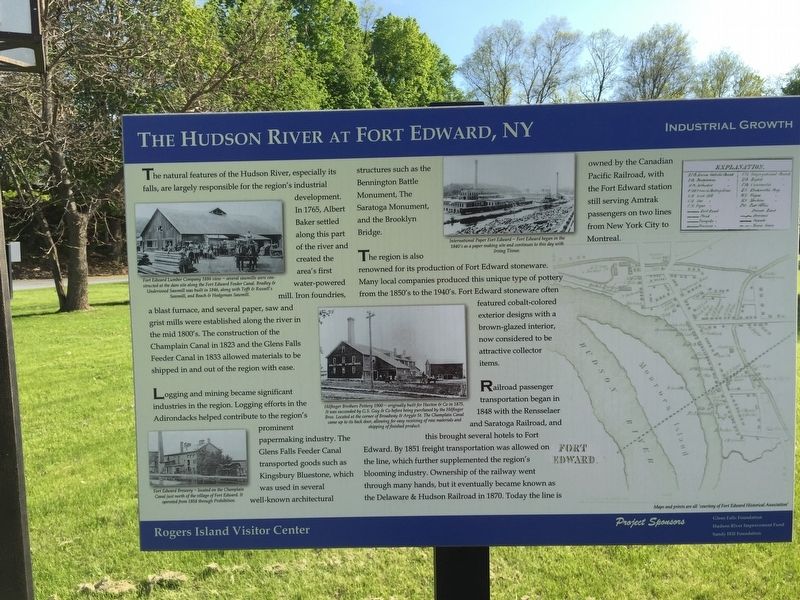
The natural features of the Hudson River, especially its falls, are largely responsible for the region’s industrial development. In 1765, Albert Baker settled along this part of the river and created the area’s first water-powered mill. Iron foundries, a blast furnace. And several paper, saw, and grist mills were established along the river in the mid 1800-s. The construction of the Champlain Canal in 1823 and the Glen Falls Feeder Canal in 1833 allowed materials to be shipped in and out of the region with ease.
Logging and mining became significant industries in the region. Logging efforts in the Adirondacks helped contribute to the region’s prominent papermaking industry. The Glen Falls Feeder Canal transported goods such as Kingsbury Bluestone, which was used in several well-known architectural structures such as the Bennington Battle Monument, the Saratoga Monument, and the Brooklyn Bridge.
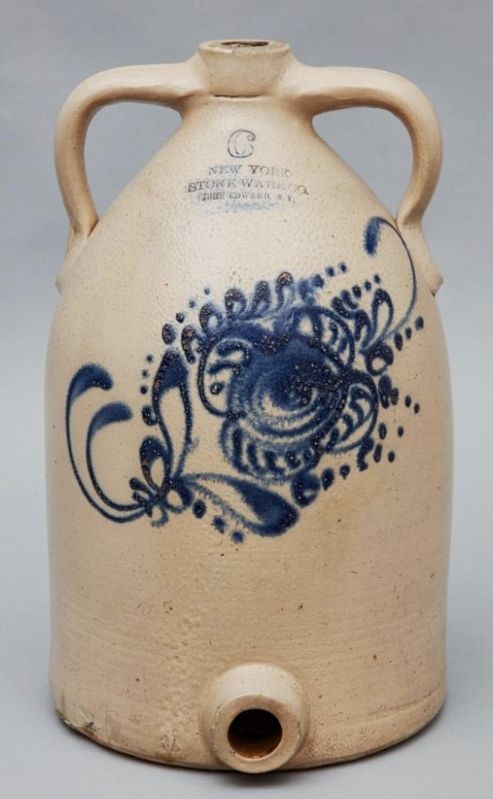
The region is also renowned for its production of Fort Edward stoneware. Many local companies produced this unique type of pottery from the 1850’s to the 1940’s. Fort Edward stoneware often featured cobalt-colored exterior with
this page online
Railroad passenger transportation began in 1848 with the Rensselaer and Saratoga Railroad, and this brought several hotels to Fort Edwards. By 1851, freight transportation was allowed on the line, which further supplemented the region’s blooming industry. Ownership of the railway went though many hands, but it eventually became known as the Delaware & Hudson Railroad in 1870. Today the line owned by Canadian Pacific Railroad, with the Fort Edward station still serving Amtrak passengers in two lines from New York to Montreal.
Erected by Glen Falls Foundation, Sandy Hill Association, Hudson River Improvement Fund.
Topics. This historical marker is listed in these topic lists: Industry & Commerce • Railroads & Streetcars • Settlements & Settlers • Waterways & Vessels. A significant historical year for this entry is 1765.
Location. 43° 15.917′ N, 73° 35.246′ W. Marker is in Fort Edward, New York, in Washington County. It is on Rogers Island Drive, in the median. Touch for map. Marker is in this post office area: Fort Edward NY 12828, United States
Photographed by Steve Stoessel
2. Fort Edward Stoneware
Shaker Museum|Mount Lebanon Collection

Regionally, this marker is in Upstate New York and in the Capital District. It is also in the American Northeast and in the Mid-Atlantic. Globally, it is in North America, the Great North Woods, the Western Hemisphere, the Western World, and the Anglosphere. Historically, it finds itself in what was once the Viceroyalty of New France, New Netherland, and one of the original Thirteen Colonies.
Other nearby markers. At least 8 other markers are within walking distance of this marker: A different marker also named The Hudson River at Fort Edward, NY (a few steps from this marker); Jane McCrea (within shouting distance of this marker); a different marker also named The Hudson River at Fort Edward (within shouting distance of this marker); Rogers Island - Fort Edward, NY (within shouting distance of this marker); a different marker also named The Hudson River at Fort Edward, NY (within shouting distance of this marker); a different marker also named Rogers Island - Fort Edward, NY (within shouting distance of this marker); a different marker also named The Hudson River at Fort Edward (within
Photographed by Steve Stoessel, May 18, 2019
3. Rogers Island Visitor Center
Photographed by Steve Stoessel, May 18, 2019
4. The Hudson River at Fort Edward, NY
Credits. This page was last revised on June 5, 2019. It was originally submitted on May 31, 2019, by Steve Stoessel of Niskayuna, New York. This page has been viewed 758 times since then and 55 times this year. Photos: 1, 2, 3, 4. submitted on May 31, 2019, by Steve Stoessel of Niskayuna, New York. • Bill Pfingsten was the editor who published this page.
