
Midtown in Harrisburg in Dauphin County, Pennsylvania — The American Northeast (Mid-Atlantic)
Visionaries
⎯⎯⎯
Community Building
1953 - 1995
Sixth and Herr Streets
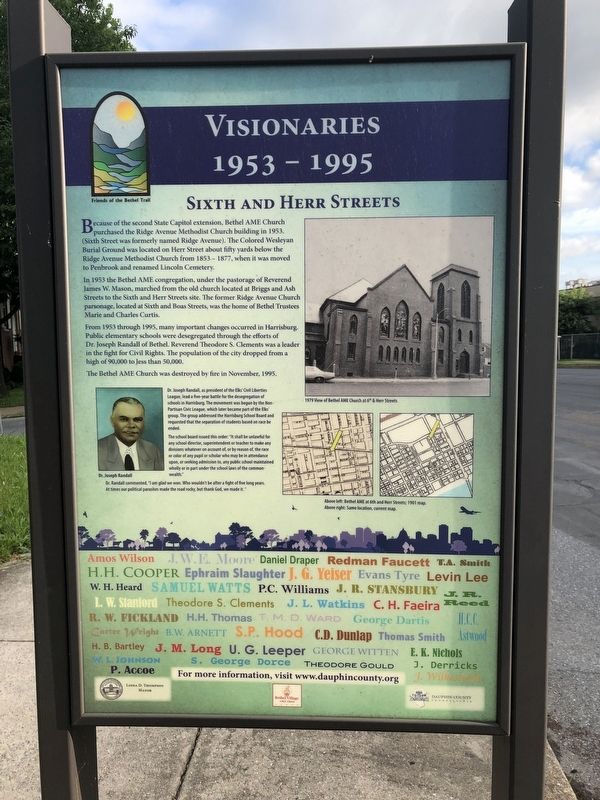
In 1953 the Bethel AME congregation, under the pastorage of Reverend James W. Mason, marched from the old church located at Briggs and Ash Streets to the Sixth and Herr Streets site. The former Ridge Avenue Church parsonage, located at Sixth and Boas Streets, was home of Bethel Trustees Marie and Charles Curtis.
From 1953 through 1995, many important changes occurred in Harrisburg. Public elementary schools were desegregated through the efforts of Dr. Joseph Randall of Bethel. Reverend Theodore S. Clements was a leader in the fight for Civil Rights. The population of the city dropped from a high of 90,000 to less than 50,000.
The Bethel AME Church was destroyed by fire in November, 1995.
[Caption:]
Dr. Joseph Randall, as president of the Elks' Civil Liberties League, lead a five-year battle for the desegregation of schools in Harrisburg. The movement was begun by the Non-Partisan Civic League, which later became part of the Elks' group. The group addressed the Harrisburg School Board and requested that the separation of students based on race be ended.
The school board issued this order: "It shall be unlawful for any school director, superintendent or teacher to make divisions whatever on account of, or by reason of, the race or color of any pupil or scholar who may be in attendance upon, or seeking admission to, any public school maintained wholly or in part under the school laws of the commonwealth."
Dr. Randall commented, "I am glad we won. Who wouldn't be after a fight of five long years. At times our political parasites made the road rocky, but thank God we made it."
this page online
You're standing at the Northern gateway to the trail. An incredible list of leaders emerged from Bethel African Methodist Episcopal (AME) congregation that once gathered here at 6th and Herr Streets. They lived through tumultuous times for Central Pennsylvania.
Bethel AME's commitment and endurance has contributed to the character of Harrisburg's community and the quality of life for the descendants of African American citizens who gathered in their halls since 1834.
Bethel's 6th and Herr Street church was a crossroads of community. Indeed, the church's sanctuary, Sunday school, auditorium, meeting halls, and parish house hosted an impressive number of important social, fraternal and civil rights events until fire brought it down in 1995.
[Captions:]
Bethel anchored the block that was once a vital Black business corridor. The Curtis Funeral Home, Jackson Hotel, and Jackson Barber Shop were all part of the tapestry that made up the Bethel Village.
From
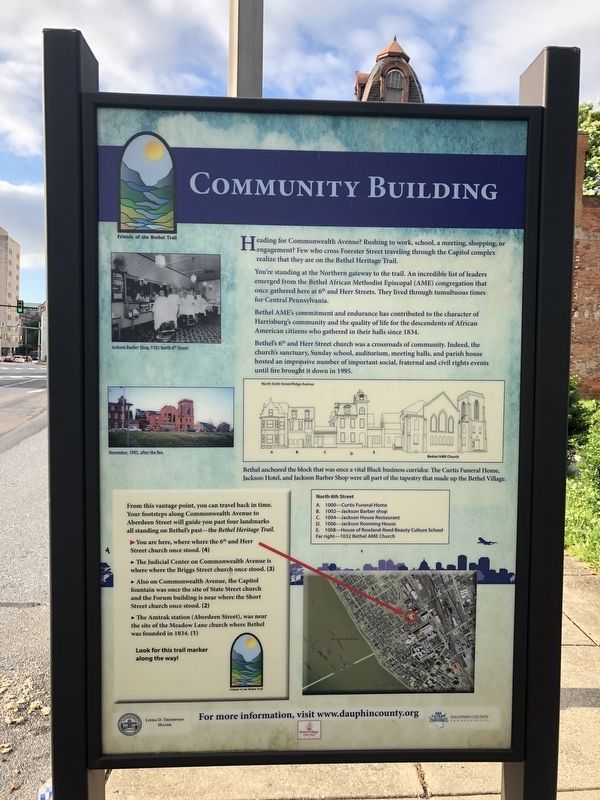
► You are here, where where the 6th and Herr Street church once stood. (4)
► The Judicial Center on Commonwealth Avenue is where the Briggs Street church once stood. (3)
► Also on Commonwealth Avenue, the Capitol fountain was once the site of State Street church and the Forum building is near where the Short Street church once stood. (2)
► The Amtrak station (Aberdeen Street), was near the site of the Meadow Lane church where Bethel was founded in 1834. (1)
North 6th Street
A. 1000—Curtis Funeral Home
B. 1002—Jackson Barber shop
C. 1004—Jackson House restaurant
D. 1006—Jackson Rooming house
E. 1008—House of Rowland-Reed Beauty Culture School
Far right—1032 Bethel AME Church
Erected by Dauphin County, Pennsylvania. (Marker Number 4.)
Topics and series. This historical marker is listed in these topic lists: African Americans • Civil Rights • Education • Religion & Religious Structures.
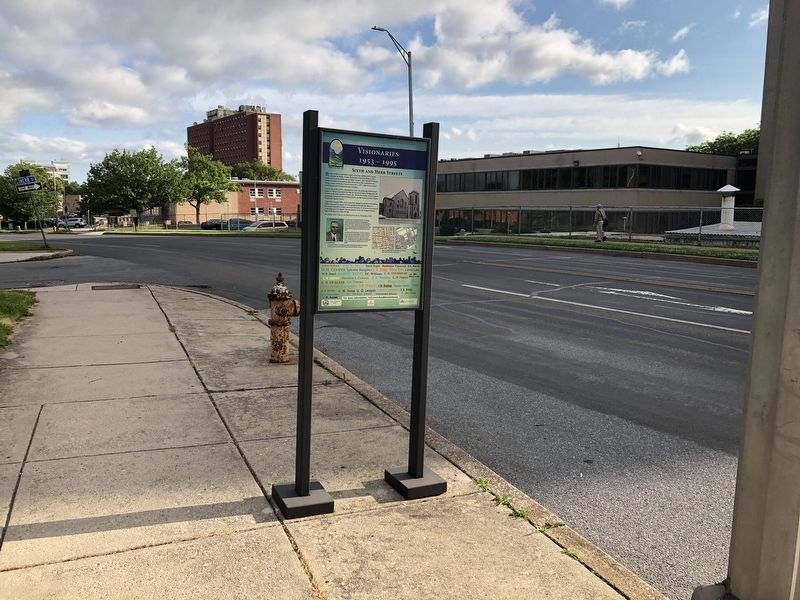
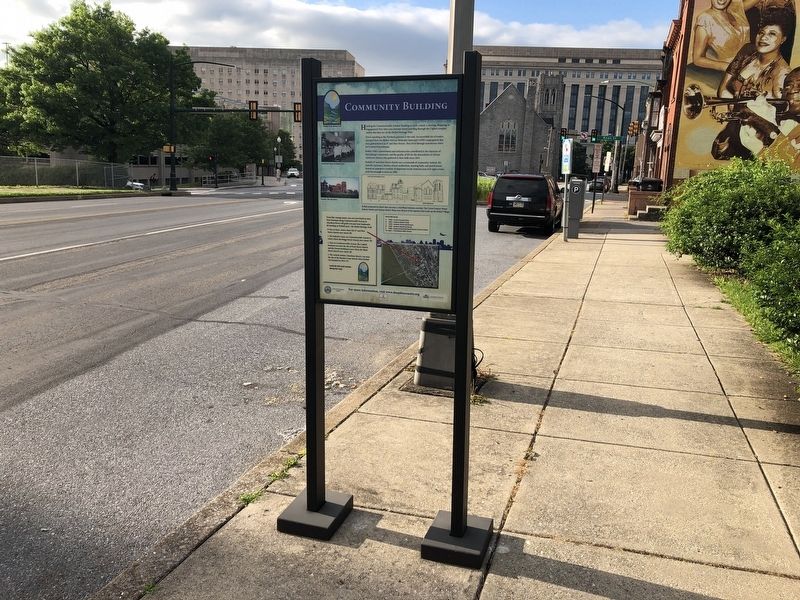
Location. 40° 16.138′ N, 76° 53.103′ W. Marker is in Harrisburg, Pennsylvania, in Dauphin County. It is in Midtown. It is at the intersection of North 6th Street and Herr Street, on the left when traveling north on North 6th Street. Touch for map. Marker is at or near this postal address: 1012 North 6th Street, Harrisburg PA 17102, United States of America. Touch for directions.

Regionally, this marker is in South-Central Pennsylvania, specifically in Pennsylvania Dutch Country, and in the Susquehanna Valley. It is also in the American Northeast and in the Mid-Atlantic. Globally, it is in North America, the Western Hemisphere, the Western World, and the Anglosphere. Historically, it finds itself in what was once the Haudenosaunee (Iroquois) Confederacy and also one of the original Thirteen Colonies.
Other nearby markers. At least 8 other markers are within walking distance of this marker: The African-American Business District that Became "Jackson Square" (within shouting distance of this
Another marker is no longer nearby. Pennsylvania State Archives (was approx. 0.2 miles away but has been permanently removed).
Credits. This page was last revised on August 5, 2024. It was originally submitted on June 1, 2019, by Devry Becker Jones of Washington, District of Columbia. This page has been viewed 668 times since then and 28 times this year. Photos: 1, 2, 3, 4. submitted on June 1, 2019, by Devry Becker Jones of Washington, District of Columbia.
