Near Glencree in County Wicklow, Leinster, Ireland — Mid-East (and Dublin)
The German Military Cemetery, Glencree
Der Deutsche Soldatenfriedhof Glencree
| — | Reilig Mhíleata Gearmánach i nGleann Criothaigh | — |
Photographed by William Fischer, Jr., May 15, 2019
1. The German Military Cemetery, Glencree Marker

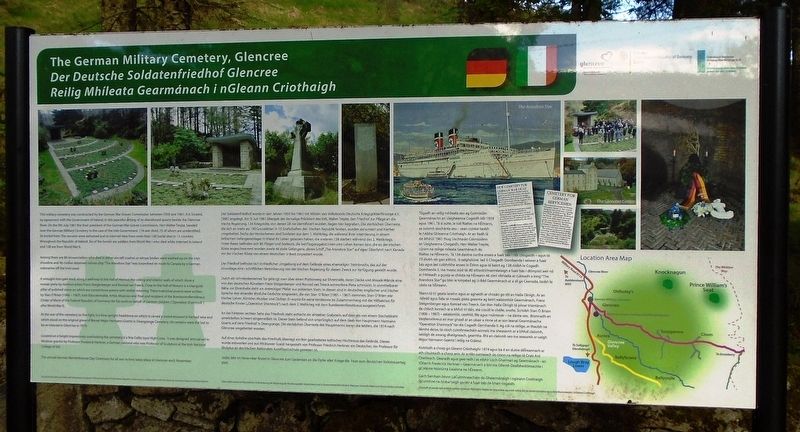
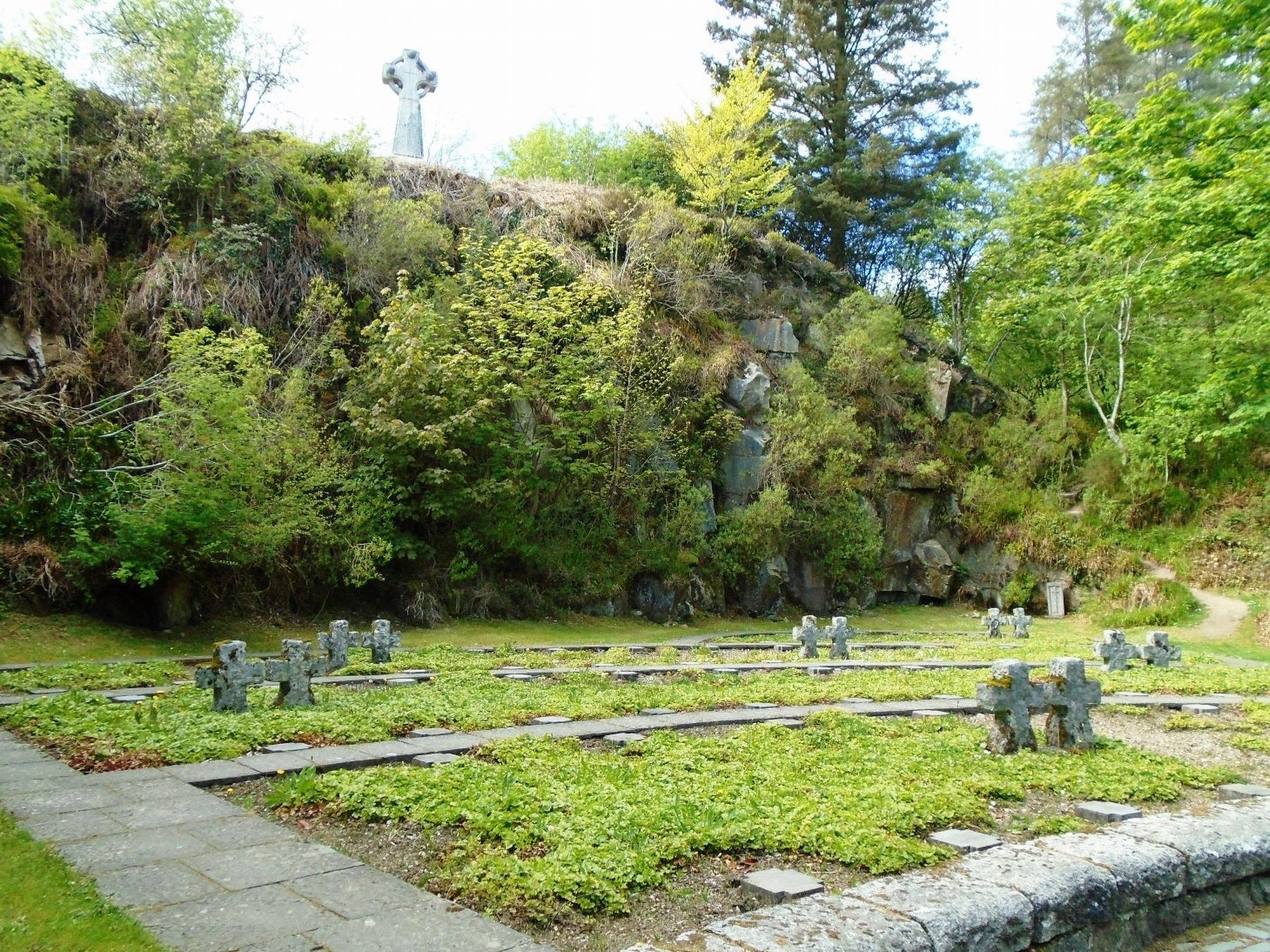
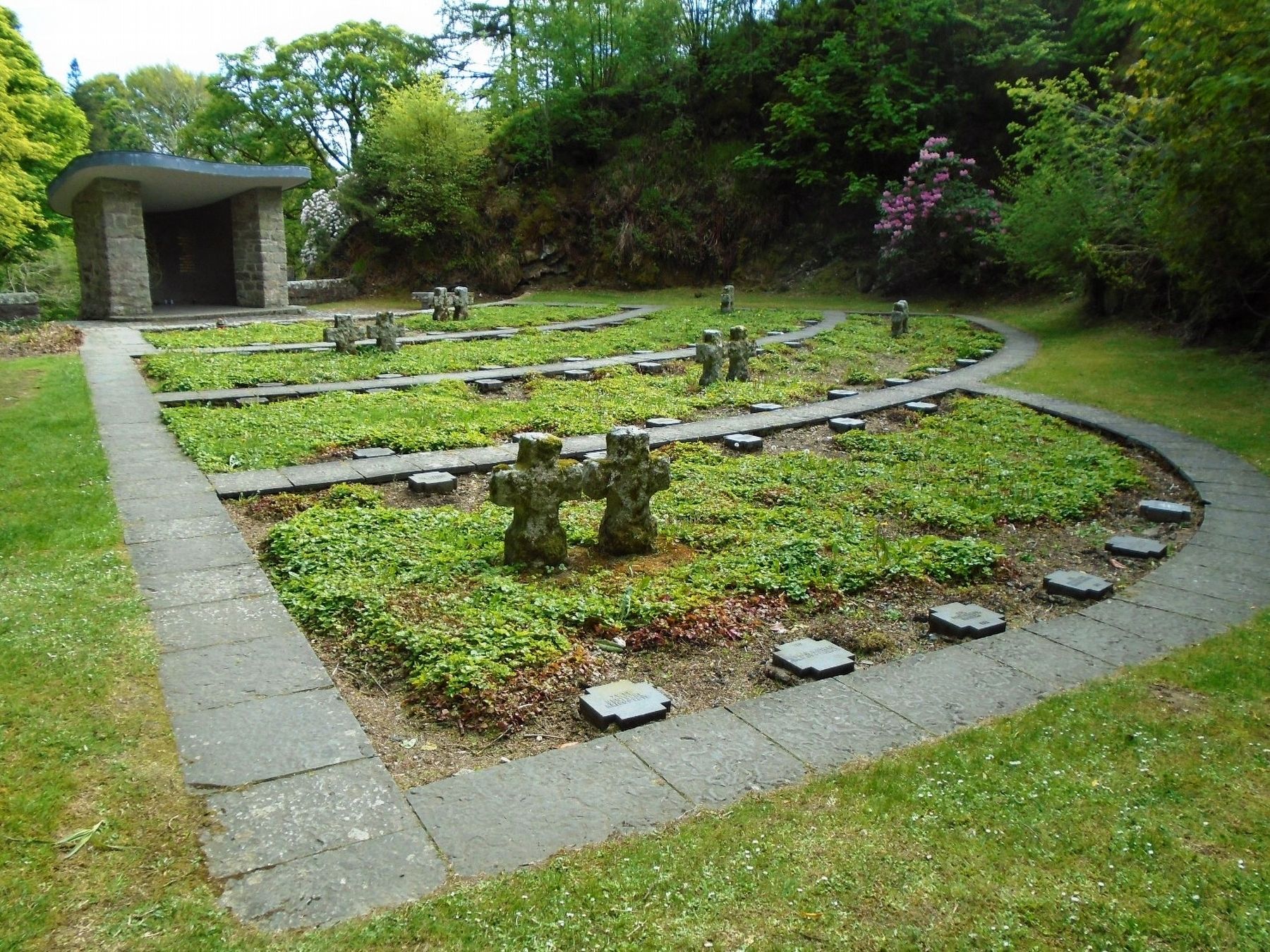
This military cemetery was constructed by the German War Graves Commission between 1959 and 1961. It is located, by agreement with the Government of Ireland, in this peaceful setting of an abandoned quarry beside the Glencree River. On the 9th July 1961 the then president of the German War Graves Commission, Herr Walter Trepte, handed over the German Military Cemetery to the care of the Irish Government. 134 war dead, 75 of whom are unidentified, lie buried here. The remains were exhumed and re-interred here from more than 100 burial sites in 15 counties throughout the Republic of Ireland. Six of the burials are soldiers from World War I who died while interned in Ireland and 128 are from World War II.
Among them are 80 airmen/sailors who died in either aircraft crashes or whose bodies were washed up on the Irish shoreline and 46 civilian detainees whose ship "The Arandora Star" was torpedoed en route to Canada by a German submarine off the Irish coast.
A wrought-iron gate leads along a pathway to the Hall of Honour, the ceiling and interior walls of which show a mosaic pieta by German artists Franz Steigenberger
this page online
At the rear of the cemetery, to the right, is a lone upright headstone on which is carved a sword encased in barbed wire and which stood on the original grave of Brevet Major Hermann Goertz in Deangrange Cemetery. His remains were the last to be re-interred in Glencree in 1974.
Located on a height impressively overlooking the cemetery is a fine Celtic type High Cross. It was designed and carved in Wicklow granite by Professor Frederick Herkner, a German national who was Professor of Sculpture at the Irish National College of Art.
The annual German Remembrance Day Ceremony for all war victims takes place at Glencree each November.
Photographed by William Fischer, Jr., May 15, 2019
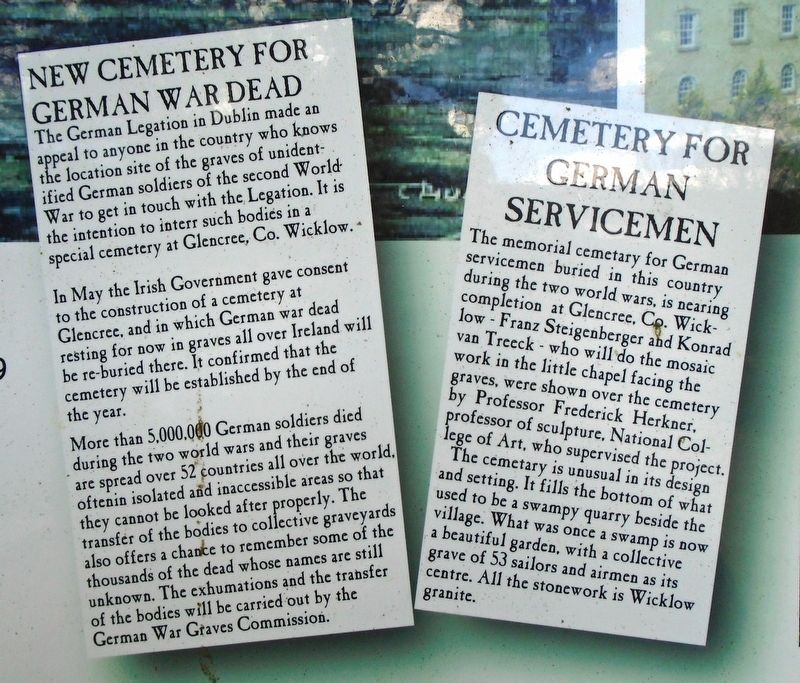
2. The German Military Cemetery, Glencree Marker Detail
Der Friedhof befindet sich in friedlicher Umgebung auf dem Gelände eines ehemaligen Steinbruchs, das auf der Grundlage einer schriftlichen Vereinbarung von der irischen Regierung für diesen Zweck zur Verfügung
Photographed by William Fischer, Jr., May 15, 2019
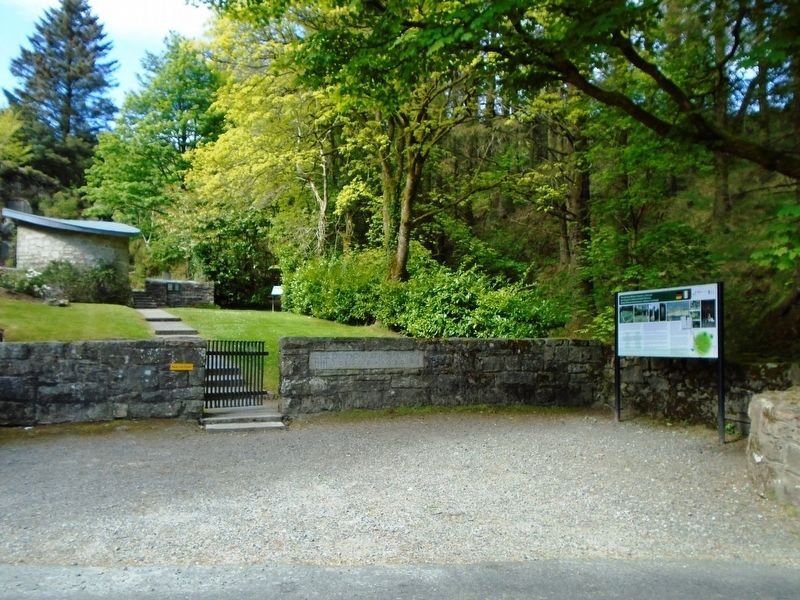
3. The German Military Cemetery, Glencree and Marker
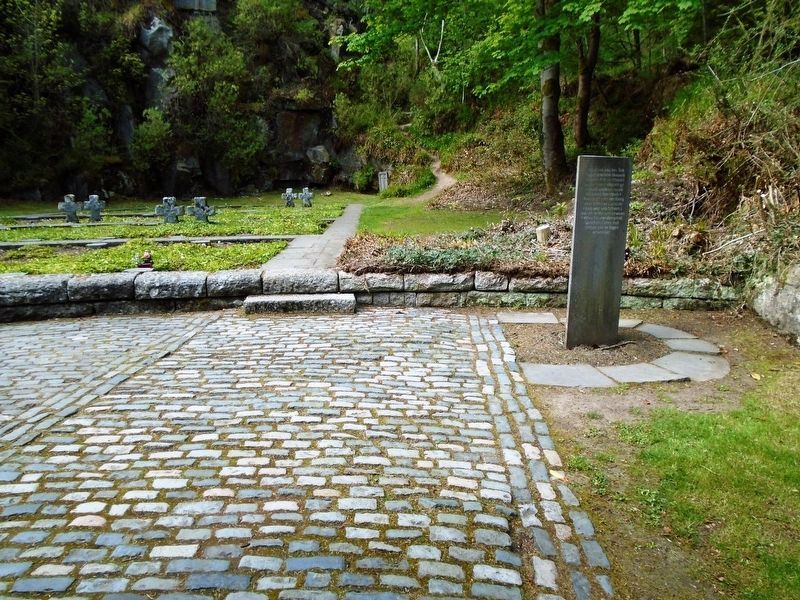
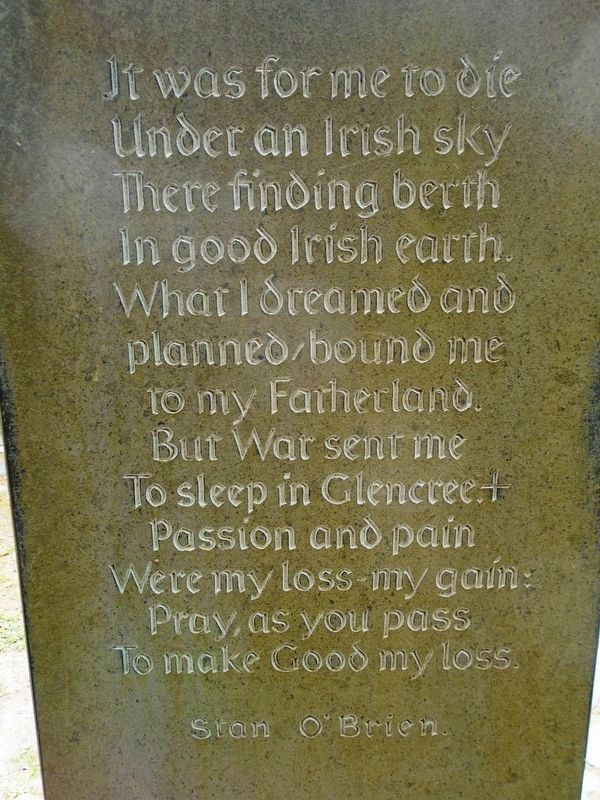
Durch ein schmiedeeisernes Tor gelangt man über einen Plattenweg zur Ehrenhalle, deren Decke und Mosaik-Wände eine von den deutschen Künstlern Franz Steigenberger und Konrad van Treeck entworfene Pieta schümckt. In unmittelbarer Nähe zur Ehrenhalle steht ein dreieckiger Pfeiler aus poliertem Stein. In diesen sind in deutscher, englischer und irischer Sprache drei einander ähnliche Gedichte eingraviert, die von Stan O'Brien (1901 - 1967) stammen. Stan O'Brien war irischer Lehrer, Künstler, Musiker und Dichter. Er wurde für seine Verdienste im Zusammenhang mit der Hilfsaktion für deutsche Kinder („Operation Shamrock”) nach dem 2.Weltkreig mit dem Bundesverdienstkreuz ausgezeichnet.
An der hinteren rechten Seite des Friedhofs steht aufrecht ein einzelner Grabstein, auf dem ein von einem Stacheldraht umwickeltes Schwert eingemeißelt ist. Dieser Stein befand sich ursprünglich auf dem Grab von Hauptmann Hermann Goertz auf dem Friedhof in Deangrange. Die sterblichen Überreste der Hauptmanns waren die letzten, die 1974 nach Glencree umgebettet wurden.
Auf einter Anhöhe oberhalb des Friedhofs überragt ein fein gearbeitetes
Photographed by William Fischer, Jr., May 15, 2019
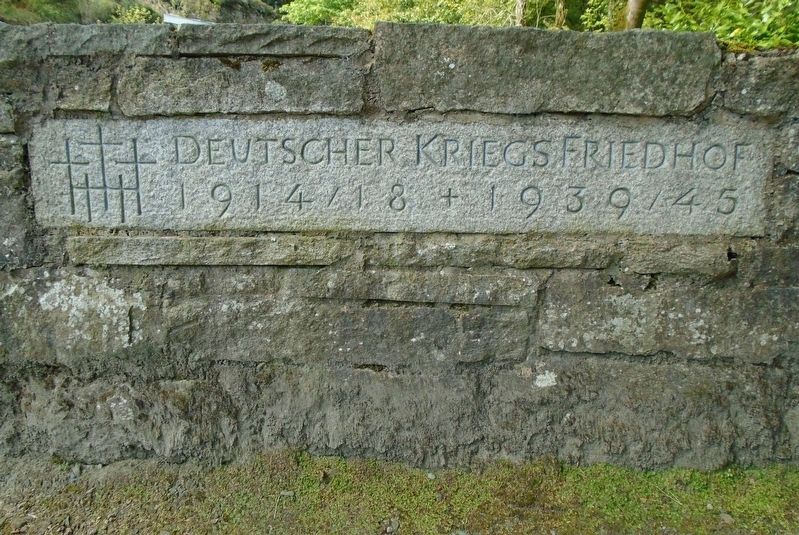
4. The German Military Cemetery, Glencree Sign
Jedes Jahr im November findet in Glencree zum Gedenken an die Opfer aller Kriege die Feier zum deutschen Volkstrauertag statt.
Photographed by William Fischer, Jr., May 15, 2019
5. The German Military Cemetery, Glencree
Téann tú trí geata iarainn agus ar aghaidh ar chosán go dtí an Halla Oinigh. Ar an tsíleáil agus falla tá mosaic pieta greanta ag beirt ealaíontóir Gearmánach, Franz Steigenberger agus Konrad van Treeck. Gar don Halla Oinigh tá pilear triantánach de chloch lonrach ar a bhfuil trí dán, atá cosúil le chéile, snoíte. Scríobh Stan Ó Briain (1906 - 1967) - ealaíontóir, ceoltóir, file agus múinteoir - na dánta seo. Bronnadh an Verdienstkreuz air mar gheall ar an obair a rinne sé ar son leanaí Gearmánacha "Operation Shamrock" tar-éis Cogadh Domhanda II. Ag cúl na reilige, ar thaobh na láimhe deise, tá cloch cuimhneacháin aonraic ina sheasamh ar a bhfuil claíomh, laistigh de sreang dheilgneach, gearrtha. Bhí an claíomh seo ina seasamh ar uaigh Major Hermann Goertz i reilig na Gráinsí.
Aistríodh a chorp go Gleann Criothaighi 1974 agus ba é an duine deireannach ar ath-chuireadh a chorp ann. Ar ardán suntasach ós cionn na reilige tá Crois Ard Cheiteach. Dearadh agus gearradh í as eibhir Loch Gharman ag Gearmánach - an tOllamh Frederick Herkner - Gearmánach
Photographed by William Fischer, Jr., May 15, 2019
6. The German Military Cemetery, Glencree Marker
Gach Samhain bíonn LáCuimhneacháin do Ghearmánaigh i ngleann Croithaigh igcuimhne na híobartaigh go léir a fuair bás de bharr cogaidh.
Erected by the Federal Republic of Germany and the Glencree Centre for Peace and Reconciliation.
Topics. This memorial is listed in these topic lists: Cemeteries & Burial Sites • Patriots & Patriotism • War, World I • War, World II. A significant historical date for this entry is July 9, 1961.
Location. 53° 12.043′ N, 6° 17.531′ W. Memorial is near Glencree, Leinster, in County Wicklow. It is on Local Route L1011 0.6 kilometers east of Leinster Route R115, on the left when traveling east. Touch for map. Memorial is in this post office area: Glencree, Leinster A98 D635, Ireland. Touch for directions.

Regionally, this memorial is in the Ancient East. Globally, it is on the Atlantic Ocean, in the North Atlantic Region, in Europe, on the Island of Ireland, on the Celtic Fringe, in the European Union, in Atlantic Europe, on one of the British Isles, in the Western World, and in the Anglosphere.
Other nearby markers. At
Photographed by William Fischer, Jr., May 15, 2019
7. Stan O'Brien Poem Pillar in the German Military Cemetery, Glencree
Also see . . .
1. Glencree German War Cemetery. (Submitted on June 24, 2019, by William Fischer, Jr. of Reynoldsburg, Ohio.)
2. Glencree Centre for Peace and Reconciliation (nearby). (Submitted on June 24, 2019, by William Fischer, Jr. of Reynoldsburg, Ohio.)
Photographed by William Fischer, Jr., May 15, 2019
8. Stan O'Brien English Poem in the German Military Cemetery, Glencree
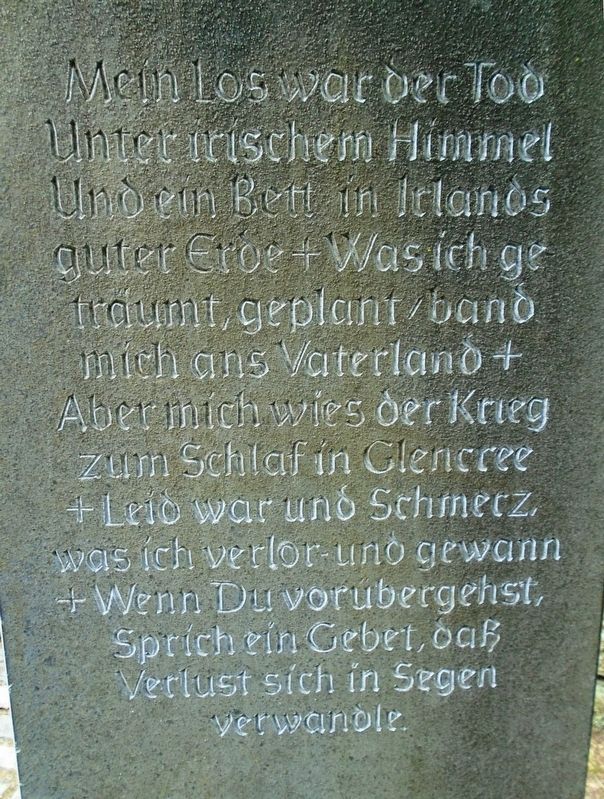
Photographed by William Fischer, Jr., May 15, 2019
9. Stan O'Brien German Poem in the German Military Cemetery, Glencree
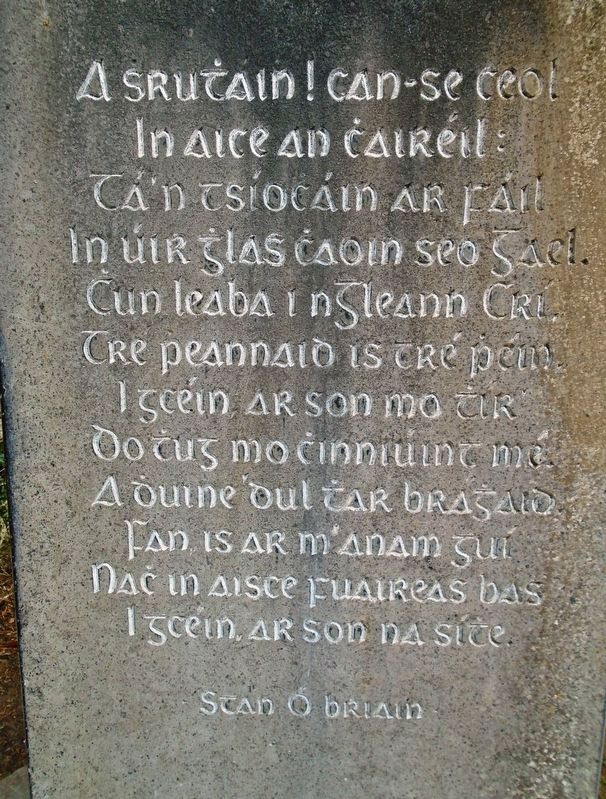
Photographed by William Fischer, Jr., May 15, 2019
10. Stan O'Brien Gaelic Poem in the German Military Cemetery, Glencree
Credits. This page was last revised on May 16, 2024. It was originally submitted on June 23, 2019, by William Fischer, Jr. of Reynoldsburg, Ohio. This page has been viewed 750 times since then and 59 times this year. Photos: 1, 2, 3, 4, 5, 6, 7, 8, 9, 10. submitted on June 24, 2019, by William Fischer, Jr. of Reynoldsburg, Ohio.
