Pigtown in Baltimore, Maryland — The American Northeast (Mid-Atlantic)
Working for the Railroad: Women
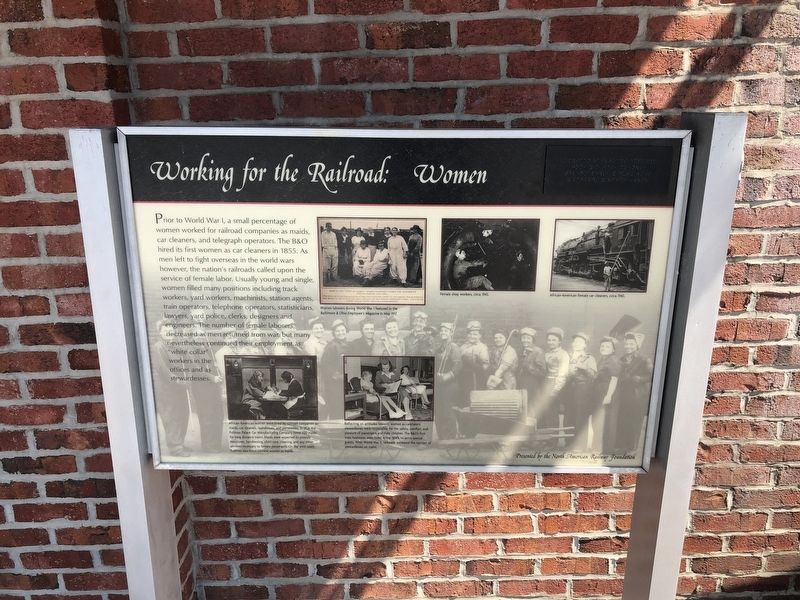
Prior to World War I, a small percentage of women worked for railroad companies as maids, car cleaners, and telegraph operators. The B&O hired its first women as car cleaners in 1855. As men left to fight overseas in the world wars however, the nation's railroads called upon the service of female labor. Usually young and single, women filled many positions including track workers, yard workers, machinists, station agents, train operators, telephone operators, statisticians, lawyers, yard police, clerks, designers and engineers. The number of female laborers decreased as men returned from the war, but many nevertheless continued their employment as "white collar" workers in the offices and as stewardesses.
[Image captions:]
Women laborers during World War I featured in the Baltimore & Ohio Employee's Magazine in May 1917.
Female shop workers, circa 1943.
African-American female car cleaners, circa 1943.
African-American women were hired by railroad companies as maids, car cleaners, laundresses, and porterettes. In 1926 the Pullman Palace Car Manufacturing Company hired 200 maids for long distance trains. Maids were expected to provide manicures, hairdressing, child care, cleaning, and any other services necessary to female passengers. On the west coast, Pullman also hired Chinese women as maids.
Reflecting on attitudes towards women as caretakers, stewardesses were responsible for the safety, comfort and pleasure of passengers and their children. The B&O's first train hostesses were hired in the 1890s to serve special guests. After World War II, railroads increased the number of stewardesses on trains.
Erected by The
this page online
Topics and series. This historical marker is listed in these topic lists: Industry & Commerce • Railroads & Streetcars • Women. In addition, it is included in the Baltimore and Ohio Railroad (B&O) series list. A significant historical month for this entry is May 1917.
Location. Marker has been permanently removed. It was located near 39° 17.125′ N, 76° 37.991′ W. Marker was in Baltimore, Maryland. It was in Pigtown. It could be reached from West Pratt Street east of South Schroeder Street, on the right when traveling east. Touch for map. Marker was at or near this postal address: 901 W Pratt St, Baltimore MD 21223, United States of America.
We have been informed that this marker is no longer there and will not be replaced. This page is an archival view of what was.
Regionally, this marker was in Central Maryland. It was also in the American Mid-Atlantic, in the Chesapeake Bay Region, and on the Eastern Seaboard. Globally, it was in the North Atlantic Region, North America, the Western Hemisphere, the Western World, and the Anglosphere. Historically, it found itself in what was once

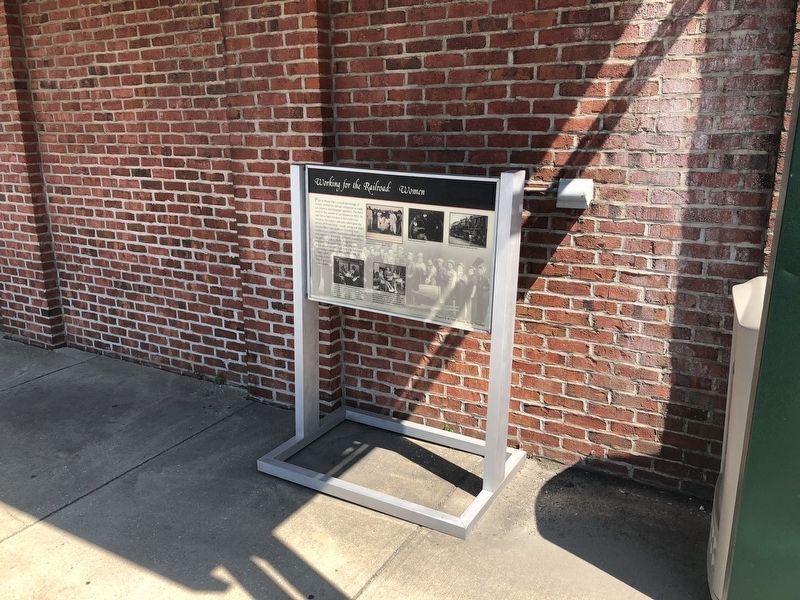
Other nearby markers. At least 8 other markers are within walking distance of this location: Connectivity: Street Art at the Intersection of Rail, Community, & Identity (here, next to this marker); Main Line Electrification of the Baltimore and Ohio Railroad (B&O) 1895 (a few steps from this marker); B&O Railroad Museum (a few steps from this marker); CSX Corporation (a few steps from this marker); American Freedom Train No. 1 (within shouting distance of this marker); B&O No. 908 (within shouting distance of this marker); Luther G. Smith (within shouting distance of this marker); Pullman Troop Sleeper No. 7437 (within shouting distance of this marker). Touch for a list and map of all markers in Baltimore.
Other markers no longer nearby. First Commercial Railroad Right-of-Way in America (was within shouting distance of this marker but has been permanently removed); Camp Carroll (was within shouting distance of this marker but has been permanently removed); Working for the Railroad: African Americans (was within shouting distance of this marker but has been permanently removed).
Credits. This page was last revised on January 4, 2025. It was originally submitted on June 29, 2019, by Devry Becker Jones of Washington, District of Columbia. This page has been viewed 567 times since then and 62 times this year. Photos: 1, 2. submitted on June 29, 2019, by Devry Becker Jones of Washington, District of Columbia.
