Society Hill in Philadelphia in Philadelphia County, Pennsylvania — The American Northeast (Mid-Atlantic)
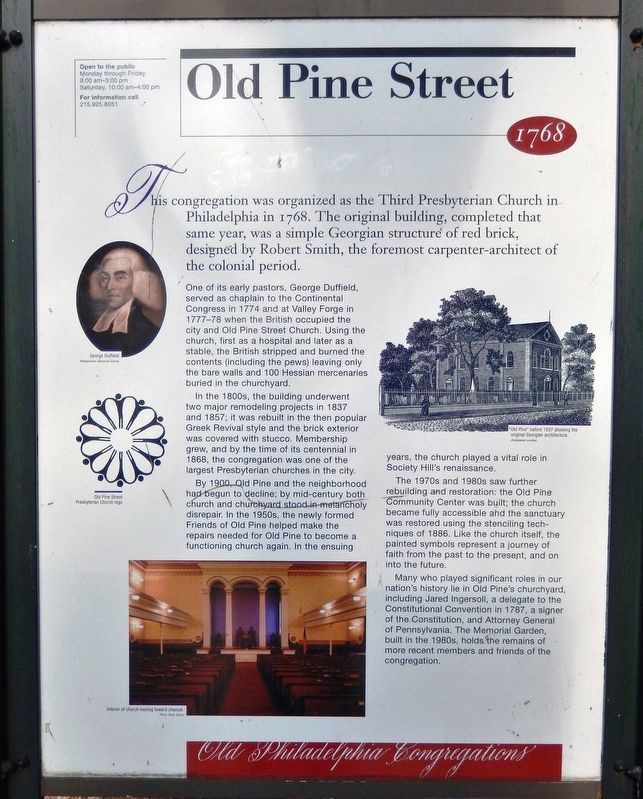
Old Pine Street
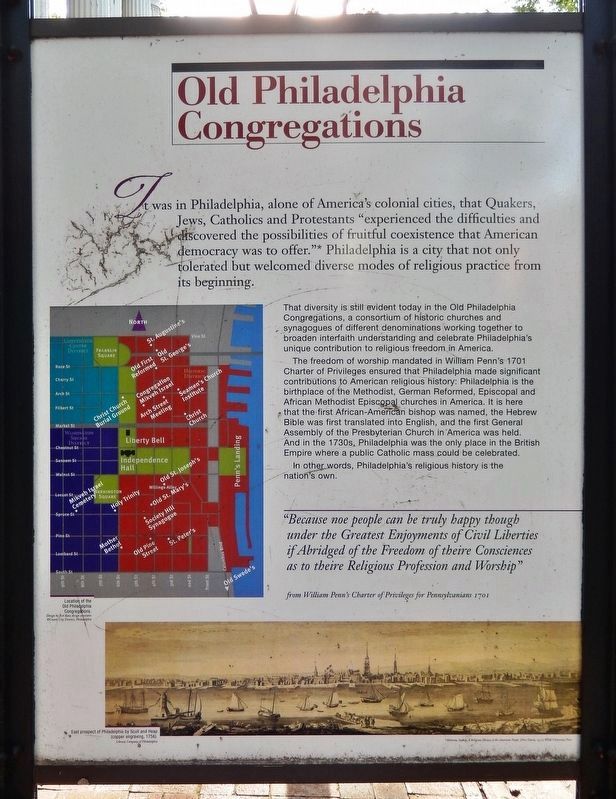
Old Philadelphia Congregations
Photographed by Cosmos Mariner, June 27, 2019
1. Old Pine Street Marker
One of its early pastors, George Duffield, served as chaplain to the Continental Congress in 1774 and at Valley Forge in 1777-78 when the British occupied the city and Old Pine Street Church. Using the church, first as a hospital and later as a stable, the British stripped and burned the contents (including the pews) leaving only the bare walls and 100 Hessian mercenaries buried in the churchyard.
In the 1800s, the building underwent two major remodeling projects in 1837 and 1857; it was rebuilt in the then popular Greek Revival style and the brick exterior was covered with stucco. Membership grew, and by the time of its centennial in 1868, the congregation was one of the largest Presbyterian churches in the city.
By 1900, Old Pine and the neighborhood had begun to decline; by mid-century both church and churchyard stood in melancholy
this page online
The 1970s and 1980s saw further rebuilding and restoration: the Old Pine Community Center was built; the church became fully accessible and the sanctuary was restored using the stenciling techniques of 1886. Like the church itself, the painted symbols represent a journey of faith from the past to the present, and on into the future.
Many who played significant roles in our nation's history lie in Old Pine's churchyard, including Jared Ingersoll, a delegate to the Constitutional Convention in 1787, a signer of the Constitution, and Attorney General of Pennsylvania. The Memorial Garden, built in the 1980s, holds the remains of more recent members and friends of the congregation.
(side 1 photo captions)
• George Duffield (Presbyterian Historical Society)
• Old Pine Street Presbyterian Church logo
• “Old Pine” before 1847 showing the original Georgian architecture (anonymous woodcut)
• Interior
Photographed by Cosmos Mariner, June 27, 2019
2. Old Philadelphia Congregations
(marker side 2)
(marker side 2)
That diversity is still evident today in the Old Philadelphia Congregations, a consortium of historic churches and synagogues of different denominations working together to broaden interfaith understanding and celebrate Philadelphia’s unique contribution to religious freedom in America.
The freedom of worship mandated in William Penh's 1701 Charter of privileges ensured that Philadelphia made significant contributions to American religious history: Philadelphia is the birthplace of the Methodist, German Reformed, Episcopal and African Methodist Episcopal churches in America. It is here that the first African-American bishop was named, the Hebrew Bible was first translated into English, and the first
Photographed by Cosmos Mariner, June 27, 2019
3. Old Pine Street Marker
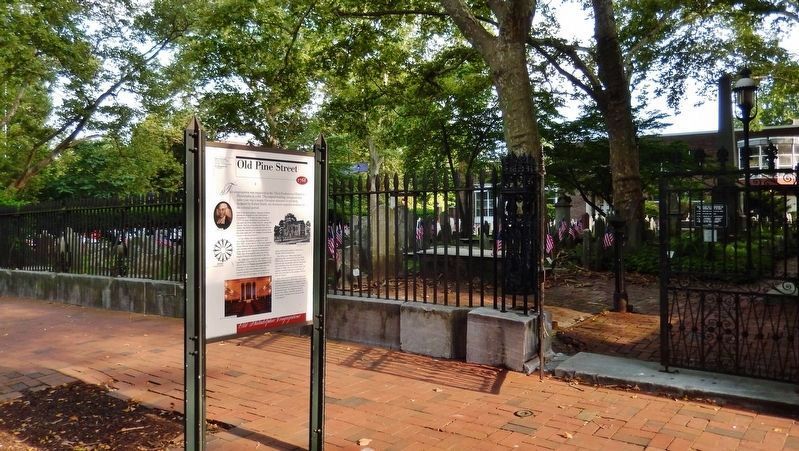
(view from Pine Street • church cemetery in background)
(view from Pine Street • church cemetery in background)
In other words, Philadelphia's religious history is the nation's own.
"Because noe people can be truly happy though under the Greatest Enjoyments of Civil Liberties if Abridged of the Freedom of theire Consciences as to theire Religious Profession and Worship"
from William Penn’s Charter of Privileges for Pennsylvanians 1701
(side 2 photo captions)
• Location of the Old Philadelphia Congregations
• East Prospect of Philadelphia by Scull and Heap (copper engraving, 1756)
Topics and series. This historical marker is listed in these topic lists: Architecture • Colonial Era • Religion & Religious Structures. In addition, it is included in the African Methodist Episcopal (AME) Church series list. A significant historical year for this entry is 1768.
Location. 39° 56.611′ N, 75° 8.953′ W. Marker is in Philadelphia, Pennsylvania, in Philadelphia County. It is in Society Hill. It is on Pine Street east of Lawrence Court, on the right when traveling
Photographed by Cosmos Mariner, June 27, 2019
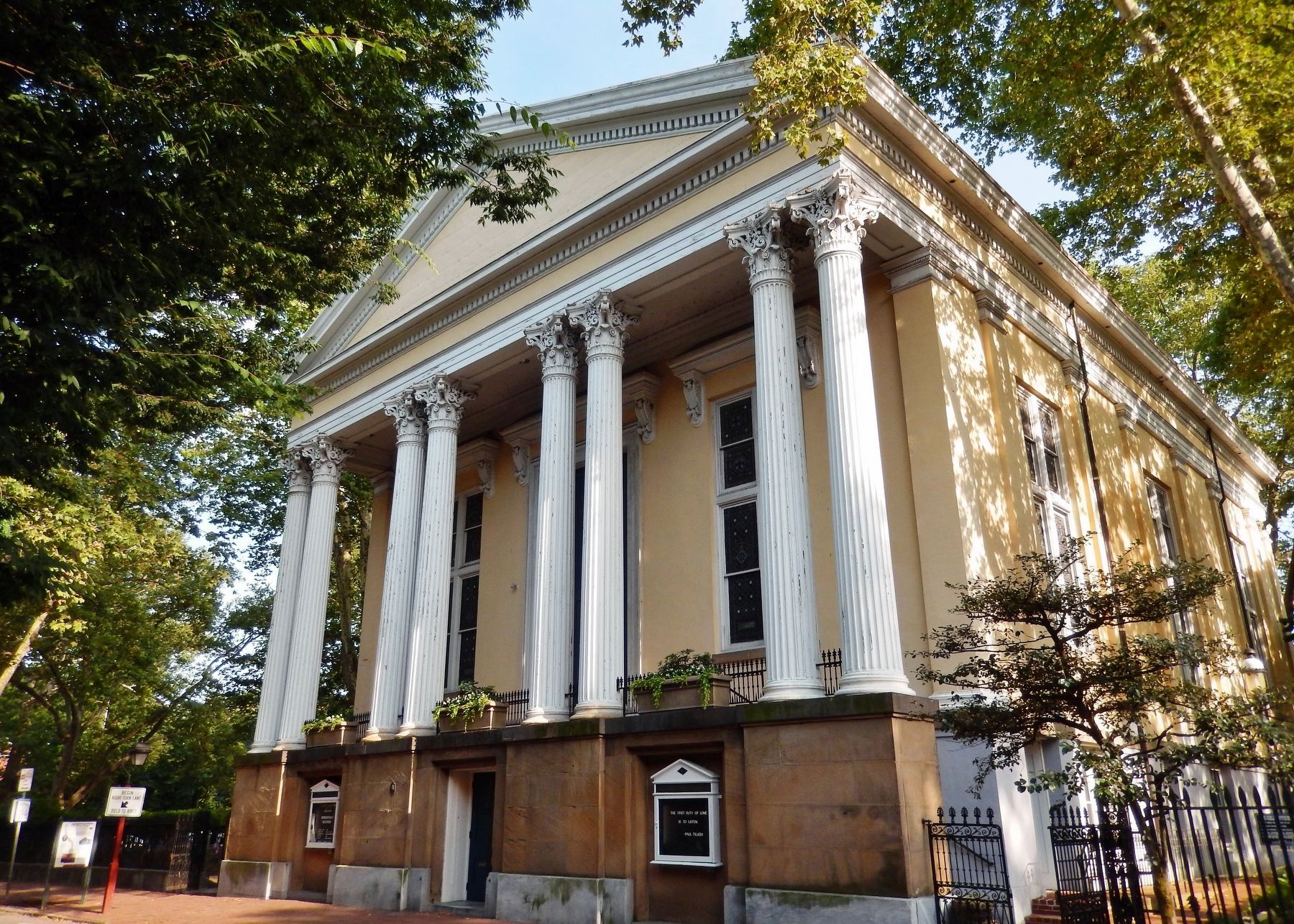
4. Old Pine Street Presbyterian Church (marker visible near bottom left corner)

Regionally, this marker is in Southeast Pennsylvania. It is also in the American Northeast and in the Mid-Atlantic. Globally, it is in North America, the Western Hemisphere, the Western World, and the Anglosphere. Historically, it finds itself in what was once the Haudenosaunee (Iroquois) Confederacy, New Netherland, and one of the original Thirteen Colonies.
Other nearby markers. At least 8 other markers are within walking distance of this marker: Captain Paul Cox (here, next to this marker); In 1835… (here, next to this marker); a different marker also named Captain Paul Cox (here, next to this marker); Old Pine Street Presbyterian Church Historic Graveyard (a few steps from this marker); Daniel McKaraher (a few steps from this marker); Here lieth the body of Samuel McCutchon… (a few steps from this marker); Lt Thomas Mitchell (a few steps from this marker); Here in this historic graveyard…
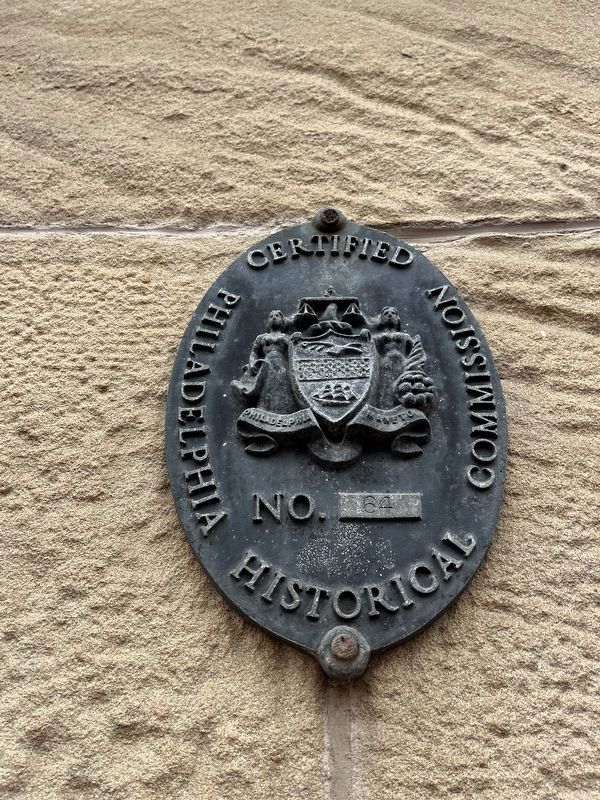
Photographed by Devry Becker Jones (CC0), January 13, 2023
5. Certified Philadelphia Historical Commission plaque for the church building
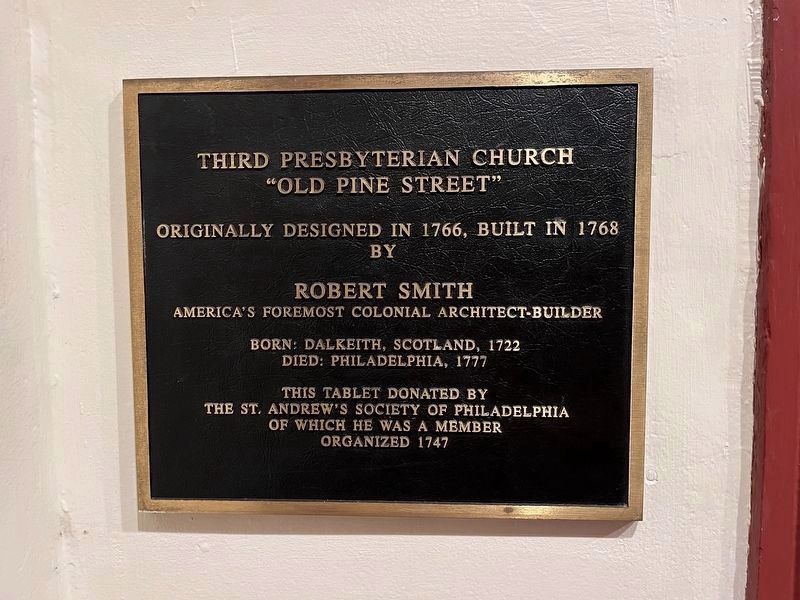
Photographed by Devry Becker Jones (CC0), January 13, 2023
6. Additional signage for the church just inside the vestibule
Credits. This page was last revised on February 2, 2023. It was originally submitted on June 30, 2019, by Cosmos Mariner of Cape Canaveral, Florida. This page has been viewed 520 times since then and 45 times this year. Photos: 1. submitted on July 1, 2019, by Cosmos Mariner of Cape Canaveral, Florida. 2, 3, 4. submitted on July 10, 2019, by Cosmos Mariner of Cape Canaveral, Florida. 5, 6. submitted on January 16, 2023, by Devry Becker Jones of Washington, District of Columbia.
