Southwestern Sacramento in Sacramento County, California — The American West (Pacific Coastal)
Sacramento City Cemetery
⎯⎯⎯
People of the Cemetery
Photographed by J. Makali Bruton, July 2, 2019
1. Sacramento City Cemetery / People of the Cemetery Marker
Sacramento City Cemetery
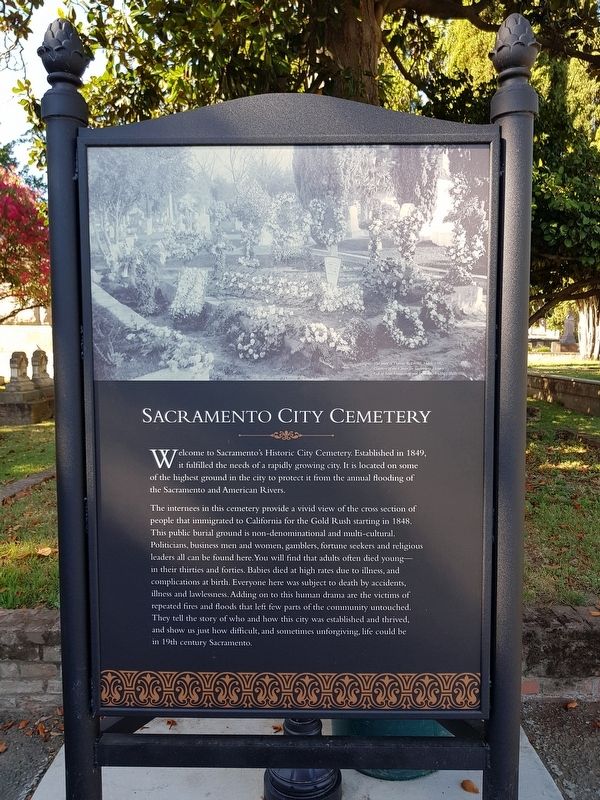
Welcome to Sacramento's Historic City Cemetery. Established in 1849, it fulfilled the needs of a rapidly growing city. It is located on some of the highest ground in the city to protect it from the annual flooding of the Sacramento and American Rivers.
The internees in this cemetery provide a vivid view of the cross section of people that immigrated to California for the Gold Rush starting in 1848. This public burial ground is non-denominational and multi-cultural. Politicians, business men and women, gamblers, fortune seekers and religious leaders all can be found here. You will find that adults often died in their thirties and forties. Babies died at high rates due to illness, and complications at birth. Everyone here was subject to death by accidents, illness and lawlessness. Adding on to this human drama are the victims of repeated fires and floods that left few parts of the community untouched. They tell the story of who and how this city was established and thrived, and show us just how difficult, and sometimes unforgiving, life could be in 19th century Sacramento.
People of the Cemetery
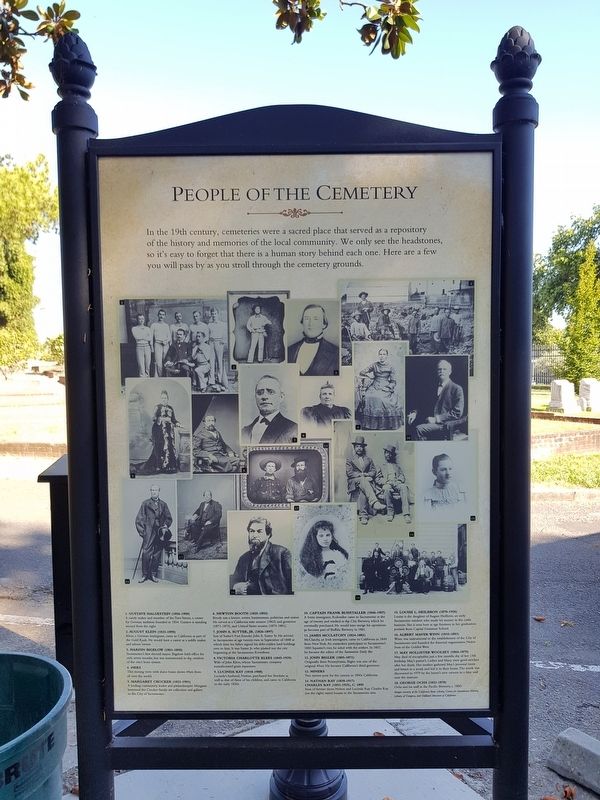
In the
this page online
1. Gustave Halgestein (1856-1900)
A candy maker and member of the Turn Verein, a center for German tradition founded in 1854. Gustave is standing second from the right.
2. August Klein (1825-1890)
Klein, a German immigrant, came to California as part of the Gold Rush. He would have a career as a saddle maker and saloon owner.
3. Hardin Bigelow (1801-1850)
Sacramento's first elected mayor. Bigelow held office for only seven months, but was instrumental in the creation of the city's levee system.
4. 49ers
This mining view with sluice boxes shows 49ers from all over the world.
5. Margaret Crocker (1822-1901)
A leading community leader and philanthropist. Margaret bestowed the Crocker family art collection and gallery to the City of Sacramento.
6. Newton Booth (1825-1892)
Booth was a lawyer, writer, businessman, politician and orator. He served
Photographed by J. Makali Bruton, July 2, 2019
2. Sacramento City Cemetery / People of the Cemetery Marker
7. John A. Sutter, Jr. (1826-1897)
Son of Sutter's Fort founder John A. Sutter Sr. He arrived in Sacramento at age twenty-two in September of 1848 at which time his father signed his debt-ridden land holdings over to him. It was Sutter Jr. who platted out the city beginning at the Sacramento Riverfront.
8. Victoria Charlotte Klees (1845-1929)
Wife of John Klees, whose Sacramento company manufactured grain separators.
9. Lucinda Ray (1818-1908)
Lucinda's husband, Nathan, purchased her freedom as well as that of three of his children, and came to California in the early 1850s.
10. Captain Frank Ruhstaller (1846-1907)
A Swiss immigrant, Ruhstaller came to Sacramento at the age of twenty and worked at the City Brewery, which he eventually purchased. He would later merge his operations to become part of Buffalo Brewery in 1881.
11. James McClatchy (1824-1883)
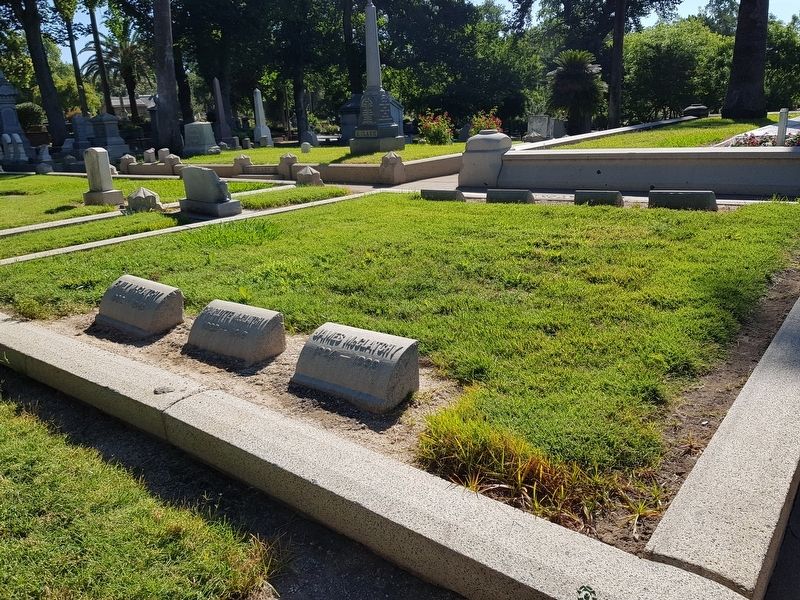
McClatchy, an Irish immigrant, came to California in 1849 from New York. An outspoken participant in Sacramento's 1850 Squatters riot, he sided with the settlers. In 1857, he became
Photographed by J. Makali Bruton, July 2, 2019
3. Sacramento City Cemetery / People of the Cemetery Marker
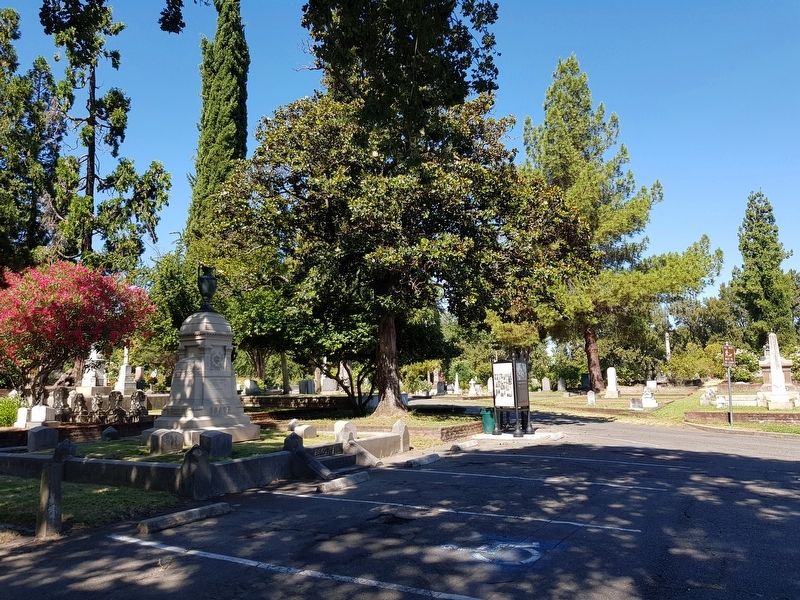
The marker is to the right in this view, with the grave of Newton Booth, mentioned in the marker text, to the left.
12. John Bigler (1805-1871)
Originally from Pennsylvania, Bigler was one of the original 49ers. He became California's third governor.
13. Miners
Two miners pose for the camera in 1850s California.
14. Nathan Ray (1838-1917)
Charles Ray (1852-1925), c. 1890
Sons of former slaves Nelson and Lucinda Ray. Charles Ray (on the right) raised houses in the Sacramento area.
15. Louise L. Heilbron (1878-1926)
Louise is the daughter of August Heilbron, an early Sacramento resident who made his money in the cattle business. She is seen here at age fourteen in her graduation portrait from Capital Grammar School.
16. Albert Maver Winn (1810-1883)
Winn was instrumental in the establishment of the City of Sacramento and founded the fraternal organization Native Sons of the Golden West.
17. May Hollister Woolsey (1866-1879)
May died of encephalitis just a few months shy of her 13th birthday. May's parent's, Luther and Mary, were grief-stricken after her death. Her mother gathered May's personal items and letters in a trunk and hid it in their home. The trunk was discovered in 1979 by the home’s new owners in a
Photographed by J. Makali Bruton, July 2, 2019
4. The James McClatchy grave, mentioned in the marker text
18. George Ochs (1822-1878)
Ochs and his staff at the Pacific Brewery, c. 1890.
Images courtesy of the California State Library, Center for Sacramento History, Library of Congress, and Oakland Museum of California.
Topics. This historical marker is listed in these topic lists: Cemeteries & Burial Sites • Industry & Commerce • Settlements & Settlers. A significant historical month for this entry is September 1848.
Location. 38° 33.812′ N, 121° 30.048′ W. Marker is in Sacramento, California, in Sacramento County. It is in Southwestern Sacramento. It is at the intersection of Broadway and 10th Street, on the right when traveling east on Broadway. The marker is to the left a few steps upon entering the Sacramento City Cemetery. Touch for map. Marker is in this post office area: Sacramento CA 95818, United States of America. Touch for directions.

Regionally, this marker is in the Sacramento Valley and specifically in the Central Valley. It is also on the American Pacific Coast. Globally, it is in North America, on the Ring of Fire, on the Pacific Rim, in the Western Hemisphere, in the Western World,
Photographed by Cynthia Cummings
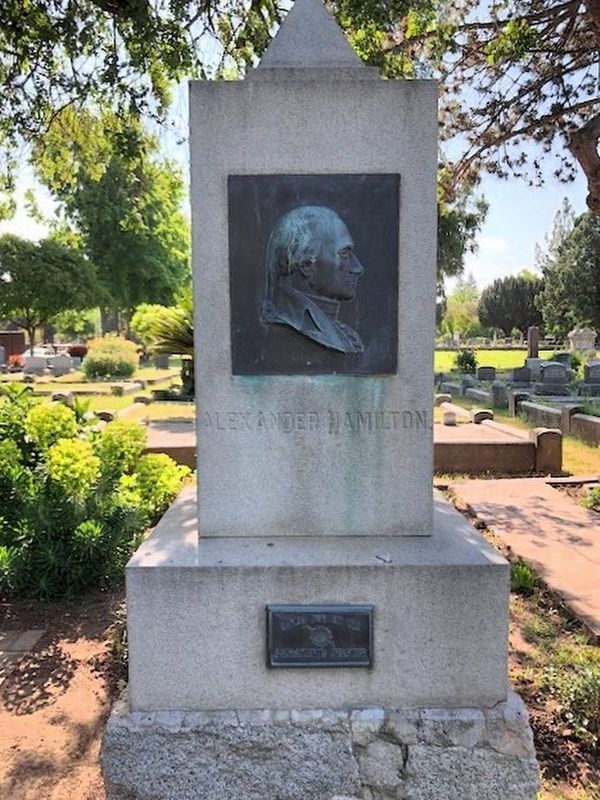
5. Alexander Hamilton Obelisk
From circa 1890, it marks the Hamilton Square plot in this cemetery and was placed by the Sacramento chapter, Daughters of the American Revolution. The sixth son of Alexander Hamilton, Willian Stephen Hamilton, is buried here.
Other nearby markers. At least 8 other markers are within walking distance of this marker: General George Wright (a few steps from this marker); Newton Booth (a few steps from this marker); John A. Sutter, Jr. (a few steps from this marker); In Memory of the Old Tier Grounds (a few steps from this marker); City Cemetery (a few steps from this marker); Sacramento City Cemetery (a few steps from this marker); Hardin Bigelow (a few steps from this marker); The 17 Doctors of the 1850 Sacramento Cholera Epidemic (a few steps from this marker). Touch for a list and map of all markers in Sacramento.
Additional commentary.
1. William Stephen Hamilton
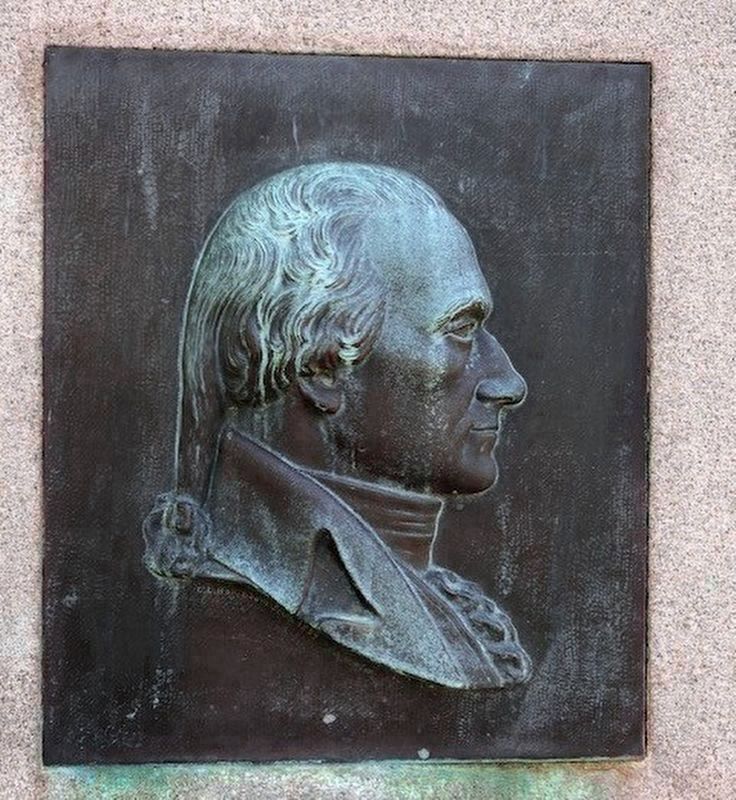
The sixth son of Alexander Hamilton, Willian Stephen Hamilton, is buried in the Old City Historic Cemetery, Sacramento. His plot is Hamilton Square—named for him. The granite obelisk placed at his burial site is made of granite transported from Quincy, Mass. by his family. There is bronze relief of his father on the front—an original plaque—created by the Hamilton family,
1889 bronze by C.L.Hogeboom. Photographed by Cynthia Cummings
6. Bronze Bas-Relief of Alexander Hamilton’s Profile
A close-up of the obelisk in photo No. 5. See Commentary No. 1 on this page for the historic significance of this bronze.
William S. Hamilton died in 1850—during the cholera epidemic. He is more well known in Michigan, where he was a Colonial, a Legislator, lawyer & founder of Hamilton Community, and many more attributions.
His plot has been cared for by the Sacramento Chapter, Daughters of the American Revolution, since 1923. Even though the Sacramento Old City cemetery is already noted as an Historic Site, the addition of William Stephen Hamilton’s name to list of notables would be appreciated. Note To Editor only visible by Contributor and editor
— Submitted April 21, 2025, by Cynthia Cummings of Sacramento.
2. The Hamilton Monument in this Cemetery
The granite monument (photos Nos. 5 and 6) was erected circa 1890 to mark the remains of William Stephen Hamilton, son of Alexander Hamilton, a Founding Father of the United States of America. Mounted to it is a bronze bas-relief of Alexander Hamilton, sculpted by Charles L. Hogeboom, a famed east coast artist of that time.
The 1930 book Alexander Hamilton’s Pioneer Son: The life and times of Colonel William Stephen Hamilton by Silvan J. Muldoon closes with a woodcut image of the monument and these three paragraphs. “The Little Giant” refers to Alexander Hamilton while the “Rough Diamond” was one of William S. Hamilton’s nicknames.
In the year of 1897 some of the members of the Hamilton family in New England sent to the proper authorities at Sacramento City, for the medallion of Alexander Hamilton which graced Colonel Hamilton’s tomb, saying that it was the only one in existence. The medallion was shipped to them, and, after securing a few copies of same, it was returned and replaced in its original granite setting where it remains today and will doubtless remain for centuries to come.
How strange are the pathways of fate. All of the Hamiltons were by nature longevous, but the two outstanding Hamilton’s, Alexander and William, whose names went down into the everlasting history of our country, died at a comparatively early age — the father at 47, and the son at 53.
Gratifying, indeed, it would be to know what either of them could have accomplished had their lives been spared, but that was not the dictate of destiny. Today, on the Atlantic side of the continent, in old Trinity Church Yard, moulder the bones of the “Little Giant;” while on the Pacific, moulder the bones of the “Rough Diamond” — graves of mighty men, one at each entrance to the great nation which they loved.
— Submitted May 5, 2025, by J. J. Prats of Powell, Ohio.
Credits. This page was last revised on May 5, 2025. It was originally submitted on July 7, 2019, by J. Makali Bruton of Washington, District of Columbia. This page has been viewed 1,018 times since then and 106 times this year. Photos: 1, 2, 3, 4. submitted on July 7, 2019, by J. Makali Bruton of Washington, District of Columbia. 5, 6. submitted on May 4, 2025, by Cynthia Cummings of Sacramento.
