St. Mary's City in St. Mary's County, Maryland — The American Northeast (Mid-Atlantic)
A Land in Need of Labor
Laboring
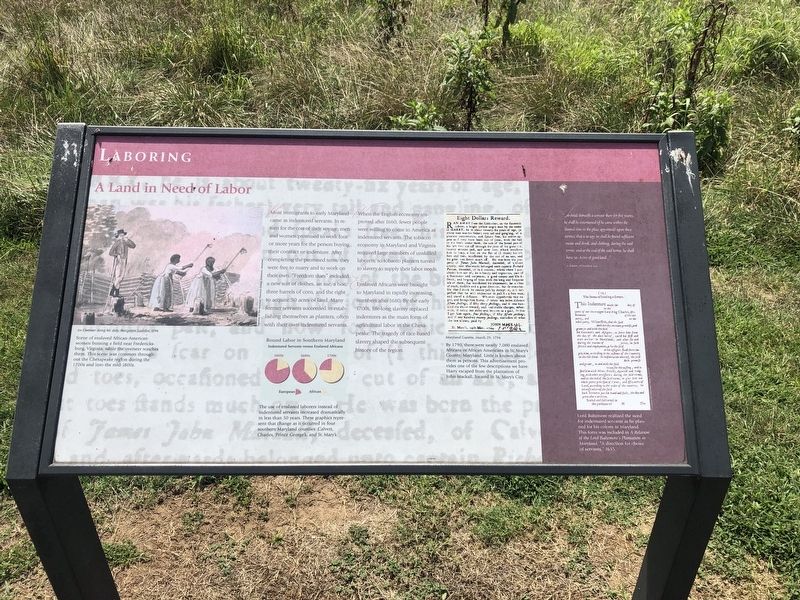
When the English economy improved after 1660, fewer people were willing to come to America as indentured servants. The tobacco economy in Maryland and Virginia required large numbers of unskilled laborers, so tobacco planters turned to slavery to supply their labor needs.
Enslaved Africans were brought to Maryland in rapidly increasing numbers after 1680. By the early 1700s, life-long slavery replaced indentures as the main form of agricultural labor in the Chesapeake. The tragedy of race-based slavery shaped the subsequent history of the region.
[Captions:]
Scene of enslaved African-American women burning a field near Fredericksburg, Virginia, while the overseer watches them. This scene was common throughout the Chesapeake region during the 1700s and into the mid-1800s.
The use of enslaved laborers instead of indentured servants increased dramatically in less than 50 years. These graphics represent that change as it occurred in four southern Maryland counties: Calvert, Charles, Prince George's, and St. Mary's.
By 1790, there were nearly 7,000 enslaved Africans or African Americans in St. Mary's County, Maryland. Little is known about them as persons. This advertisement provides one of the few descriptions we have. Harry escaped from the plantation of John Mackall, located in St. Mary's City.
[Aside:]
"to binde himselfe a servant there for five yeares, he shall be entertained (if he come within the limited time to the place appointed) upon these termes; that is to say, he shall be found sufficient meate and drink, and clothing, during the said terme; and at the end of the said terme, he shall have 50. Acres of good land..."
A Redmon...of Maryland, 1634
Lord Baltimore realized the need for indentured servants as he planned for his colony in Maryland. This form was included in A Relation of the Lord Baltimore's Plantation in Maryland," A direction for choice of servants," 1635.
Erected by Historic
this page online
Topics. This historical marker is listed in these topic lists: African Americans • Colonial Era • Settlements & Settlers. A significant historical year for this entry is 1660.
Location. 38° 11.021′ N, 76° 25.808′ W. Marker is in St. Mary's City, Maryland, in St. Mary's County. It can be reached from Point Lookout Road (Maryland Route 5) 0.2 miles east of Old State House Road, on the right when traveling east. Touch for map. Marker is at or near this postal address: 16721 Point Lookout Road, Saint Marys City MD 20686, United States of America. Touch for directions.

Regionally, this marker is in Southern Maryland. It is also in the American South, specifically in the Upper South, in the Mid-Atlantic, in the Tidewater, in the Chesapeake Bay Region, and on the Eastern Seaboard. Globally, it is in the North Atlantic Region, North America, the Western Hemisphere, the Western World, and the Anglosphere. Historically, it finds itself in what was once one of the original Thirteen Colonies and also the Antebellum South.
Other nearby markers. At least 8 other markers are within walking distance of this
Another marker is no longer nearby. Fear of War, People of Peace (was within shouting distance of this marker but has been replaced with another marker now near it).
Additional keywords. Indentured servitude
Credits. This page was last revised on September 2, 2019. It was originally submitted on September 2, 2019, by Devry Becker Jones of Washington, District of Columbia. This page has been viewed 311 times since then and 27 times this year. Photos: 1, 2. submitted on September 2, 2019, by Devry Becker Jones of Washington, District of Columbia.
