Sykesville in Carroll County, Maryland — The American Northeast (Mid-Atlantic)
Sykesville
Capturing Joe Hooker
| — | Gettysburg Campaign | — |
November 24, 2008
1. Sykesville Marker
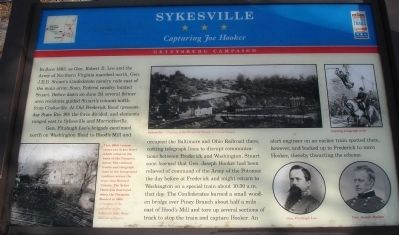
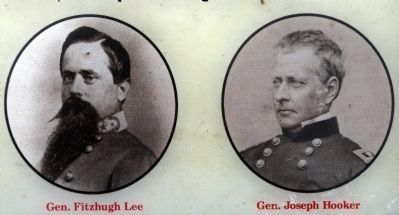
Gen. Fitzhugh Lee’s brigade continued north on Washington Road to Hood’s Mill and occupied the Baltimore and Ohio Railroad there, cutting telegraph lines to disrupt communications between Frederick and Washington. Stuart soon learned that Gen. Joseph Hooker had been relieved of command of the Army of the Potomac the day before at Frederick and might return to Washington on a special train about 10:30 a.m. that day. The Confederates burned a small wooden bridge over Piney Branch about half a mile east of Hood’s Mill and tore up several sections of track to stop the train and capture Hooker. An alert engineer on an earlier train spotted them, however, and backed up to Frederick to warn Hooker, thereby thwarting
this page online
(captions)
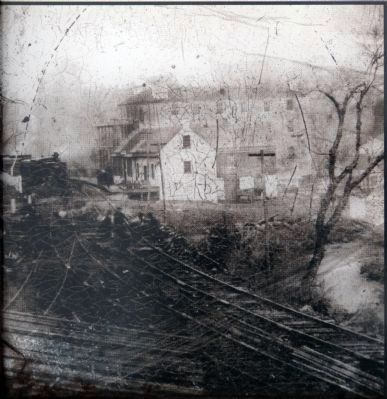
This 1860s tintype shows the Sykes Hotel that stood on the bank of the Patapsco River. The railroad tracks and telegraph lines in the foreground continued across the river into Howard County. The Sykes Hotel was destroyed when the Patapsco River flooded in 1868. - Courtesy of the collection of the Sykesville Gate House Museum of History
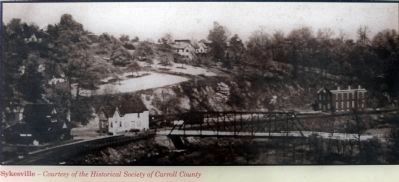
Sykesville - Courtesy Historical Society of Carroll County
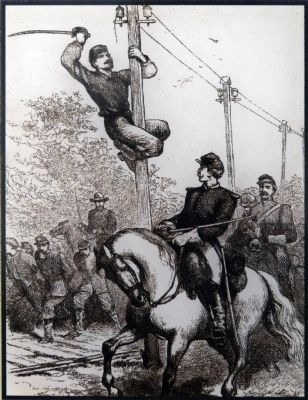
Cutting telegraph wire
Gen. Fitzhugh Lee
Gen. Joseph Hooker
Erected by Maryland Civil War Trails.
Topics. This historical marker is listed in this topic list: War, US Civil. A significant historical date for this entry is June 29, 1863.
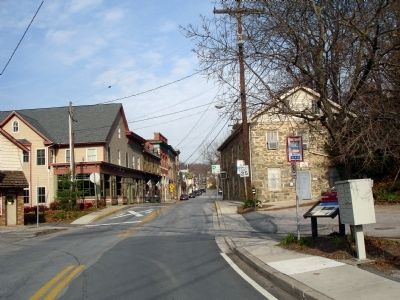
Location. This marker has been replaced by another marker nearby. It was located near 39° 21.869′ N, 76° 58.141′ W. Marker was in Sykesville, Maryland, in Carroll County. It was at the intersection of West Main Street (Maryland Route 851) and Baldwin Drive, on the right when traveling west on West Main Street. Touch for map. Marker was at or near this postal address: 7615 W Main St, Sykesville MD 21784, United States of America. Touch for directions.

Regionally, this marker
November 24, 2008
2. Civil War Trails Marker in Sykesville
Other nearby markers. At least 8 other markers are within walking distance of this location: A different marker also named Sykesville (here, next to this marker); Baldwin's Station (a few steps from this marker); Baltimore & Ohio Railroad Station (a few steps from this marker); St. Joseph's Roman Catholic Church (within shouting distance of this marker); The Town House (about 400 feet away, measured in a direct line); The Strawbridge Home for Boys (about 700 feet away); The Sykesville Bypass Bridge (approx. 0.2 miles away); The Historic Sykesville Colored Schoolhouse (approx. 0.3 miles away). Touch for a list and map of all markers in Sykesville.
Related marker. Click here for another marker that is related to this marker. New CWT Marker A This Location also titled "Sykesville".
Also see . . . Sykesville, Maryland.
Photographed by Allen C. Browne, November 16, 2013
3. Sykesville
Historical Society of Carroll County
Photographed by Allen C. Browne, November 16, 2013
4. Cutting the telegraph wire
Photographed by Allen C. Browne, November 16, 2013
5. General Fitzhugh Lee and General Joseph Hooker
Photographed by Allen C. Browne, November 16, 2013
6. Sykes Hotel in the1860s
This 1860s tintype shows the Sykes Hotel which stood on the bank of the Patapsco River. The railroad tracks and telegraph lines in the foreground continue across the river into Howard County. The Sykes Hotel was destroyed when the Patapsco flooded in 1868.Close-up of photo on marker
Photographed by Allen C. Browne, November 16, 2013
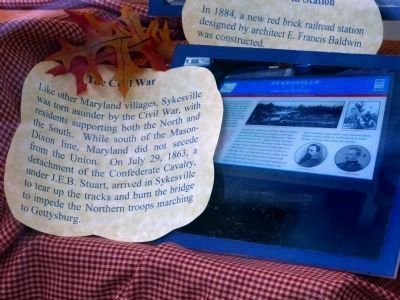
7. The Civil War
Photo of marker in a window display at the Wade H.D. Warfield building.
"Like other Maryland villages, Sykesville was torn asunder by the Civil War, with residents supporting both North and South. While south of the Mason-Dixon line, Maryland did not secede from the Union. On July 29, 1863, a detachment of Confederate Cavalry, under J.E.B. Stuart, arrived in Sykeville to tear up the tracks and burn the bridge to impede the Northern troops marching to Gettysburg."
"Like other Maryland villages, Sykesville was torn asunder by the Civil War, with residents supporting both North and South. While south of the Mason-Dixon line, Maryland did not secede from the Union. On July 29, 1863, a detachment of Confederate Cavalry, under J.E.B. Stuart, arrived in Sykeville to tear up the tracks and burn the bridge to impede the Northern troops marching to Gettysburg."
Credits. This page was last revised on July 25, 2024. It was originally submitted on November 26, 2008. This page has been viewed 6,503 times since then and 217 times this year. Photos: 1, 2. submitted on November 26, 2008. 3, 4, 5, 6, 7. submitted on November 17, 2013, by Allen C. Browne of Silver Spring, Maryland. • Craig Swain was the editor who published this page.
