Franklin in Williamson County, Tennessee — The American South (East South Central)
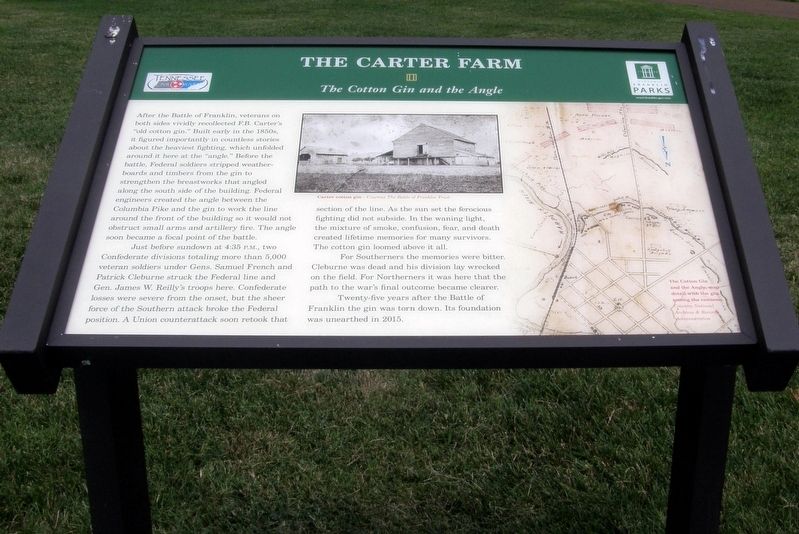
The Carter Farm
The Cotton Gin and the Angle
| — | Tennessee Civil War National Heritage Area | — |
Photographed by Larry Gertner, June 16, 2019
1. The Carter Farm - The Cotton Gin and the Angle marker
Just before sundown at 4:35P.M., two Confederate divisions totaling more than 5,000 veteran soldiers under Gens. Samuel French and Patrick Cleburne struck the Federal line and Gen. James W. Reilly’s troops here. Confederate losses were severe from the onset, but the sheer force of the Southern attack broke the Federal position. A Union counterattack soon retook that section of the line. As the sun set the ferocious fighting did not subside. In the waning light, the mixture of smoke, confusion, fear
this page online
For Southerners the memories were bitter. Cleburne was dead and his division lay wrecked on the field. For Northerners it was here that the path to the war’s final outcome became clearer.
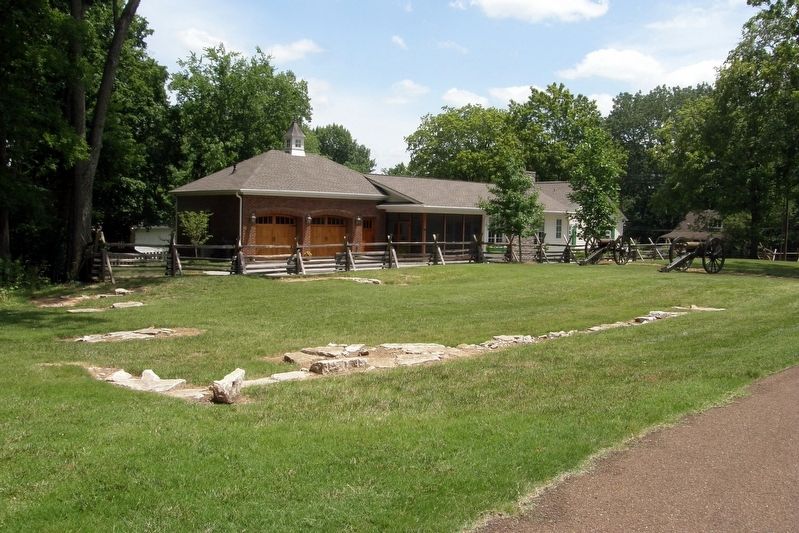
Twenty-five years after the Battle of Franklin the gin was torn down. Its foundation was unearthed in 2015.
Erected by Historic Franklin Parks.
Topics. This historical marker is listed in this topic list: War, US Civil. A significant historical date for this entry is November 30, 1864.
Location. 35° 54.946′ N, 86° 52.378′ W. Marker is in Franklin, Tennessee, in Williamson County. It is at the intersection of Columbia Avenue (Business U.S. 31) and Cleburne Street, on the right when traveling north on Columbia Avenue. Located at Cotton Gin Site and Park. Touch for map. Marker is in this post office area: Franklin TN 37064, United States of America. Touch for directions.

Regionally, this marker is in Middle Tennessee and in Greater Nashville. It is also in the American South and specifically in the Upper South. Globally, it is in North America, the Western
Photographed by Larry Gertner, June 16, 2019
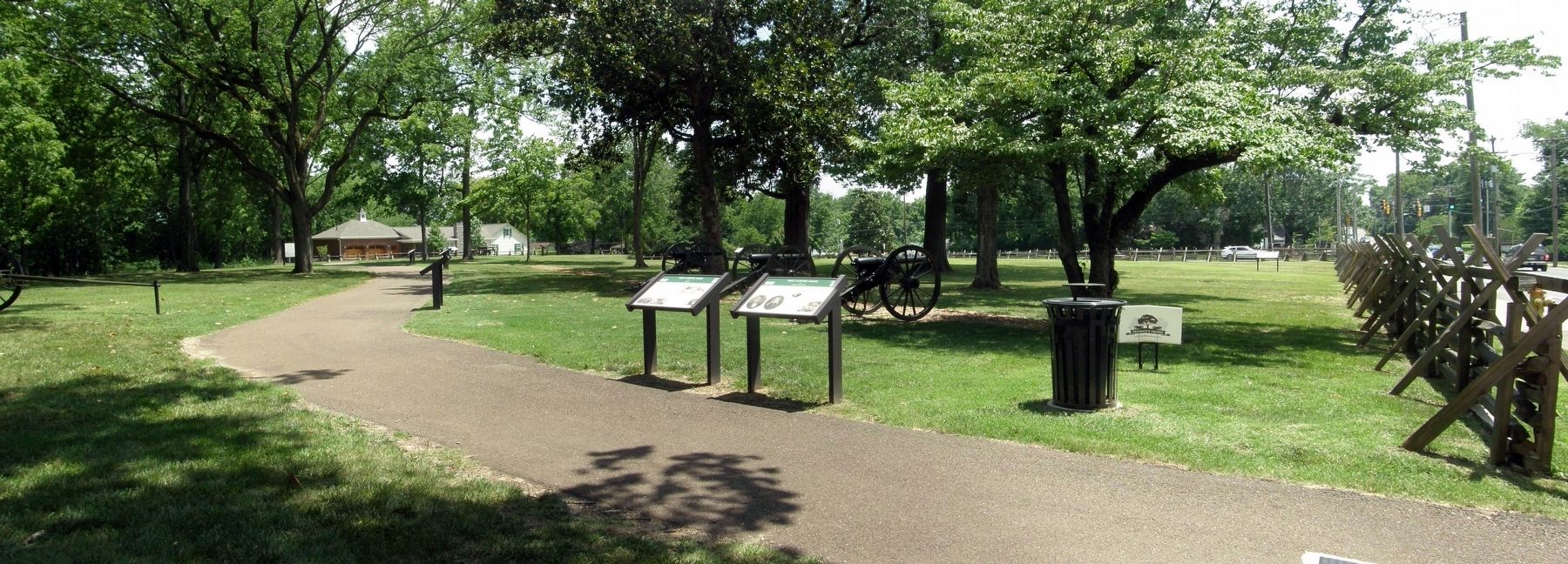
2. Carter Gin Site and Park
The marker is in the vicinity of the building in the background.
Other nearby markers. At least 8 other markers are within walking distance of this marker: A different marker also named The Carter Farm (a few steps from this marker); a different marker also named The Carter Farm (a few steps from this marker); a different marker also named The Carter Farm (a few steps from this marker); a different marker also named The Carter Farm (within shouting distance of this marker); a different marker also named The Carter Farm (within shouting distance of this marker); Main Entrenchment Federal Battle Line (within shouting distance of this marker); a different marker also named The Carter Farm (within shouting distance of this marker); a different marker also named The Carter Farm (within shouting distance of this marker). Touch for a list and map of all markers in Franklin.
Other markers no longer nearby. The Cotton Gin Assault (was within shouting distance of this marker but has been
Photographed by Larry Gertner, June 16, 2019
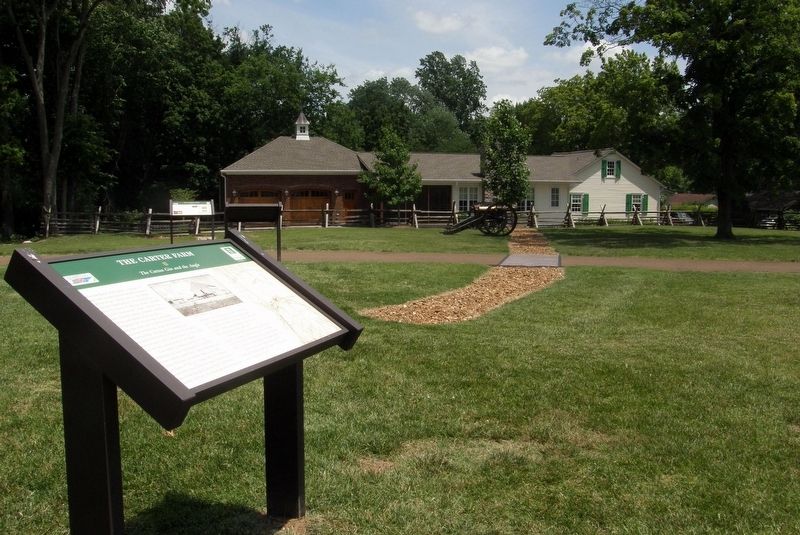
3. The Angle locale
The mulched path follows the line of entrenchments.
Photographed by Larry Gertner, June 16, 2019
4. The Cotton Gin site
All that remains of the foundation.
Photographed by Larry Gertner, June 16, 2019
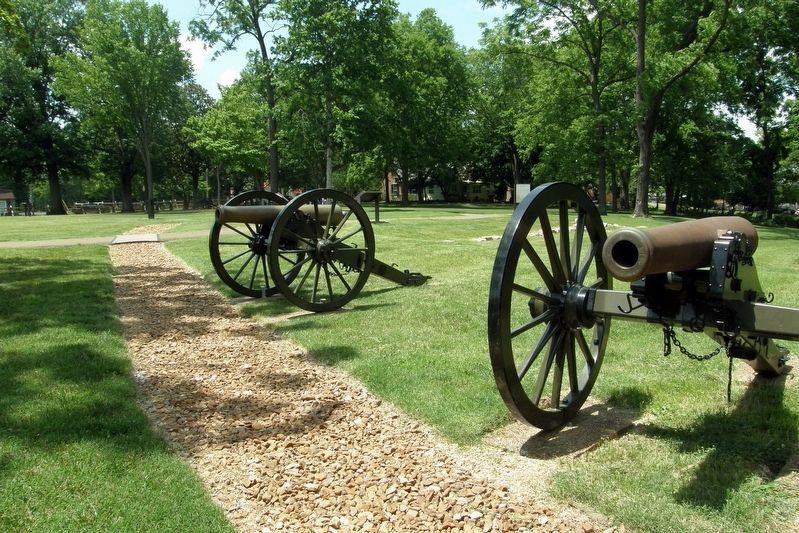
5. 12 pounder Napoleons at The Angle.
Two guns from the 6th Ohio Battery were here. The cotton gin foundation is in the background, with the path of the entrenchments forming the salient around it is in front of the guns.
Photographed by Larry Gertner, June 16, 2019
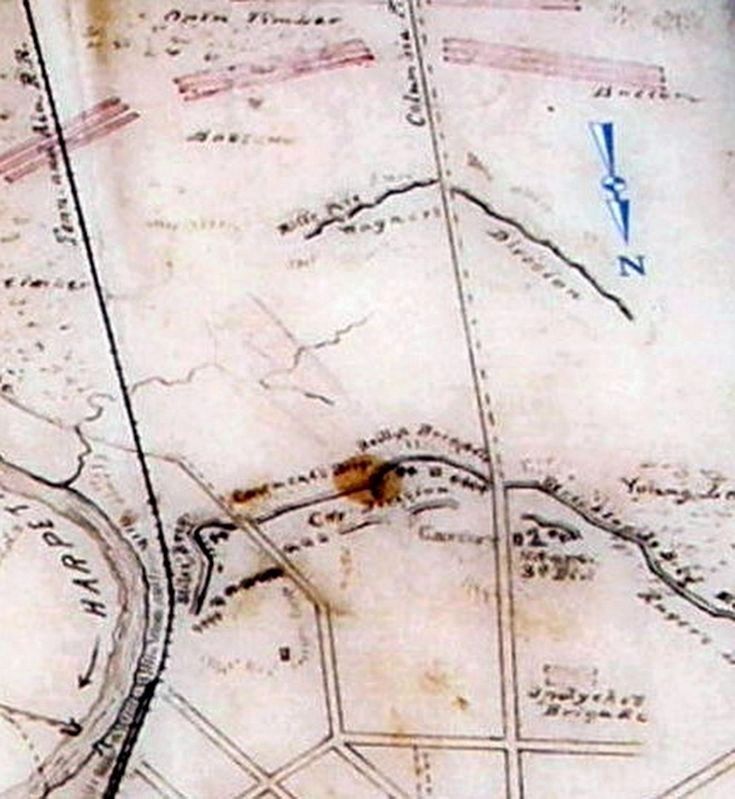
6. Situation map
The Cotton Gin and the Angle, map detail with the gin amidst the cannons.
June 16, 2019
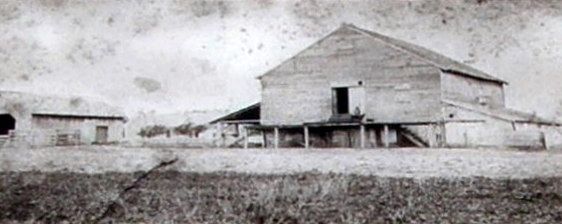
7. Inset
The Carter Cotton Gin House
Credits. This page was last revised on July 27, 2022. It was originally submitted on September 16, 2019, by Larry Gertner of New York, New York. This page has been viewed 599 times since then and 65 times this year. Photos: 1, 2, 3, 4, 5, 6, 7. submitted on September 16, 2019, by Larry Gertner of New York, New York. • Bernard Fisher was the editor who published this page.
